Dominic Ng had an interest that did not immediately suggest a future in banking: American television. At the University of Houston, the student from Hong Kong took communications courses, studied radio and television, and watched The Mary Tyler Moore Show and All in the Family. He was trying to understand the country he had entered. His older brother had a more practical concern: where, exactly, was this going to lead?
Accounting won the family argument. Ng graduated with a business degree in 1980. Yet the earlier interest makes sense alongside the career that followed. He kept finding reasons to talk with people whose work, background or ambitions differed from his own. Eventually, those conversations included property developers, university trustees, filmmakers and Don Felder, the former Eagles guitarist. A bank balance sheet has considerable room for numbers. Ng’s working life has made room for this rather unusual cast.
The student who watched American television
Born in Hong Kong in 1959, Ng was the youngest of six children. His parents had left Shanghai for Hong Kong after the Communist takeover in 1949. His mother made school uniforms; his father drove a school bus. They wanted their children to study overseas. Ng arrived in the United States in 1977 and tutored other students in mathematics and science while at Houston. The family’s experience of starting again preceded his own.
Houston remained part of the story long after graduation. In 2024, the university awarded him an honorary Doctor of Humane Letters. Its academic center for student-athletes bears his name and that of his wife, Ellen. The center supplies tutoring, academic advising and learning support. There is a pleasing continuity in a former student tutor helping put his name on a place devoted to helping other students through their coursework. The transcript, it turns out, can have a long afterlife.
His first professional home was Touche Ross, which later became part of Deloitte & Touche. Work in Houston and Los Angeles exposed him to banking and to businesses with ties to Asia. Accounting gave him an entry into companies. Learning what those companies wanted to do gave him a reason to stay in conversation.
A different kind of bank customer
One client relationship changed his career. The Nursalim family, investors from Indonesia, asked him to lead their American investment operation. In 1991, he helped them acquire East West Bank and became executive chair. In 1992, they asked him to take over as CEO. He was entering a savings institution with roughly $600 million in assets, rooted in a Chinese American community that mainstream lenders had often underserved.
The bank’s origins were practical. People needed somewhere to save, borrow and establish themselves. Ng wanted it to accompany customers further into American business and international commerce. In 1995, he converted its savings charter into a commercial bank charter. Trade finance could follow customers’ existing family and business connections across the Pacific. An institution created to help people settle could also help them expand.
By 1997, that outward movement had a local expression. East West helped finance Crescent Village, a 130-unit housing development in downtown Los Angeles for elderly and low-income residents. Its contribution was $5.9 million. Commercial banking could sound abstract; a housing project supplied an address and a use. It also put the bank into collaboration with city and state agencies, extending its working relationships beyond its original customer base.
The ownership changed again in 1998. Ng led an investor group that bought East West, and the company subsequently listed on Nasdaq. He was now responsible for a public institution. The challenge of maintaining a recognizable purpose while serving a wider market would accompany the bank’s expansion. Knowing a particular community gave it useful expertise. Customers’ plans gave that expertise somewhere new to go.
The cost of looking away
The long tenure contains an uncomfortable admission. Before the financial crisis, Ng had stepped back from daily operations while considering succession. Construction lending had grown. When the property market deteriorated, he had to confront the consequences of both credit exposure and his own distance from the details. He described the episode plainly: “It was a combination of mistake and timing.”
Recovery required decisions considerably less glamorous than describing a vision. East West reappraised property loans, reduced problem credits and raised capital in 2008. In 2009, it took over the banking operations of failed United Commercial Bank through an FDIC-assisted transaction. Preparation created room to act when another institution failed. The sequence gives substance to Ng’s later emphasis on prudence: growth still required someone to attend the meetings and inspect what was going wrong.
“I do what is needed.”
Dominic Ng, on his approach to work
The numbers now belong to a different scale. At June 30, 2026, East West Bancorp reported approximately $85 billion in assets. Second-quarter net income was $364 million, with diluted earnings per share up 18 percent from a year earlier. Those results describe an institution built over decades. They also give the early $600 million figure some perspective without making every intervening decision look inevitable. Ng’s own account supplies a useful corrective to that temptation.
An invitation to the city
His civic work offers another measure of expansion. In 2000, Ng became the first Asian American to chair the United Way of Greater Los Angeles fundraising campaign. The 2000–2001 effort raised $66 million. Bringing more people into a shared civic undertaking was a different kind of relationship building from winning a banking client, although both depended on reaching beyond an established circle.
He joined the USC Board of Trustees in 2014. His responsibilities have also included Mattel’s board and cultural institutions in Los Angeles. These are different organizations with different demands; a university, a toy company and an art museum have limited use for a single managerial script. The overlap lies in the people and decisions a board member encounters, and in the obligation to take those decisions seriously.
In 2023, he chaired the APEC Business Advisory Council. The agenda included making international commerce more accessible to smaller businesses, women and Indigenous entrepreneurs, alongside supply-chain resilience and digital trade. That work brought his commercial concerns into a policy setting. A company can have something to sell and still struggle with the rules, financing and logistics of reaching another market. Helping it across requires more than an introduction.
When the banker called the guitarist
Ng’s arts interests make the photograph of him with Don Felder less surprising than the job titles might suggest. He plays guitar. Music has been part of his life since his student years. The friendship became a public collaboration in 2006, when they helped organize a Hurricane Katrina benefit concert at the Cerritos Center for the Performing Arts.
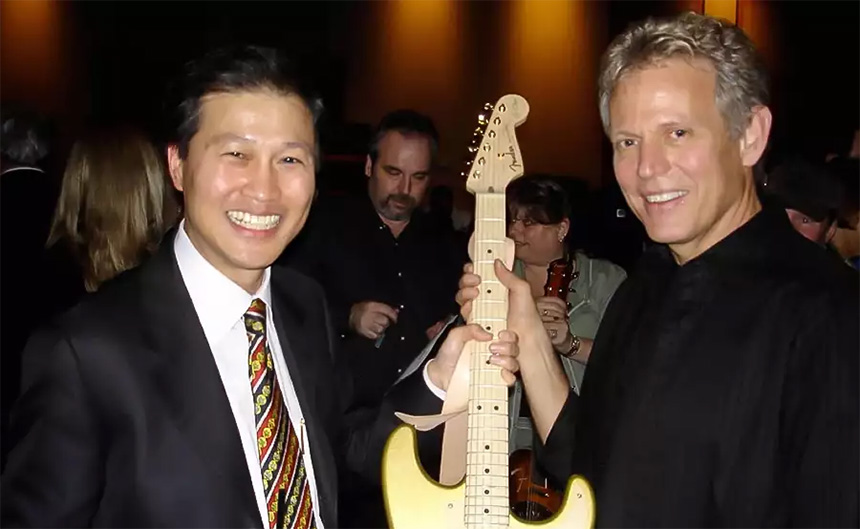
Felder assembled musicians and formed his first solo band for the show. He later credited Ng with prompting that step. The event raised $157,000 for the American Red Cross and Salvation Army. It was a specific undertaking with a venue, performers, sponsors and beneficiaries. The banker’s enthusiasm for music had become a reason to organize something other people could attend.
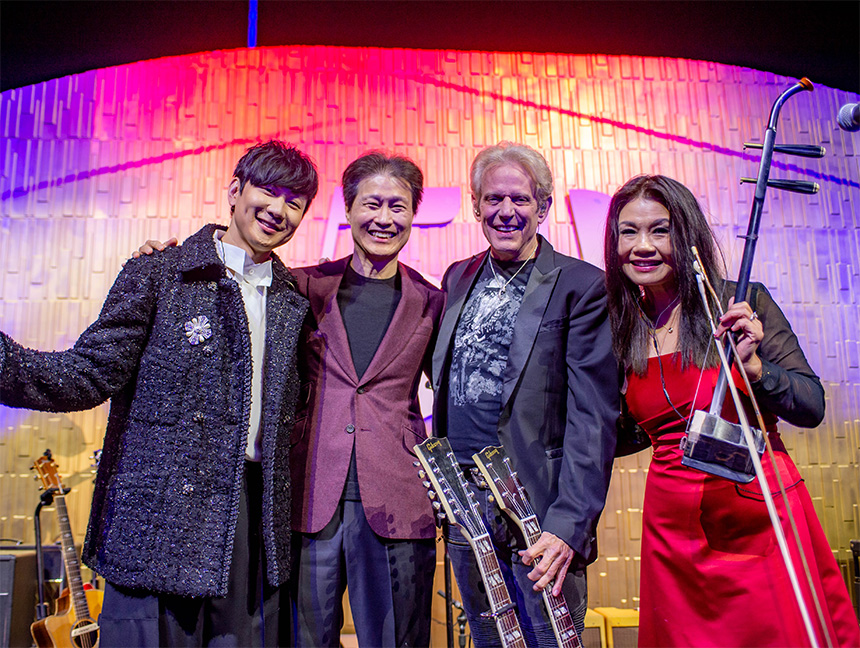
Their connection continued. At East West’s fiftieth anniversary celebration in 2023, Felder appeared alongside Singaporean singer JJ Lin and erhu player Karen Han. The combination was unusually apt for the occasion. Ng has described music as “a universal connector.” Here, the idea had actual instruments attached.
In April 2025, the Wallis Annenberg Center for the Performing Arts gave Ng its inaugural Icon Award for corporate philanthropy. The recognition followed years of involvement with the city’s cultural organizations. Arts support asks institutions to commit resources to activities whose value includes what an audience experiences together. For someone occupied with relationships across cultures, that is familiar territory, even when the evening’s program contains no banking at all.
A place for stories before they sell
In July 2025, Ng joined Miky Lee and Janet Yang as founding partners of First Light StoryHouse. Managed by CJ ENM, the label was established to develop Asian and Asian American film and scripted television projects. Its involvement begins early, with development investment and participation as a co-producer, followed by efforts to secure studio, production-company or streaming partners.
That choice of stage matters. Before a project can compete for an audience, someone must help turn an idea into material a producer or distributor can assess. Development gives a story time and professional attention, while leaving its eventual reception uncertain. First Light’s stated model puts resources into that interval. It gives Ng’s interest in cultural exchange a commercial task as well as a philanthropic one.
The bank’s foundation has also supported the One House Filmmakers Fund with Sundance Institute and Gold House. The fund backs filmmakers from underrepresented communities; its second cohort included ten projects in development. That activity sits alongside the new label as another practical way of helping creative work reach a further stage. The routes differ, but each requires funding before a finished work can speak for itself.
By May 2026, Ng was on a Milken Institute panel discussing entertainment’s future with leaders from Sony Pictures, Tubi, YouTube and Black Bear, as well as writer and producer Mara Brock Akil. The student who once studied American broadcasting had acquired rather different company for the conversation. Accounting remained the foundation of his career. Curiosity about the people on the other side of the table kept finding him more work.