The Department of National Defence sells nothing, has no shareholders and can call on ships, satellites and howitzers. Yet it resembles a giant enterprise in one essential way: it must turn money, people, hardware, software and partnerships into an outcome its customers can feel. That outcome is readiness. Most days, Canada's roughly 41 million residents do not notice it. On the worst day, nobody wants to discover it was imaginary.
DND is the civilian department supporting the Canadian Armed Forces, a legally separate military institution. Together they form the Defence Team. The department writes policy, buys and maintains equipment, runs bases and housing, funds science, manages digital systems and supports operations. The CAF supplies the people who sail, fly, patrol, rescue and deploy. Their shared brief spans domestic disaster response, search and rescue, Arctic sovereignty, continental defence with the United States and allied missions from Latvia to the Indo-Pacific.
Calling this a company, as our directory requires, produces a useful thought experiment. Its customer is everyone. Its board is Parliament. Its revenue is an appropriation. Its competitors are not rival firms but bad alternatives: dependence on allies, obsolete equipment, slower response or risk quietly left uninsured. Its product cannot be inspected on a shelf. It appears as a surveillance picture arriving early, an aircraft launching on time, a unit trained before a crisis, or a partner that already knows how Canada operates.
The product is a chain, not a tank
The popular picture of defence is a platform: one fighter, one frigate, one armoured vehicle. DND's real work is the chain around it. A crew must be recruited, medically cleared and trained. Fuel, ammunition and spare parts must arrive. Secure networks must carry information. A base must have a runway, heat and housing. Allies need compatible procedures. Parliament must know where the money went. Pull one link and the glamorous machine becomes expensive sculpture.
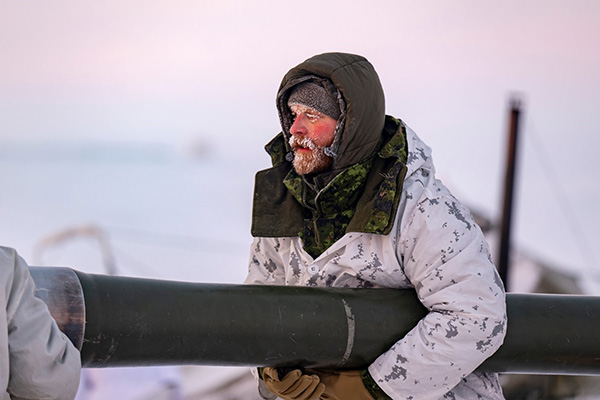
That explains the department's strange product catalogue. It includes combat forces and surveillance, but also childcare, medical standards, payroll, cloud systems, procurement officers, research laboratories and environmental remediation. Defence Research and Development Canada works on AI, quantum sensing, autonomy, cyber, space and counter-drone systems. The IDEaS program brings Canadian innovators into controlled trials. At the other end of the temperature scale, a 2026 Arctic exercise moved two M777 howitzers more than 3,500 kilometres from Manitoba to Victoria Island. Software ambition meets frozen steel.
Customers sit at every joint. Military members need equipment that works and a workplace they can trust. Civil authorities need surge capacity during fires, floods and emergencies. Northern communities live beside the infrastructure that southern planners draw on maps. NATO needs a credible Canadian-led multinational brigade in Latvia. NORAD needs sensors and decisions that mesh with the United States. Suppliers need specifications stable enough to build against. DND is different from a contractor because it owns the public mandate and the integration problem. Contractors can deliver components. The department must decide which risks matter, assemble the system and remain accountable when assumptions age badly.
Readiness only ships when every handoff works
A simplified map of the Defence Team's value chain
Recruit · clear · train · retain
Buy · test · connect · sustain
Detect · deter · rescue · defend
What failed first: the old assumption
Nanisivik is the cleanest window into how this machine learns. Announced in 2007, the planned naval facility in Nunavut was meant to refuel Arctic ships. What failed first was not a dramatic piece of hardware. It was the operating thesis. The seasonal access window proved very short. Construction suffered delays and reductions in scope. Jetty repairs grew costly. Then the Royal Canadian Navy received Harry DeWolf-class patrol vessels able to travel about 6,800 nautical miles without refuelling. The ships changed; the justification did not keep up.
By May 2026, DND had spent $110.2 million on a site never used for routine or sustained naval operations. Making it fully operational would have required another $200 million. The department chose to transition it out of operational use. This was not a victory lap. It was a late, expensive correction. But public institutions often confuse consistency with competence, so a visible stop matters.
“The Arctic has changed significantly since 2007, and Canada's investments need to keep pace with today's realities.”David J. McGuinty, Minister of National Defence, May 2026
What changed minds was a stack of evidence: newer ships with more endurance, limited operational utility, a punishing season, repeated construction trouble and a clear bill for continuing. The replacement idea is more distributed. Canada is planning Northern Operational Support Hubs, upgrading forward operating locations and expanding sensing. Networks are less photogenic than one ribbon-cutting, but they fit a region where distance and weather attack every single point of failure.
Planned spending rises by roughly $16 billion in one year
DND/CAF departmental plans, Canadian dollars
Buy the physics; build the participation
The Arctic Over-the-Horizon Radar program shows the other side of the reset. Ordinary radar looks outward until the planet curves away. OTHR refracts signals through the ionosphere, reaching much farther into northern approaches. Rather than pretend the technology was born in Ottawa, Canada partnered with Australia, which has decades of experience operating it. A June 2026 government-to-government arrangement moved the program into delivery, with BAE Systems Australia producing the system under Australian contracting authority.
The radar procurement commitment is $2.5 billion; infrastructure, installation and integration take the broader program beyond $6 billion. Initial capability is anticipated by December 2029. An industrial-benefits agreement requires Canadian participation across acquisition and sustainment. The logic is shrewd: borrow proven technical certainty, reduce invention risk and localize economic and maintenance value around it. It works when the partner's system truly fits Canadian geography and allied networks. It fails when customization becomes a back door to rebuilding the product from scratch.
The first bottleneck still wears boots
Hardware does not solve an empty seat. A 2025 Auditor General review found that, across the three years ending March 2025, about one in 13 online applicants was recruited. The CAF had not adequately analyzed why applicants disappeared, basic-training capacity could not meet planned demand, security screening was backlogged and the recruiting machinery still leaned on weak data and old processes.
The response became more concrete. An online applicant portal launched in March 2025 so candidates could upload documents, book appointments and track files. Revised medical standards stopped automatically excluding some applicants with conditions such as controlled asthma, anxiety or ADHD. A probationary model allowed suitable candidates to begin basic training with reliability status while longer checks continued. Intake reached about 13,100 Regular and Primary Reserve members in fiscal 2025-26, up from roughly 8,100 two years earlier. Yet the force remained about 8,600 below authorized strength in March 2026. Throughput improved; the backlog did not magically evaporate.
Culture is part of that funnel. After repeated failures involving sexual misconduct, racism and trust, former Supreme Court justice Louise Arbour delivered 48 recommendations in 2022. DND/CAF eventually accepted all of them. A broader plan now sequences 194 recommendations from four external reviews through 2028, with public tracking and an external monitor. The useful change was recognizing that another named initiative would not fix the institution. Owners, dependencies, dates and outside scrutiny are less stirring, and far more operational.
The copyable playbook
A founder cannot copy a sovereign mandate or a defence budget. The operating habits are portable. DND's strongest recent choices treat strategy as a set of testable assumptions rather than a monument.
- Price the next decision, not the last one.Nanisivik had already absorbed $110.2 million. The relevant number was the extra $200 million required to make a limited facility operational.
- Measure the whole funnel.Application volume flattered recruiting. Conversion, processing time, training seats and attrition revealed where readiness leaked away.
- Partner at the risk boundary.Australia supplies proven radar expertise; Canadian participation concentrates where local industry can support delivery and sustainment.
- Design a network for hostile conditions.Longer-range ships, distributed hubs, satellites and radar are more resilient together than one seasonal stop.
- Give criticism an operating cadence.External reviews matter only when recommendations have accountable owners, visible status and independent follow-up.
These moves do not work everywhere. A partnership fails if allies will not share technology or priorities diverge. A distributed network fails if communications and logistics cannot bind it. Faster recruiting fails if training, housing and unit leadership cannot absorb newcomers. Killing a sunk-cost project becomes theatre if the replacement is vague. Public dashboards can reward box-checking when leaders measure actions instead of lived outcomes. The condition underneath every tactic is permission to surface bad news before it becomes expensive history.
DND now wants to be secure, agile and AI-enabled by 2030. The AI phrase will attract attention; the unglamorous dependencies deserve it. Useful military AI needs governed data, secure infrastructure, trained people, clear accountability and a mission problem worth solving. It will not rescue a broken intake process or refuel a ship. Canada's defence rebuild will be judged by those handoffs: whether more money becomes more readiness, whether new sensors shorten decisions and whether people trust the institution asking them to serve.
The Arctic is a merciless editor. It cuts the decorative language, freezes the weak assumptions and leaves the operating model exposed. For Canada's Defence Team, that may be the payoff. The North did not ask for a prettier strategy. It asked whether the system could see farther, move longer, learn faster and stop funding yesterday's answer. In 2026, the department finally offered a few concrete replies.