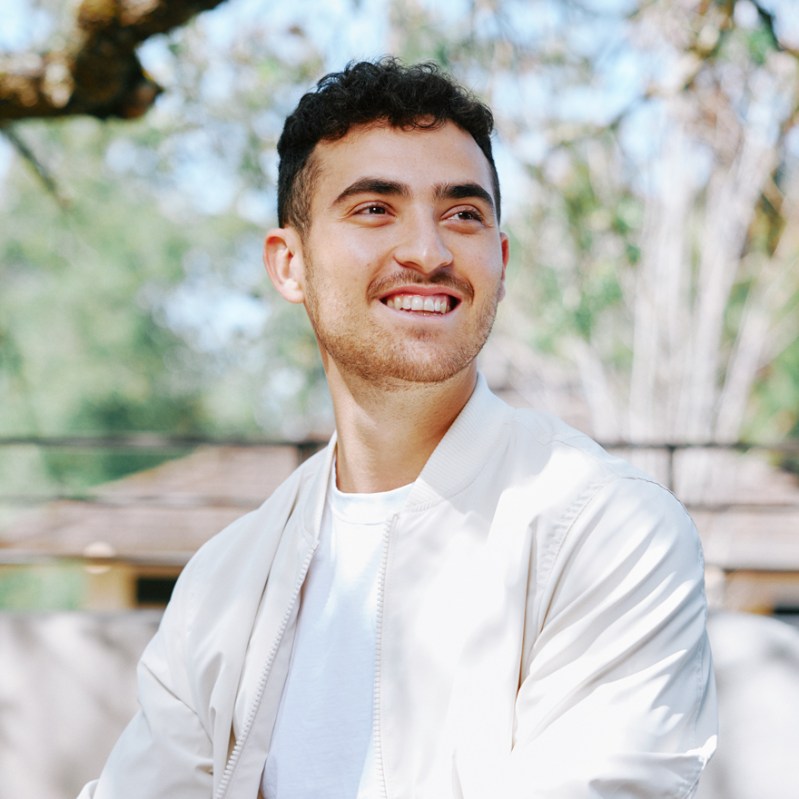
Profile
The Counter-Consensus Investor
When Dean Meyer boarded a plane for Tel Aviv in early 2024, the smart money was heading the other direction. October 7th had just happened. Founders were being called up for reserve duty. The ecosystem that had spent two decades quietly becoming the world's second-highest per-capita startup nation was navigating its most existential crisis in a generation. Meyer walked straight into it and opened Sequoia Capital's Israel office.
That kind of bet - counter-consensus, deeply grounded in domain conviction - is exactly what his career has trained him to make. Meyer grew up in Amsterdam, homeschooled himself through high school on a diet of math and computer science while training professionally with AFC Ajax. Not the junior academy - the first team environment at one of Europe's oldest and most storied football clubs. He played professionally from 2014 to 2017, then moved to Maccabi Tel Aviv, which is also when Israel switched from being a destination to becoming home.
He enrolled at Reichman University (IDC Herzliya) to study computer science - and didn't just pass. He graduated at the top. But before graduation, he had already gotten himself a side project that would shape everything: a trading bot. He built it. It worked. Then it blew up - not because the algorithm failed, but because he hadn't built the systems around it properly. No risk controls, no circuit breakers, no guard rails. He lost the proceeds.
Any other person files that under "embarrassing college story." Meyer filed it under "formative." The lesson - that infrastructure is not optional, it is the point - now underpins his entire investment thesis. He backs founders in infrastructure, cloud, data, AI, and cybersecurity. People who have already solved hard systems problems at depth, not founders who are learning those lessons at your expense.
His path into venture wasn't linear. He joined Team8, the Israeli venture group built around the Unit 8200 network, as an investor in 2020. Then moved to Vine Ventures, where he established the fund's Israeli presence and seeded what would become two notable cybersecurity exits: Dig Security and Talon Cyber Security. By the time Sequoia came calling in 2024, Meyer had a track record, a network, and a theory of the market that was very specifically his own.
At Sequoia, his first deals telegraphed his instincts immediately. Decart - an AI startup building interactive, real-time video experiences with co-founders Moshe Shalev and Dean Leitersdorf - went in at pre-seed. It is now valued at $3.1 billion. Eon, a cloud-backup company built by veterans of the Unit 8200 intelligence corps, took a $20M seed round from Sequoia and became a unicorn inside a year. Kela, a defense-tech firm building modern intelligence tools for Israel and its Western allies, took a Sequoia-led $10M seed. Irregular, whose AI security platform backs the curve on threat detection, followed shortly after.
The through-line: founders with deep, specialized, earned knowledge. Not generalists with a pitch deck. Engineers who have sat inside the specific problem long enough to know exactly where the bodies are buried. Meyer's job, as he sees it, is to recognize that depth when he sees it - and then get out of the way.
Off the cap table, he is easier to describe through his hobbies than his LinkedIn. Part-time archaeologist. Soccer player (obviously). Paganini fan - not "classical music fan," specifically Niccolo Paganini, the 19th-century Italian virtuoso who was so technically extraordinary that audiences thought he had made a deal with the devil. There's a pattern there somewhere.
"He built a trading bot in college that worked perfectly. Then lost everything because he forgot to build the system around it. Now he only backs founders who already know what 'the system' is."
- Career-defining anecdote, Sequoia Capital profile