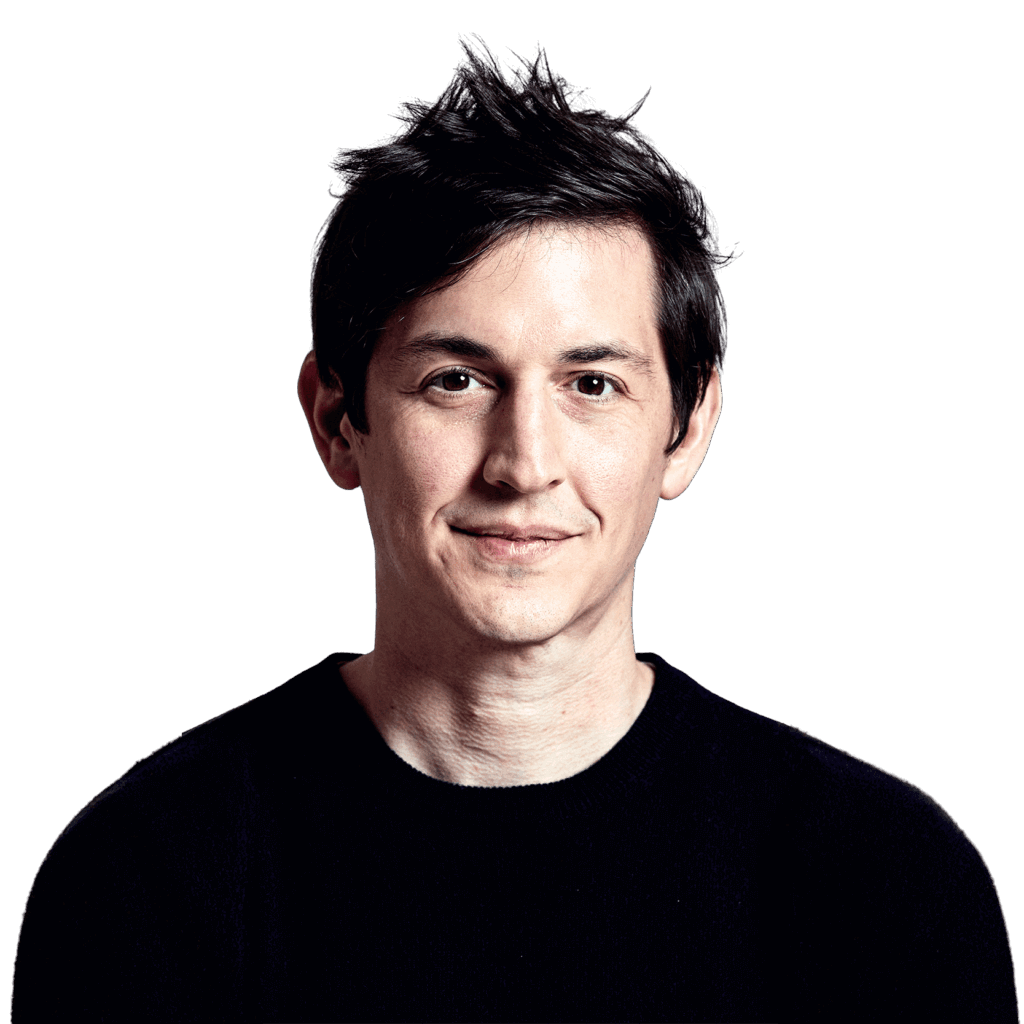
The Bridge-Builder
Most venture capitalists pick a lane. David Haber built a highway. By the time he joined Andreessen Horowitz in 2021, he had already been an investor, a founder, a Goldman Sachs executive, and the most reliably present person at every meaningful fintech event in New York City. His a16z colleague Alex Rampell put it plainly: "Only rarely, if ever, do I encounter a fintech entrepreneur who does not know David." That is not a compliment about his calendar management. It is a compliment about his gravitational pull.
The trajectory is deceptively clean in retrospect. Harvard, class of roughly 2011, degree in Biochemical Sciences - not finance, not computer science. Then Spark Capital in New York as a 23-year-old associate among seven GPs, attending downtown meetups where the founders of Plaid and Venmo were still figuring out what they were building. He sourced Plaid's seed round in 2013. He got it right because he was in the room. He was in the room because he was curious. That pattern has not changed.
It's rare to find an established investor, entrepreneur, and executive in one, much less one so deeply rooted in the NYC ecosystem.
- Alex Rampell, General Partner at Andreessen HorowitzBond Street came next. The thesis was simple in description and brutally difficult in execution: transform small business lending through technology, data, and design. The American small business owner was chronically underserved by banks that could not profitably price a $150,000 loan. Haber and his co-founders built the underwriting infrastructure that made it possible. By 2015, the company was deploying $300 million in lending capital. By October 2017, Goldman Sachs had seen enough - it acquired Bond Street to anchor what would become Marcus, the bank's digital banking platform.
The Goldman chapter is instructive. Haber describes the transition from startup CEO to senior executive inside a 45,000-person institution as something like "recovery." But he used that recovery period to do something few founders bother with: he studied how large, complex organizations actually work. He helped connect Goldman's chief strategy officer Stephanie Cohen to the technology ecosystem. He watched how institutional thinking creates both defensibility and inertia. He filed everything away.
Career Arc
Spark Capital, New York - Joined as associate, one of seven people at the firm. Focused on fintech, e-commerce, and marketplace companies in the nascent NYC tech scene.
Plaid Seed Investment - Sourced and led the seed investment in Plaid while at Spark Capital. Met the founders at New York startup meetups before "fintech" was a recognized category.
Co-Founded Bond Street - Left Spark to build Bond Street, targeting the chronic underservice of American small businesses by traditional banks. Technology-first underwriting for $50K-$500K loans.
$300M Lending Capital - Bond Street raises $300 million in new lending capital, establishing itself as a leading SMB lending platform.
Acquired by Goldman Sachs - Bond Street joins forces with Goldman Sachs (October 2017) to build Marcus, the bank's digital finance platform. Haber becomes a senior executive in Firmwide Strategy.
Joined Andreessen Horowitz - Named General Partner, becoming a16z's first full-time GP based in New York City. Focus: fintech, B2B software, enterprise AI.
a16z Opens NYC Offices - Haber helps establish the firm's permanent New York presence, planting Silicon Valley's most influential VC brand in Manhattan.
Vertical AI Bets - Co-leads a16z's $2.2B AI Apps fund. Leads investments in Camber (healthcare RCM), Eve (legal AI, $47M Series A), and continues building the vertical AI thesis.
The Investment Thesis
Haber arrived at a16z with a fully formed theory, forged across ten years of seeing fintech from every angle. His framework begins with a refusal to see fintech as its own vertical. "Fintech is much more of a horizontal than a vertical," he has said. The implication is significant: the most important fintech companies are not the ones that built a better bank. They are the ones that embedded financial logic into workflows that previously had nothing to do with finance.
His bias is for companies that lead with software - not with a financial product. The financial product comes later, once the software has created the distribution, the data, and the trust. Companies like Ramp and Brex did not win because they built better credit cards. They won because they built software that companies actually wanted to use - and then attached a card to it.
In Vertical AI, market structure is the new TAM.
- David Haber, a16zThe evolution of this thesis into vertical AI is the most interesting move. Haber's current framework rejects traditional TAM analysis as the primary investment filter. Instead, the question is: what is the market structure? Fragmented markets allow a vertical AI company to own end-to-end workflows and build toward software-level margins. Concentrated markets - where large incumbents dominate - demand a different approach: complementary positioning, integration strategies, becoming indispensable to the incumbents rather than competing with them.
The messy inbox is his favorite metaphor. Across every professional industry - healthcare, legal, construction, finance - the same problem repeats: expensive humans living in Excel, not just for modeling, but for tracking work. AI that can capture and organize unstructured data from those inboxes - emails, PDFs, faxes, phone calls - and transform them into structured workflows is the category. Tennr (healthcare document processing), Eve (legal workflow automation), and Camber (revenue cycle management) are all expressions of this thesis.
David Haber - By the Numbers
Portfolio Companies
Firm vs Fund
One of Haber's most cited frameworks is his distinction between a fund and a firm. Funds optimize for a single question: how do I generate the most carry with the fewest people in the shortest amount of time? Firms pursue something different - delivering exceptional returns while building a source of compounding competitive advantage.
Funds become fragile as they grow. Without competitive moats, larger fund structures face existential risks that smaller shops do not. Firms build moats: decision-making autonomy distributed among entrepreneurial leaders, institutional platform capabilities (a16z runs a 400-person support operation costing hundreds of millions annually), and the kind of organizational agility that allows rapid adaptation while accruing economies of scale.
Haber's Goldman chapter informed this deeply. He watched an institution that had been building compounding advantages for over 150 years - wealth management distribution, proprietary data networks, the ability to attract talent across market cycles. He emerged from it with a conviction that the best VC firms are not competing to pick winners. They are competing to build the kind of platform that makes founders choose them over anyone else.
The kind of vehicle you want to build, if you want your institution to last 100 years.
- David Haber, on building a firm vs a fundIn His Own Words
"Fintech is much more of a horizontal than a vertical."
on investing philosophy"It has always been easy for me to come up with business ideas - the harder question is determining which to pursue."
on founding companies"AI is making markets that weren't attractive to software companies suddenly very attractive."
on vertical AI opportunity"Would I be willing to pitch my mother-in-law to invest in the company? [as a commitment test]"
on investment conviction"Expensive humans living in Excel - not just to do modeling, but using Excel to track work."
on enterprise software inefficiency"I feel best somewhere in the middle - between investor and entrepreneur roles."
on identity- Harvard biochemistry degree - the scientist who became fintech's most connected VC
- Started companies as a child - the entrepreneurial impulse predates the resume
- Was 23 years old at Spark Capital, already pushing for equal voice among seven GPs
- Described Goldman Sachs post-acquisition as "recovery" from startup intensity
- Opened a16z's first Manhattan office - Silicon Valley VC's New York beachhead
- Investment sweet spot: $20M checks, seed through Series B