Dan Hydes has a useful measure of progress: a customer comes back. There is something pleasingly untheatrical about it. The first purchase can contain hope, curiosity and a generous allowance for a good presentation. A second purchase has had time to acquire an opinion. In a 2020 conversation about IgniteData, Hydes singled out repeat business as one of the things that made him proud. The customer had seen the work and still wanted more.
He also remembered the café where an idea had begun to become a company. A café is a forgiving place for a business plan. It requires neither a financial model nor a working product before it will bring you another coffee. Hydes and his co-founder, Richard Yeatman, eventually had to take their idea into rooms with rather more demanding entry requirements. That passage, from an agreeable conversation to something people would pay for, is the story worth following.
Two different kinds of useful
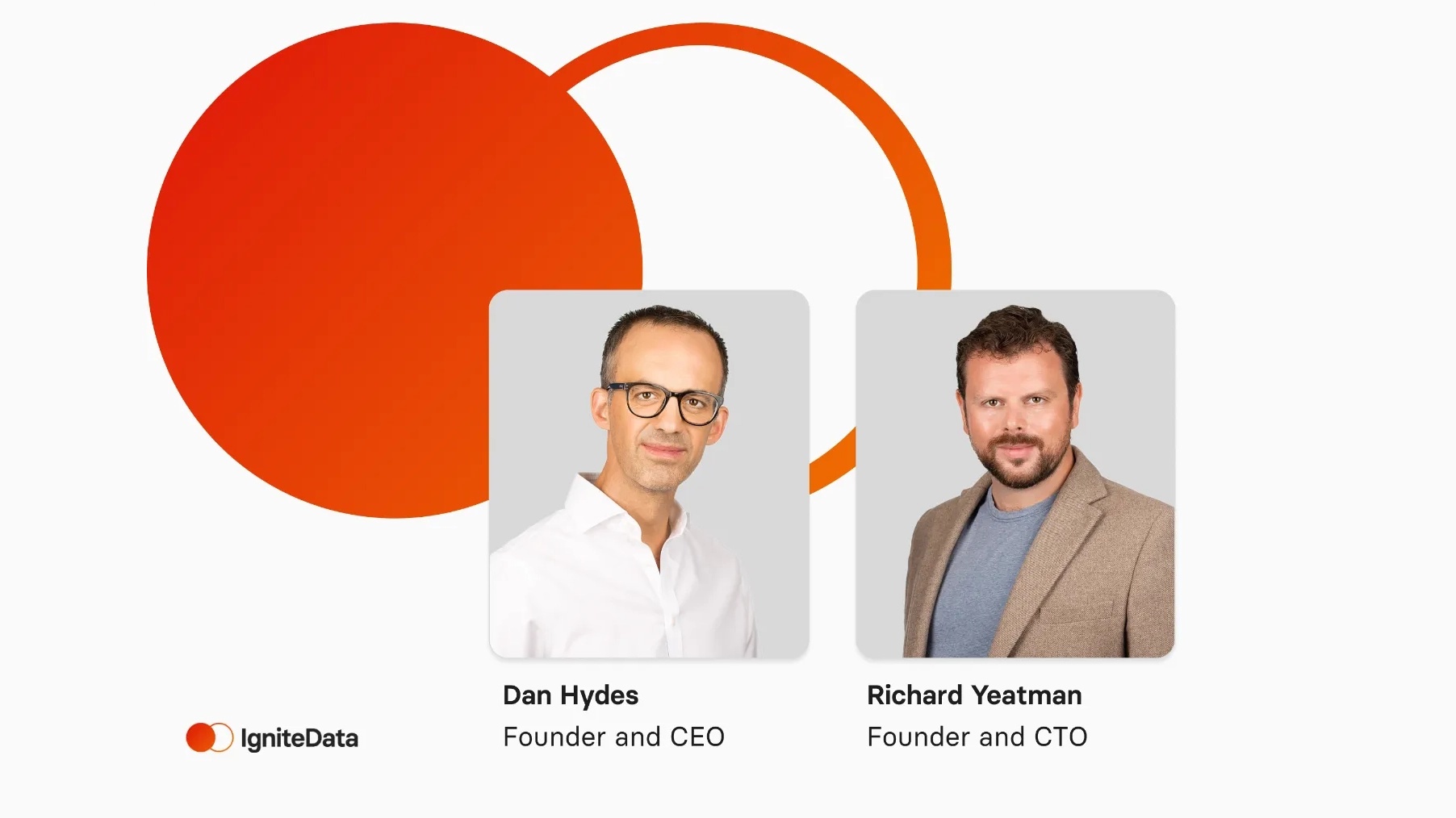
The partnership had a practical beginning. Hydes and Yeatman met in 2013 while consulting, and formed IgniteData in 2014. Hydes was looking at commercial opportunities and potential deals; Yeatman brought a focus on systems and technology. The pairing gave them different ways to interrogate the same problem. One could ask whether the machinery would work. The other could ask who would want it, and on what terms.
That distinction matters in a young company. A product needs someone willing to argue for it outside the room where it was conceived. It also needs someone capable of making the argument survive contact with the product itself. Their early business developed through services and consultancy, while feedback helped refine what they should build. The two founders had opportunities to learn from paid work as well as from their own enthusiasm.
Hydes had already co-founded an earlier business in 2008. IgniteData therefore followed experience of running a company, rather than a sudden introduction to entrepreneurship. In his account of the company’s development, the founders spent five years providing services before beginning work on Archer in 2019. The calendar supplies a useful corrective to the tidy startup story: an idea can be clear long before all the conditions for building it are in place.
The spreadsheet gets a speaking part
The less photogenic details are sometimes the most revealing. When IgniteData sought development capital through the Thames Valley Berkshire Expansion Loan Scheme, accountant Sean Hackemann and SME Web Accountants helped its management team with financial modelling. Hydes credited the resulting integrated model with helping the company raise the money under tight timeframes. Somewhere between ambition and a lender’s decision, the spreadsheet had earned a speaking part.
The funds were intended for growth and working capital. That last phrase is small enough to disappear into an announcement, but it describes an ordinary business obligation: having money available while the work gets done. A founder can believe firmly in an idea and still need a convincing account of how the company will finance its next stage. Hydes’s acknowledgement puts an adviser’s contribution inside the story, alongside the more familiar contributions of founders and engineers.
A £300,000 expansion loan and help obtaining grant funding became part of IgniteData’s development. In the FSE Group’s 2021 impact report, Hydes was candid about how necessary debt support had been: the project would otherwise have been abandoned. It is an unusually plain admission in a world fond of making every successful company sound inevitable. Funding had consequences. A project continued that might have stopped.
Expansion loan through the Thames Valley Berkshire scheme.
A partner brings more than a cheque
On 1 February 2022, ZS announced a strategic partnership supported by a multimillion-dollar investment in IgniteData. For Hydes, this added a different kind of relationship to the company’s history. The business was moving beyond the earlier combination of customer revenue, borrowing and grants toward a partnership with an established professional services firm.
The announcement connected the investment with ZS’s worldwide presence. Money can buy time and staff; an organisation with an international network can also bring access to conversations a smaller company would find harder to reach. The interest lies in the combination. A commercial founder has to consider what a partner can help the business do after the announcement has finished circulating.
There is no need to give the cheque a personality. The people on either side still have work to do. Expectations need translating into agreements, and agreements into delivery. Hydes’s place in this story is the commercial work: making a proposition understandable enough for another organisation to commit to it, then helping the relationship produce something useful.
- 2014Hydes & Yeatman form IgniteData
- 2019Work begins on Archer
- 2022Strategic partnership with ZS
- 2024Hydes becomes President
The founder on the other side of the pitch
By January 2024, Hydes was discussing startup decisions on The Scope of Things podcast with Ward Lemaire and host Deborah Borfitz. The episode introduced his experience shaping IgniteData’s value proposition, commercial model and global expansion strategy. It also noted an earlier part of his career: leading large commercial teams for global media organisations. Selling and organising commercial work had preceded his present company.
The conversation’s startup subjects included meeting competing demands and directing limited resources. Those are pleasantly concrete concerns. Every young company has more conceivable projects than affordable projects. The founder’s job includes deciding which attractive possibility will have to wait. Experience in larger commercial teams offers a different vantage point on that task: people, attention and money must still be organised around something a customer actually values.
In February 2024, Hydes sat on the judging panel at SCOPE’s inaugural startup pitch contest in Orlando. His fellow judges included Jessica Federer, Andrew Hedin and Lemaire. More than 100 nominations had been submitted; CliniSpan won the competition. Hydes had gone from presenting his own company’s case to listening to other founders make theirs.
A judging seat gives that journey a visible shape. The pitch is a brief performance with a longer business attached to it. Someone listening has to consider both. For Hydes, whose own work centres on commercial models, the setting brought him into direct contact with the next group of founders trying to make a limited amount of time count.
President, with the work still attached
In 2024, IgniteData announced a change in its leadership. The founders brought in Zach Taft as CEO. Hydes became President, with a renewed focus on the value proposition, commercial model and strategy for growth. Yeatman moved from CTO to COO, while Steven Tolle joined as Chief Product and Technology Officer. Several jobs changed together.
The announcement described a division of responsibilities rather than a departure. Hydes retained the work most closely associated with his commercial background. Yeatman took on operations. A new chief executive would concentrate on growth, alongside a new product and technology leader. The organisational chart was catching up with the company’s ambitions.
It is tempting to read every founder’s title as a verdict. The actual responsibilities offer a more useful reading. President, in Hydes’s case, came with specific work to do. A company can need its founder’s judgement in one area while giving another person the authority to lead the whole. The change makes the partnership story larger: more people now carry defined parts of the business.
“every contract is a team effort”Dan Hydes · 2020
A wingman and a better forecast
Hydes’s public voice has room for a little levity. Before speaking at SCOPE in 2023, he described Mats Sundgren as his “wingman” and recommended the event partly because its weather improved on the UK’s. It is a modest joke, but it makes the conference circuit sound recognisable. There are colleagues to see, a talk to deliver and, with luck, a reason to leave the coat behind.
The relationship with Sundgren remained visible when Hydes later shared his call for contributions to a conference about leadership and artificial intelligence in research-intensive industries. The connection extends beyond a single appearance onstage. His public activity includes keeping colleagues’ work in circulation as well as promoting his own company.
At a Founder x Funder reception associated with London Tech Week, Hydes also spoke about IgniteData’s relationship with Microsoft. He described its contribution in both technical and commercial terms, then welcomed the chance to meet people in person instead of on Teams. A technology partnership still contains people who occasionally benefit from occupying the same room. Even the calendar invitation has its limits.
The next invitation
In March 2025, Hydes recalled the early scepticism surrounding IgniteData. People had questioned whether the founders could solve a problem that had resisted earlier attempts. His reflection paired that memory with appreciation for the team working under Taft’s leadership. He was looking back at the doubt from inside a company that had continued to develop.
The recollection is useful because it leaves the uncertainty in the story. At the beginning, the founders had a proposal and objections to answer. Later milestones did not erase that period. They gave it an ending, at least for that particular chapter. Hydes’s enthusiasm was directed toward the work ahead and the people doing it.
Today his role remains co-founder and President. The commercial proposition, the model and the growth strategy are still on his desk. IgniteData’s stated values include earned trust and collaboration, which suit a business whose progress depends on other organisations choosing to work with it. Those choices need renewing as the company changes.
The café conversation makes a good beginning. The borrowing, advisers, partnerships, pitch panel and changed titles make the middle more interesting. Together they give Hydes’s career a texture that a list of appointments would miss: a founder repeatedly finding the next practical arrangement that allows work to continue. The returning customer remains a useful figure in that picture. Someone has already tried the company. Now they are asking it back.