01 / WHO THEY ARE NOW
A power plant on a flatbed
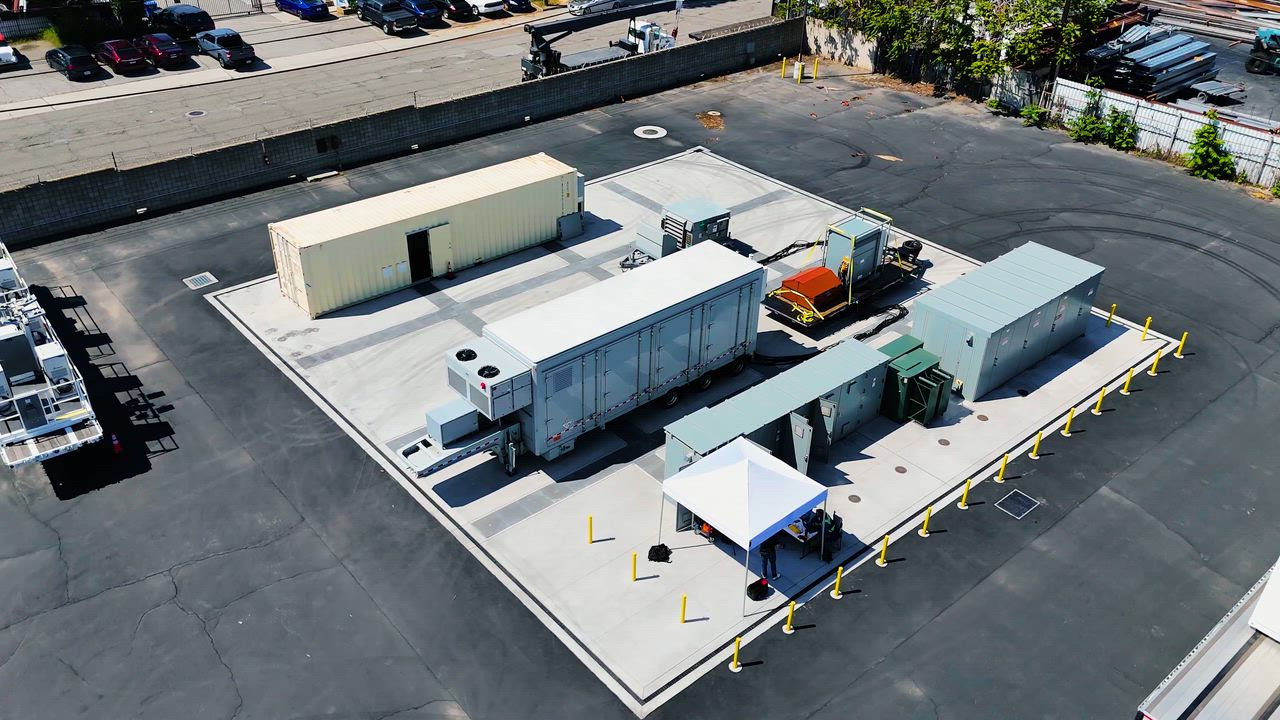
Somewhere outside Mojave, a row of grey cabinets sits on a fresh concrete pad. No smokestack. No substation. Just batteries, a controller, and a factory next door that is running today instead of waiting until 2029.
That is Critical Loop in one frame. The company builds modular, relocatable battery microgrids and wires them to a software controller called Cygnus. When a business needs power and the utility says "get in line," Critical Loop rolls in storage, taps whatever generation is available, and keeps the lights on while the paperwork catches up.
It is not glamorous work. The hardware looks like shipping containers. The wins are measured in megawatt-hours and connection dates. But the problem underneath is one of the largest constraints on the American economy right now: you can build the factory, sign the customers, and still not get electricity for years.
Today the company runs 67 active control nodes across California and has deployed roughly 50 MWh of storage. It serves more than eight industries - aerospace, advanced manufacturing, logistics, data centers, critical infrastructure - mostly companies you have heard of and a few you have not.
The pitch is almost suspiciously simple: power, without the permitting marathon.
"In just a couple of years, we've built a software and hardware stack that has the potential to accelerate time to power from years to days."
- Bala Ramamurthy, Co-Founder & CEO
02 / THE PROBLEM THEY SAW
The grid forgot how to say yes
Ask anyone trying to plug a large new load into the grid - a factory, a fleet depot, a data center - and you hear the same word: queue. Interconnection requests can sit for years while utilities study, upgrade, and study again. Capacity exists somewhere; it just isn't where you need it, when you need it.
The conventional fix is a transmission line and a transformer. Both are slow, expensive, and require a level of optimism about permitting timelines that most CFOs no longer possess.
Critical Loop's read was sharper: the bottleneck is rarely electrons. It is the connection. So instead of waiting for the grid to expand, put storage on site, let software decide when to pull from the grid and when to lean on batteries, and treat the connection as a flexible thing rather than a fixed one.
That reframing matters. A flexible load can promise the utility it will back off at peak - which means it can connect now, on the wires that already exist.
"Capacity isn't the scarce resource. Time is. Critical Loop is in the business of selling time back to people the grid put on hold."
- The central bet, in plain terms
03 / THE FOUNDERS' BET
Rocket people, grounded
When the person who helped human-rate the Falcon 9 tells you the electrical grid is the harder problem, it is worth a second look.
Critical Loop was founded in 2023 by three people who had spent their careers making complicated hardware behave: Bala Ramamurthy, Lydia Maher, and Andrew Grinalds. Ramamurthy led flight-safety engineering at SpaceX on the rocket that returned American astronauts to orbit. The team around them came out of SpaceX, Tesla, Palantir, and Rivian - companies where "the hardware can't fail" is a daily operating assumption.
Their bet was that aerospace-grade controls discipline, applied to a sector that still leans on diesel generators and multi-year studies, would produce something the energy industry could not build on its own: a power system that is software-defined first and hardware-agnostic by design.
Bala Ramamurthy
Co-Founder & CEO
Former SpaceX flight-safety chief engineer; led development of the human-rated Falcon 9.
Lydia Maher
Co-Founder & CTO
Leads the technology stack behind Cygnus and the modular storage platform.
Andrew Grinalds
Co-Founder & COO
Runs operations and field deployment - the part where the cabinets actually reach the concrete.
"They left an industry obsessed with leaving Earth to fix the most earthbound problem there is: getting a wire connected on time."
- On the founding team's pivot
04 / THE PRODUCT
Cygnus, and the boxes it commands
The brain is Cygnus, a compact, software-defined power controller. It watches the grid in real time, pulls maximum power when the grid is willing and cheap, and switches to batteries or generators the instant it is not. Off-grid or on-grid, it does not particularly care - that is the point.
The muscle is the CLB-5100, a 1 MW battery system that packs storage, flexible generation and Cygnus control into a single platform you can relocate. When the grid runs out of room in one place, the power source moves to where it is needed instead.
The connective tissue is the combiner - a microgrid cabinet that ties together different battery chemistries, grid connections and on-site generation without custom rework. Critical Loop sources batteries from six manufacturers, in units from 250 kW to 2 MW, because the software was built not to care whose hardware it is.
That hardware-agnostic stance is the quiet competitive moat. Most energy companies sell you their box. Critical Loop sells the orchestration and will run whatever box makes sense.
6
battery makers integrated
"Most energy companies sell you a box. Critical Loop sells the decision about which box to use, and when - which turns out to be the valuable part."
- On the hardware-agnostic model
05 / THE PROOF
Customers, megawatts, and a regulator
Proof of an energy thesis is unglamorous: it looks like uptime. When a utility outage threatened to shut down the manufacturer Cover for eight months, Critical Loop powered the facility through it. San Diego International Airport runs 11 MW of flexible load with Critical Loop's batteries and solar. Terawatt Infrastructure added 4+ MW of capacity for EV charging sites through the partnership.
Then there is the kind of validation money cannot buy. In February 2026, the California Public Utilities Commission cited Critical Loop in a rulemaking requiring SCE and PG&E to offer flexible service connection options for grid-constrained customers. The model isn't just being bought - it is being written into how the grid is allowed to work.
Investors followed. The $26M Series A in April 2026, led by Conifer Infrastructure Partners and Hanover with Better Ventures, Climate Capital, Adapt Nation Capital and Cyrus Ventures, pushed total committed equity and debt to $49M.
Funding & deployment, by the numbers
SERIES A, APRIL 2026 // RELATIVE SCALE
Bars scaled for comparison within each measure. Figures from company statements and 2026 press coverage; deployment numbers are approximate and growing.
"Uptime is the only review that matters in this business. Eight months of it, for a factory that was told to wait, is the whole sales deck."
- On the Cover deployment
06 / THE MISSION
Make the grid say yes again
Critical Loop's mission is narrow on purpose: eliminate the years-long interconnection bottleneck so growth is never gated by how long a utility takes to add capacity.
There are two ways to buy it. Energy-as-a-service, where Critical Loop owns the asset and sells power and uptime. Or a long-term service agreement, where you buy the equipment and Critical Loop runs the orchestration remotely. Either way, the company is selling speed and reliability, not just hardware.
The target is the industrial midmarket - sites needing roughly 5 to 100 MWh - the unglamorous middle that is too big for a generator and too small to command a utility's full attention. It is a large, underserved, and deeply practical market.
The broader stakes are real. Electrification, reshored manufacturing, and the data center boom are all colliding with a grid that adds capacity slowly. Whoever makes the connection flexible makes the whole transition faster.
"The grid was built to deliver power. Critical Loop is rebuilding it to deliver answers - faster than the queue can."
- On what the company is really selling
07 / WHY IT MATTERS TOMORROW
Back to the pad outside Mojave
Demand for electricity is not slowing down. AI data centers, electric fleets, reshored factories - all of them want power, all of them want it now, and none of them can wait out an interconnection queue. The constraint Critical Loop attacks is only getting tighter.
If the model holds, "time to power" stops being a multi-year project-killer and becomes a line item measured in weeks. Regulators are already nudging utilities toward flexible connections. Capital is flowing. The hardware is hardware-agnostic, so it scales without betting on a single supplier.
Return to that concrete pad outside Mojave. A year ago it might have been an empty lot with a permit pending and a factory idling beside it. Now the grey cabinets hum, the orange generator sits unused, and the business next door is shipping product. Same grid. Same wires. Different answer.
The grid still takes years to add capacity. Critical Loop just stopped letting that be your problem.