The first product Coolstar Technology hoped to sell was not a chip. It was the right to use a transistor. Founder Xiaotong Lin and her partner thought they could license their new silicon device and let other companies do the remaining work. It was a neat plan, as neat plans often are before a customer tries to use them.
Then came the awkward arithmetic. Making the device useful inside a particular power amplifier demanded customization. Lin later said that optimization would be expensive and the licensing return marginal. So the Santa Clara company changed the unit of ambition: build the complete chip. That meant working with a foundry on the process, developing the device, designing the circuit and getting a finished part into production. The bet became longer and costlier in effort, even though public funding amounts and product prices are not disclosed.
- Coolstar designs RF power amplifiers and front-end chips for wireless equipment.
- Its NovaFET silicon platform was co-developed with TSMC.
- The customer is an equipment maker, especially one building dense Wi-Fi 6E or Wi-Fi 7 systems.
- Its founder says chip-level customization broke the original licensing economics.
A hot little job
An RF power amplifier sits near the business end of a wireless transmitter. It must raise the signal to a useful level without blurring the information carried by that signal. The work is particularly fussy in a modern access point, where several antennas may transmit in a tight enclosure. Extra electrical power becomes heat; heat changes the demands on the board, the enclosure and the components around it. A part that looks cheap on a price list can become expensive in the system built around it.
Coolstar's answer is NovaFET, its proprietary silicon device platform co-developed with TSMC. The company says the structure is designed for high linear output at RF frequencies, with efficiency and thermal behavior that compare favorably with gallium arsenide, a familiar material in RF amplifiers. This is a vendor claim, not a universal law of chip physics. The useful point for a buyer is that Coolstar is selling a system trade: signal quality, output power, heat, integration and cost measured together.
Figures are Coolstar's published comparisons; results depend on the device and test conditions.
Those figures need careful reading. Lower thermal resistivity describes how readily heat gets out; lower heat generation describes how much waste heat the device makes in the first place. They are related but separate advantages. DEVM, meanwhile, is a measure tied to modulation accuracy: a lower error floor can leave more room for a clean, high-rate signal. An engineer would still ask for the test setup, output level, duty cycle and whole-board result before treating any comparison as a design win.
The part the customer can actually buy
The product list shows what the licensing rethink produced. Coolstar offers front-end solutions for the 2.4, 5 and 6 GHz Wi-Fi bands. A front end combines a power amplifier with a transmit-receive switch and a low-noise amplifier for the receiving side. That combination reduces the amount of radio plumbing a customer has to assemble separately. It is the sort of packaging decision that rarely makes a billboard and frequently makes a product possible.
High-power Wi-Fi 7 front end spanning 5.150 to 7.125 GHz.
High-power Wi-Fi 6E/7 front end for 5.925 to 7.125 GHz.
Wi-Fi 6E power amplifier in a 3.0 × 3.0 mm 16-pin QFN package.
Mid-power Wi-Fi 7 front ends for 5, 6 and combined 5+6 GHz ranges.
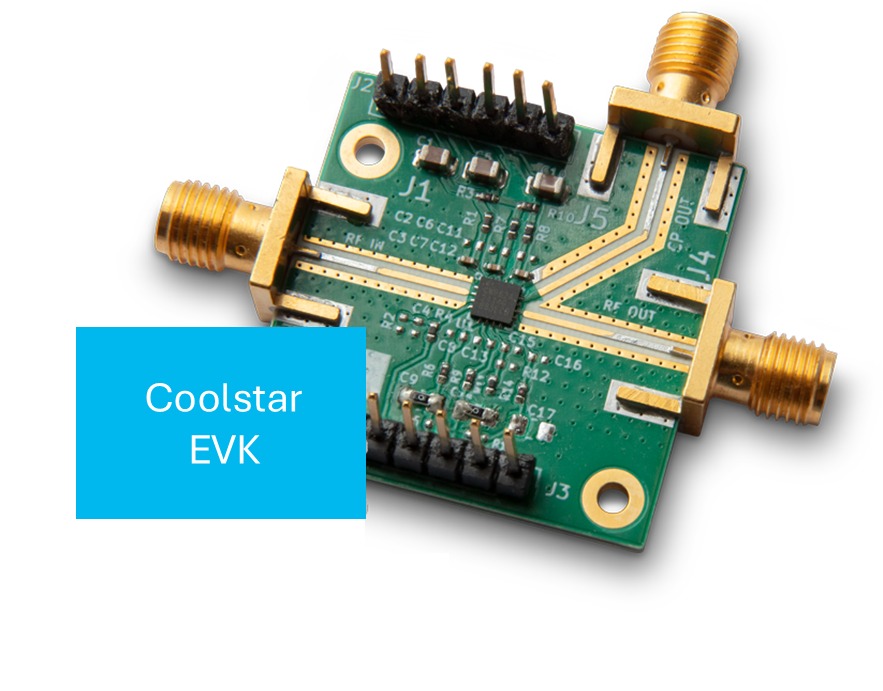
The CWP62A data sheet makes the strategy tangible. It specifies a 5.925 to 7.125 GHz Wi-Fi 6E amplifier, integrated input and output 50-ohm matching, a power detector and coupler, and a tiny QFN package. Its stated aim is to reduce board area and the bill of materials while balancing efficiency against linear output. Coolstar even lists an evaluation kit, CWP62A-EVK1, for a customer to put the part through its own measurements. That is what a finished product offers that a transistor license does not: a shorter path from promising device to a design review.
Illustrative product coverage, not a scaled spectrum chart. Coolstar publishes parts for 2.4, 5, 6 and combined 5+6 GHz Wi-Fi designs.
A company built around the difficult middle
Coolstar is fabless: it designs the technology and chips, while foundry partners make the silicon. It says it has relationships with leading foundries and tier-one equipment makers and design manufacturers, though it does not publicly name its buyers. Its published applications include Wi-Fi 6E and Wi-Fi 7 access points, mobile equipment and sub-6 GHz 5G Massive MIMO systems. The catalog, however, is most concrete around Wi-Fi front ends. That is where a reader can see actual part numbers, bands and specifications rather than an attractive possibility.
The alternative for an equipment maker is an established RF front end, often using gallium arsenide for the amplifier. Coolstar argues that its silicon device can match or exceed that performance while giving designers silicon's integration and cost advantages. Whether it wins a socket depends on the actual radio design: a wide operating band, high output and a crowded thermal budget make its proposition more compelling. A simple, low-volume design with generous cooling may find less value in changing a qualified supply chain. That is an engineering inference, not a reported Coolstar customer outcome.
“When Coolstar first started, my partner and I thought that we would license our technology...”
Xiaotong Lin, in a GSA founder interview
Lin had spent 2005 to 2014 at Broadcom as a senior principal scientist and contributed to energy-efficient Ethernet and Automotive BroadR-Reach specifications. She founded Coolstar in 2014, and the company reports seed, Series A and Series B funding in 2014, 2016 and 2021. It has shown work in TSMC's Innovation Zone and lists an advisory board with experience at Intel, Qualcomm, Atheros and Infineon. Such names do not prove a device's performance, but they do explain why the firm can attempt work that crosses process engineering, RF circuits and system design.
Lin has also been unusually explicit about the human side of that work. In a GSA interview, she said her early plan had to change because the economics were wrong, and that she recruited a specialist to help solve the technical problems that followed. She has said she wants women at Coolstar to have career paths, noting women in its CEO, CTO and CAO roles. Her public advice to founders is to watch for “defocus” and for assumptions dressed up as problem definitions. A company that had to discard its first business model has earned the right to make that point.
The lesson inside the amplifier
There is a useful practice here for anyone developing hardware: measure the cost of adoption, not just the performance of the invention. Coolstar learned that a better transistor could still be a poor product if a customer had to pay too much to customize and integrate it. The response was to own more of the work, from process partnership through finished IC and evaluation board. It is expensive in engineering attention. It also gives a customer something measurable and orderable.
No public price list or named deployment lets an outsider calculate Coolstar's savings for a particular router. The company publishes testable claims and product specifications instead. That is enough to make the real question clear. In a wireless box full of antennas, the amplifier must be loud, clean and cool at once. Coolstar's wager is that the answer is a silicon chip designed with the whole box in mind.