The AI advocate built from the medical records patients were never able to read.
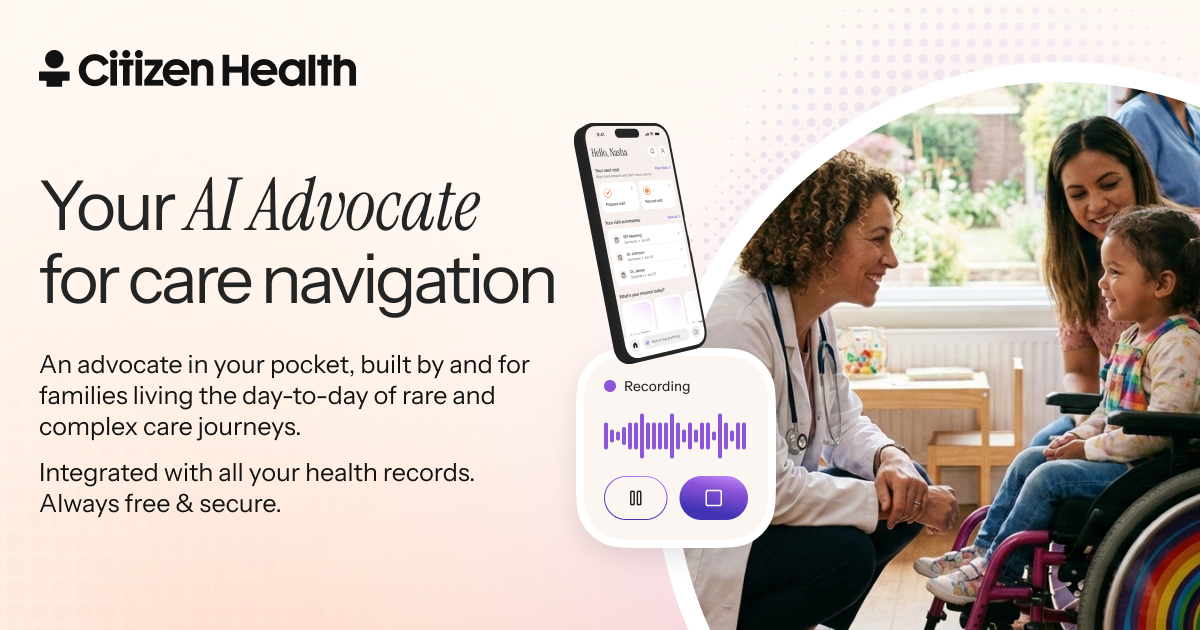
Exhibit A: a lifetime of scattered paperwork, finally fitting in one hand. The phone does the reading so the family doesn't have to.
It is 11pm somewhere in America. A parent sits at a kitchen table surrounded by the debris of a rare disease diagnosis - discharge summaries, genetic panels, three different patient portals, a binder gone soft at the corners. For years this was the job nobody applied for: full-time medical translator for someone you love. Citizen Health is the company betting that job should not exist. Today, more than 8,000 patients across 350-plus rare and complex conditions open an app, type a question in plain English, and get an answer drawn from their own complete history.
That is the present tense. Getting there required buying a company back from a bankruptcy, a $44 million bet, and two founders who refused to accept that the most vulnerable patients should also be the most poorly served.
"They deserve the same clarity, personalization, and intelligence in healthcare that they get in every other part of their lives."
Farid Vij, Co-Founder & CEOThere are roughly 7,000 rare diseases. Individually each is rare; together they touch hundreds of millions of people. The cruel arithmetic is this: the rarer your condition, the fewer specialists understand it, the more institutions you bounce between, and the more your own data scatters across systems that were never built to talk to one another.
The patient ends up as the only common thread - the unpaid integration layer between hospitals that won't share. Meanwhile, the data that could accelerate a treatment sits locked in PDFs, fax machines, and portals with forgotten passwords. Researchers can't reach it without burdening the very families already stretched thin. Everyone agrees the system is broken. Almost no one is incentivized to fix it for the people with the smallest patient populations.
"Work for patients, not the systems serving them."
Citizen Health company valueIn 2017, Farid Vij co-founded Ciitizen, a startup built to give cancer patients seamless access to their own records. In 2018, Nasha Fitter joined - and brought a perspective no pitch deck could manufacture. Her youngest daughter had been diagnosed with FOXG1 syndrome, a rare neurological condition with almost no available information and even fewer therapies. Fitter had already started a nonprofit. She understood the kitchen-table problem because it was her table.
Their bet: the techniques that helped cancer patients access data could unlock something bigger for rare disease - not just records, but a community and a dataset that could actually move research forward. Ciitizen was acquired by Invitae in 2021 in a deal valued around $325 million. Then the genetics giant began to wobble. Rather than watch the platform vanish, Vij and Fitter divested it in December 2023 - two months before Invitae filed for bankruptcy - and relaunched it as Citizen Health.
"Fearlessly build the future, with urgency."
Citizen Health company valueCo-founded Ciitizen in 2017 to give patients access to their own health data. Now leads Citizen Health's mission to give every patient an AI advocate.
A rare disease parent and advocate whose daughter has FOXG1 syndrome. Shifted the company's focus toward rare disease and the families living it.
The mechanics are deceptively simple. Citizen Health collects a patient's fragmented records - clinical notes, genetic information, patient-reported symptoms - and structures them into one longitudinal history. On top of that sits an AI advocate that speaks human: ask it about a medication, a past appointment, or what a baffling term means, and it answers from your own file. Patients can prepare for appointments, explore treatment options, even draft school and insurance documents.
Ask natural-language questions about your own medical history and get plain-language answers, term definitions, and next steps.
Aggregates scattered records, genetics, and patient-reported data into one queryable, comprehensive history.
Condition-specific communities built with advocacy groups so members learn from peers facing the same disease.
Consenting patients opt in to share de-identified data with researchers - accelerating drug development without re-burdening families.
"Never make life harder for the community."
Citizen Health company valueFree products are easy to sign up for and easy to ignore. The telling metric isn't downloads - it's trust. When Citizen Health asks patients whether they'll share their data for research, 98.3% say yes. That is not a number you buy with a marketing budget. It is what happens when people feel a platform is on their side.
Rounds raised after buying the platform back // ~$44M total
Sources: Citizen Health, PR Newswire, FierceBiotech, MedCity News. Bars scaled to the largest round.
"Citizen's AI advocate is the foundation of a pioneering patient and caregiver experience."
Caliri, Partner at 8VCThe business model is the quiet trick. Patients pay nothing. The research side - more than 10 pharmaceutical companies tapping consented, structured datasets - funds the consumer product. Roughly 70% of the 70-plus advocacy groups joined organically, which is the polite way of saying the families came looking.
Citizen Health states its mission plainly - use the power of shared experiences to provide relief to patients and families navigating rare and complex conditions. The vision goes further: that any patient, at any stage, of any condition, has immediate access to exceptional, personalized guidance on what to do next.
It sounds modest until you remember how the system actually treats the rarest cases. The genius isn't the AI - everyone has AI now. It's the decision about who the AI works for. Citizen Health pointed it at the patient instead of the institution, and a lot of the rest follows from that one choice.
Scale the model and the implications get large. Each new community is another condition with structured, consented data that researchers can actually use - which means treatments for diseases that were previously too small to bother with. The platform that helps one family read a discharge summary tonight is, in aggregate, the substrate for tomorrow's clinical research. The same data that answers "what was my last dose?" can also answer "does this drug work in this population?"
Back to that kitchen table at 11pm. The binder is still there - paper doesn't disappear because a startup raised a round. But now the parent isn't the only translator in the room. They type a question, the app answers from a record it took years to assemble, and somewhere a researcher gets a little closer to the thing the family is actually waiting for. The job nobody applied for just got a partner. That is what Citizen Health changed.