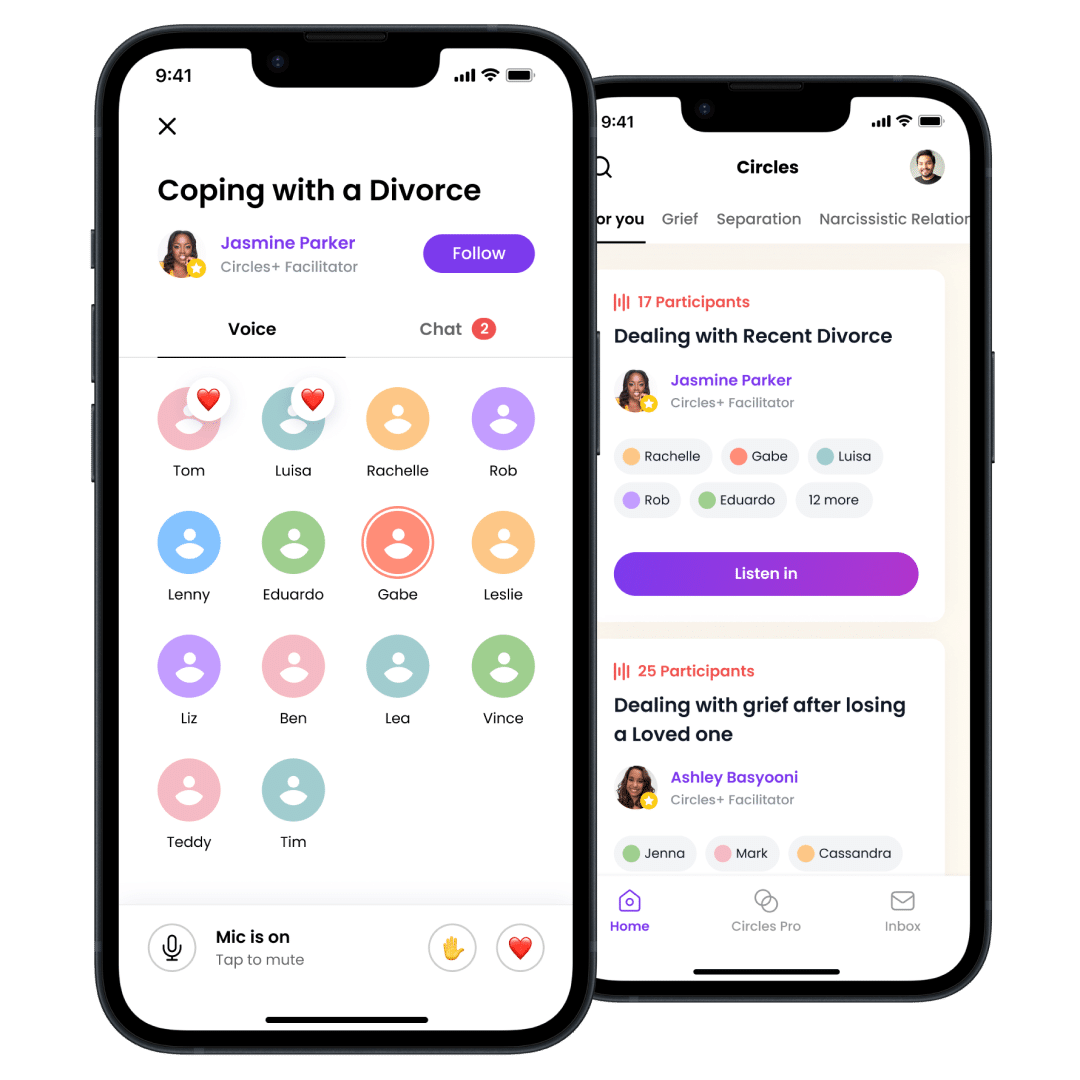
It is a Tuesday night, and somewhere a phone lights up. Six people who have never met press join. One of them lost a husband in March. Another is three weeks into a divorce nobody saw coming. A trained therapist says hello, and for the next sixty minutes the loneliest thing each of them is carrying becomes the most ordinary thing in the room. This is Circles - and the whole company is built around that single, quiet hour.
Who they are now
A support group that fits in your pocket
Circles is a New York-based digital mental health company that does something the wellness app boom mostly skipped: it puts you in a room with other people. Not a chatbot. Not a guided meditation. Not a journal that talks back. A small group - usually six to eight - of strangers who happen to be living through the same specific thing you are, with a vetted mental health professional steering the conversation.
The categories are unsettlingly precise. Grief circles. Divorce circles. Infertility circles. Caregiver circles. There is, genuinely, a circle for people leaving narcissistic relationships. The bet is that "wellness" is too vague to help anyone, and that the thing that actually moves the needle is far narrower: being heard by someone whose week looks like yours.
“No one in the world will be left alone while dealing with a life challenge.”
CIRCLES COMPANY VISION
The problem they saw
Loneliness doesn't take appointments
Here is the tension Circles exists to resolve. Traditional therapy is one-to-one, expensive, and booked weeks out. Friends and family love you but, when you are grieving or splitting up or failing to conceive, they often have no idea what to say - and you can hear them trying. The result is a particular flavor of modern loneliness: surrounded by support, understood by no one.
The pandemic took that quiet problem and turned up the volume. Isolation became a public health story, and the demand for emotional support outran the supply of therapists by a wide margin. You cannot scale one-to-one care to meet a loneliness epidemic. The math simply doesn't work.
“You cannot cure a loneliness epidemic one fifty-minute appointment at a time. The supply was never going to meet the demand.”
THE STRUCTURAL PROBLEM CIRCLES IS BUILT AROUND
The founders' bet
A phone call between two people with cancer
The origin story is almost too tidy, except that it happened. When founder Irad Eichler's mother was battling cancer, he watched her stay quietly lonely through all the love around her - and then watched her light up, laughing, on a phone call with a friend who was also sick. The comfort wasn't coming from sympathy. It was coming from recognition. From someone who simply got it.
Eichler, a social entrepreneur, co-founded Circles in 2020 with Dan Landa. The bet was contrarian for a tech company: instead of replacing human connection with software, use software to manufacture more of it - and make it cheap enough that nobody gets priced out of feeling less alone. To keep it credible, they stacked the bench with clinical heavyweights, including group-therapy expert Dr. Haim Weinberg and psychologist and TED speaker Dr. Guy Winch.
“She wasn't comforted by sympathy. She was comforted by someone who understood. We built a company around that moment.”
THE INSIGHT BEHIND CIRCLES
The product
Matched, not just downloaded
Sign up and Circles doesn't dump you into a forum. It asks questions - a short intake - and uses a matching algorithm to drop you into the group most likely to actually fit. From there it's live: 60-minute video sessions, the same handful of faces each week, a professional facilitator, and the option to message between meetings. For the hard nights, there are audio-only sessions you can join with your eyes closed.
The business model is refreshingly legible. There's a free tier with peer-led groups. Paid plans - roughly fifteen dollars a month on the annual plan, up to twenty-nine month-to-month - unlock unlimited professionally facilitated groups plus exercises, blogs and webinars. The improbable part is the price: a fraction of what a single therapy session costs, for a room full of people who keep showing up.
The short, busy life of Circles
// A COMPANY MILESTONE TIMELINE
2020
Founded in New York by Irad Eichler and Dan Landa, built on one borrowed phone call.
2021
$8M seed round (NFX, Flint Capital, Sir Ronald Cohen). Within months of soft launch: 100,000+ hours of support facilitated.
2022
$16.5M Series A led by Zeev Ventures, with Lior Ron of Uber Freight joining - cash earmarked for R&D and a smarter matching algorithm.
2022
Partnered with the Don't Clock Out initiative to support nurses' mental health in a post-COVID world.
2024
App sharpens its focus on relationship support groups; membership pushes past 160,000.
2025
Team still shipping, still answering members one review at a time.
The proof
The numbers behind the empathy
Sentiment is hard to audit, so look at behavior instead. People keep coming back, in volume, and investors who have no sentimental stake wrote real checks. Within months of its soft launch the platform had already racked up more than 100,000 hours of support. Today it counts north of 160,000 members and runs 500-plus facilitated sessions every week.
Two rounds, one thesis
// FUNDING RAISED BY CIRCLES (USD MILLIONS)
Sources: TechCrunch, Behavioral Health Business, FinSMEs, Calcalist. Bars scaled to the largest single round.
“My circle has saved me, helping me finally make real progress.”
ESTHER, A CIRCLES MEMBER
What you can actually do with it
Pick your struggle. Find your people.
Get matched
Answer a few intake questions and land in the group most relevant to what you're carrying - not a generic feed.
Show up live
Join 60-minute video sessions with the same small group each week, guided by a trained, vetted facilitator.
Lean on audio
For rough nights, drop into voice-only sessions throughout the day - support without having to be seen.
Keep going between
Message your group, plus personalized exercises, blogs and webinars so the work doesn't stop when the call ends.
The mission
Affordable is the whole point
It would be easy to read Circles as just another subscription app, and the cynic in all of us is welcome to try. But the mission has a stubborn specificity to it: connect people with peers who understand, under professional guidance, at a price that doesn't gate-keep grief. The vision statement is one line, and the company keeps repeating it because it's load-bearing - no one should be left alone while dealing with a life challenge.
That's also why the partnerships skew toward people who burn out for a living. The 2022 tie-up with the Don't Clock Out nurses' initiative wasn't a marketing flourish; it pointed the product at exactly the people the system tends to forget.
Why it matters tomorrow
The hard part is keeping it human
The competition is loud - Talkspace, BetterHelp, a crop of group-focused upstarts like Coa and Grouport, and the oldest competitor of all, the in-person circle of folding chairs. Circles' edge isn't that it invented group support; humans have done that for a very long time. It's that it made the matching smart enough, and the price low enough, to put a folding-chair circle inside a phone.
Whether that holds depends on something software can't fully control: the warmth of the room. Scale a support group too aggressively and you risk turning it into a feed. The interesting question for Circles' next chapter is whether you can grow empathy like a tech product without flattening it into one.
So, back to that Tuesday night. The hour ends. The six people who pressed join an hour ago press leave - the widow, the newly divorced, the rest of them. Nothing about their grief has technically changed. But for sixty minutes the thing each of them carried alone got set down in the middle of a room and held by people who understood its exact weight. That is the entire product. Circles just figured out how to make that room appear on a Tuesday, on a phone, for the price of lunch.
Things worth knowing
- The whole company traces back to one phone call between two people who both had cancer.
- A circle is deliberately tiny - six to eight people - so everyone actually gets to talk.
- There is a support group specifically for leaving narcissistic relationships. Specificity is the feature.
- Audio-only sessions mean you can join a support group with your eyes closed, on the worst night of the week.
- Impact-investing pioneer Sir Ronald Cohen is among the backers.