BREAKING: A whole hospital, manufactured in about three weeks BLOX turns a dead railcar plant into a medical factory 2x2x2 — twice the quality, twice the speed, twice the value Bessemer, Alabama is exporting hospitals across America "Imagine a big complex Lego that we ship out"
Founder & CEO / BLOX

Chris Giattina

He stopped designing buildings and started designing the machine that makes them.

2010
BLOX founded
~850
people on the line
3 wks
per building
2x2x2
the whole pitch
Chris Giattina, founder and CEO of BLOX

Chris Giattina — architect by training, manufacturer by conviction.

The Dispatch

A man with two business cards and one big idea

In a former Pullman Standard railcar plant on Bessemer's 5th Avenue North, where locomotives once rolled off the line, the line now produces something stranger: hospitals. Operating rooms. Patient bathrooms. Headwalls full of medical gas. They are built indoors, under fluorescent light, by people in safety glasses, and then shipped out and snapped together on a job site hundreds of miles away.

The person running that line is Chris Giattina. He carries two titles that most people would consider a full career each. He is President of Giattina Aycock Architecture Studio, the family firm in Birmingham he has helped lead since 1992. And he is founder and CEO of BLOX, the company he spun out of that firm in 2010 to do something the construction industry has talked about for a century and rarely pulled off: treat a building like a product.

His argument is blunt. Construction is the rare industry where productivity has barely moved while everything around it sped up. Cars got cheaper and better. Buildings got slower and more expensive. Giattina decided the fix was not a better contractor but a different model entirely - one borrowed from the factory floor.

He calls it Design-Manufacture-Construct. Most people just call it DMC. Either way, the goal compresses into three characters he repeats like a mantra: 2x2x2.

We deliver acute care facilities - think about hospitals - and we design them digitally and we manufacture them in our plant. Imagine a big complex Lego that we can ship out, and when we get there, we assemble it as a completed building.
Chris Giattina, on what BLOX actually does
The Method

Design. Manufacture. Construct.

Traditional construction is a relay race run by strangers. An architect hands drawings to a general contractor, who hands work to subcontractors, who hand off to other subcontractors, each meeting the building for the first time on site, each with their own incentives and their own way of doing things. Giattina's insight was to stop coordinating that chaos and start manufacturing instead. Three stages, one company, no silos.

STAGE 01

Design

Buildings are engineered digitally as products - modeled, detailed, and made repeatable before a single piece of steel is cut. Material arrives pre-punched, pre-inspected, certified, and connection-ready.

STAGE 02

Manufacture

Patient rooms, bathrooms, headwalls, and full medical modules are built on a factory line in Bessemer - the same controlled environment that lets carmakers hit quality the job site never could.

STAGE 03

Construct

Finished modules ship to the site and assemble like a complex Lego into a completed building. The promise: a whole structure in about three weeks, then keep them coming.

When we can make construction simple, we approach our goal - to make buildings with twice the quality at twice the speed with twice the value - 2x2x2.
Chris Giattina
4
Employees at the start, 2010
~850
On the team today
1M+
Sq ft of production space
~200%
Annual growth at its peak
Origin

It started with Honda, and a hunch about toilets

In the mid-2000s, Giattina led the design of automotive training facilities - Honda in Alabama, Kia in Georgia. The buildings were the assignment. The education was everything around them. Working shoulder to shoulder with Japanese and Korean engineers, he watched how a culture organized around manufacturing thinks: relentlessly, about repeatability, tolerance, flow, and waste.

Then came 2007, and then the Great Recession, and a construction industry he saw as spectacularly inefficient even before it cratered. The pieces clicked. What if a building were not a one-off act of heroic coordination but a product you could make again and again, a little better each time?

BLOX launched in 2010 with four people. The early work was patient rooms and restrooms for hospitals - the unglamorous, highly repeatable guts of healthcare real estate. But Giattina is careful about how he describes it.

The point was we were never making just toilets - we were always making a machine that could make anything.
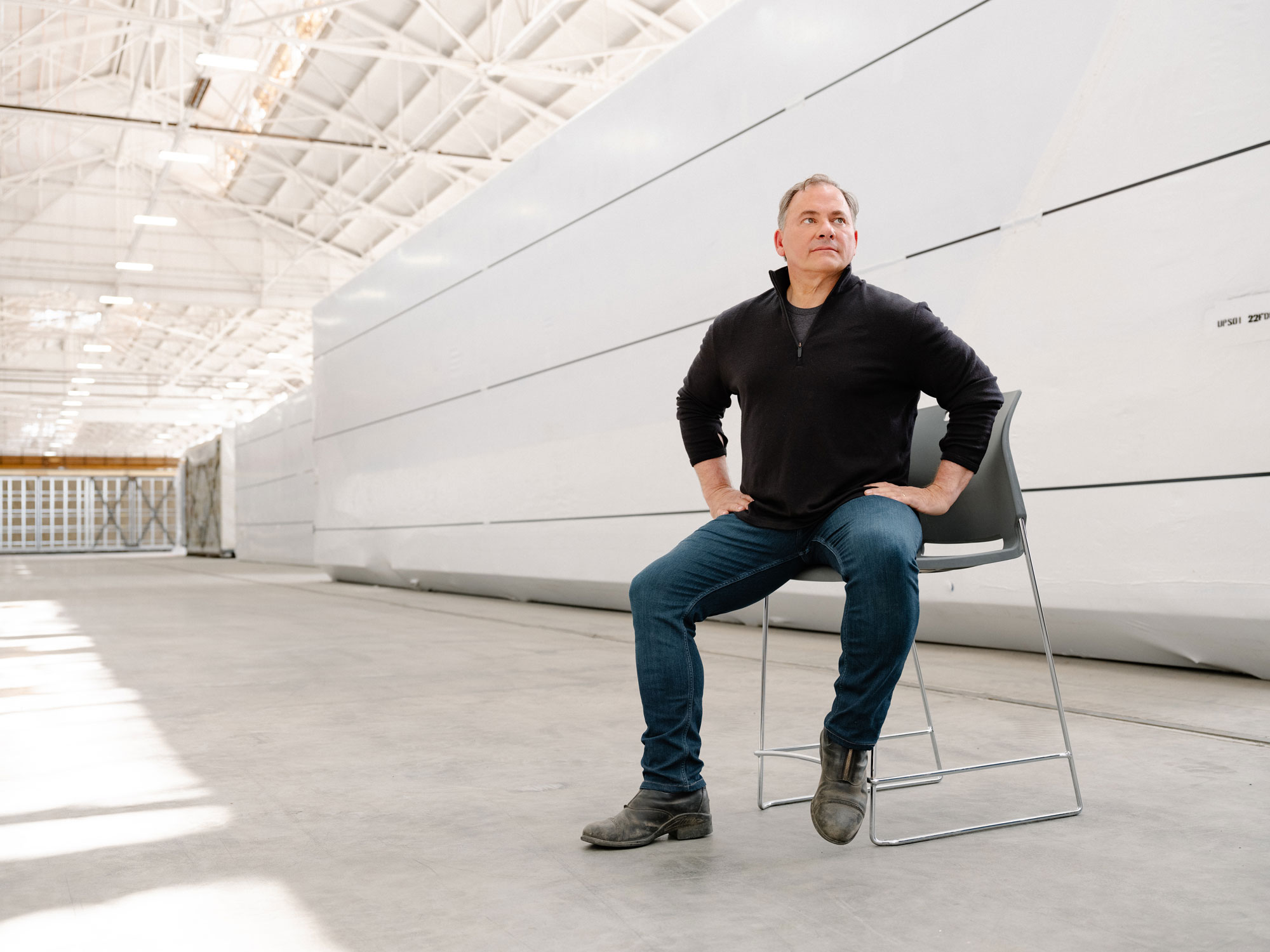
Chris Giattina

That distinction is the whole company. BLOX did not set out to be a bathroom vendor. It set out to build the system - the factory, the software, the method - that could manufacture any complex building. Healthcare was simply the market with the most pain: a pressing need to get good product to market fast in a tight labor market.

The factory's address says the rest. The former railcar plant that once built Pullman cars now builds the rooms where people are born and healed.

The Proof

From exam rooms to a temple

A method is only as good as the buildings it produces. BLOX's first local project, Cardiovascular Associates in Birmingham, put 48 pre-manufactured exam rooms to the test - a partial run of DMC that showed the operational efficiency the model promised. It was a proof of concept hiding inside a working clinic.

From there the reach widened. BLOX has delivered acute-care hospital space in states across the country, fabricating components in Bessemer and trucking them to sites that range from emergency departments to inpatient rehab facilities and primary-care clinics. The components arrive certified and connection-ready, which is the quiet part of the magic - the inspection and the precision happen at the factory, not in the mud of a job site.

The method has also stepped well outside healthcare. When The Church of Jesus Christ of Latter-day Saints built a temple in Helena, Montana, it turned to BLOX's modular process - evidence that a system designed to crank out patient rooms can produce buildings with very different ambitions.

That is exactly the point Giattina has made since day one. The factory was never a toilet shop. It is a general-purpose machine for making complex buildings, and healthcare was simply the first and hungriest customer. The same line that builds a hospital corridor can, with new instructions, build something sacred.

It's changed our DNA.
On what manufacturing did to a 90-year-old architecture practice
The Build Log

From drafting table to factory floor

1992
Joins the family firm, Giattina Aycock (GA Studio), and over time becomes President.
MID-2000s
Leads design of Honda (Alabama) and Kia (Georgia) training facilities - and gets a front-row seat to Eastern manufacturing methods.
2010
Founds BLOX as a spinoff of GA Studio. Headcount: four.
2013
BLOX blows past 350 employees amid roughly 200% annual growth.
2016
The Design-Manufacture-Construct method draws national attention for healthcare prefab.
2020
Featured on Marketplace as prefab's answer to adding critical-care hospital space, fast.
2021
BLOX raises a Series B round, reported near $40M.
2024
Takes the case to the Rotary Club of Birmingham, now leading an ~850-person team.
The Edge

An architect who files patents

Most architects draw. Giattina invents. He is a named inventor on multiple construction-technology patents, including a clip system for attaching finish panels to modular walls - a humble-sounding piece of hardware that lets a panel be nudged into an exact three-dimensional position on the wall. It is the kind of unglamorous detail that separates a slogan about manufacturing from a factory that actually works.

That is the throughline of his career: the romance of architecture married to the discipline of the production line. He talks about making "beautiful, excellent things," and in the same breath about transferable, scalable production systems. Both are true at once, and he refuses to choose between them.

He is also candid about how progress happens. His advice to teams is to study everyone else's mistakes first - and then, having absorbed those lessons, to set out with abandon to make brand-new ones. New mistakes are the price of doing something nobody has done.

In His Own Words

The Giattina file of quotable lines

You can make a whole building in about three weeks and just keep them coming.
We are going to make beautiful, excellent things. That's our vision. It takes an army to do it.
The key is bringing an understanding of manufacturing to design so that its productivity can be realized in construction.
It's changed our DNA.
We focused on health care because there was a pressing need to figure out how to get good product to market in a tight labor market.
It makes sense to everybody, and that's what's fueling our crazy growth.
Marginalia

Five things that stick

We have been extremely disciplined at developing a DMC production system that is transferable and scalable, and it is very much a part of how you make a great building as a product.
The long game, in one sentence

The aspiration is not modest. Giattina wants to industrialize building itself - to make the delivery of a hospital as predictable as the delivery of a car, and then to take that transferable system far beyond Alabama. The healthcare market is where he started, not where he intends to stop. As he puts it, the machine was never about toilets. It was always about making a machine that could make anything.