Charlie Holtz once set himself a professional goal that would have made an unusually good wall decoration: a cease-and-desist letter from LinkedIn. He was building ShlinkedIn, a social network devoted to the sort of corporate language that makes an ordinary Tuesday sound like a hostile takeover. A letter from the original would have completed the joke. By April 2023, he was still waiting.
He had achieved his other aims. He had learned Elixir, the programming language he wanted to try, and given himself and his roommate Sam somewhere to make fun of business speak. Thousands of people had joined. The joke had acquired users, publicity, and the familiar indignity of a database struggling under demand. Satire, apparently, also requires maintenance.
Holtz now runs Conductor with co-founder Jackson de Campos. Their software helps people direct several AI coding agents, keep their work separate, and review the results. The title on his biography is CEO. The project list supplies a fuller introduction: a programmer who will pursue an absurd premise far enough to make it function, then show other people how it works.
A cease-and-desist-shaped hole on the wall
ShlinkedIn began in March 2020. Its premise gave Holtz an excuse to learn a language and an audience a place to perform the excesses of professional self-presentation. He built an open-source network around the gag. The corporate internet had supplied plenty of material; he supplied somewhere to put it.
A feature in the German magazine Der Spiegel brought a rush of signups. That was when he had to work out how to handle database overload. The site also reached the top of Hacker News. Somewhere along the way, there was even a ShlinkedIn Platinum debit card offering two percent cash back. The parody had ventured surprisingly far into the accessories department.
One of his original ambitions was wonderfully specific: “Get a Cease and Desist from LinkedIn to hang on the wall.” It is a revealing choice of trophy. The imagined achievement was a reaction from the institution being teased, something physical to commemorate a joke that had escaped the browser.
The learning project also became part of a longer attachment to Elixir. In his account of his first ElixirConf talk, Holtz traced that interest to watching Chris McCord demonstrate a Twitter clone with Phoenix LiveView. Years later, he was giving his own talk, using the same ecosystem to show what could be built with AI.
A cup of water gets a speaking part
In November 2023, Holtz found another way to make an ordinary activity behave strangely. He connected his webcam to AI software and had it narrate him in an imitation of David Attenborough’s voice. He recorded the demonstration in a library, on a whim. His blue shirt became an occasion for wildlife commentary. Taking a drink acquired the gravity usually reserved for a creature approaching a watering hole.

By his December account, nearly four million people had watched the video. The mechanics were straightforward enough to explain in pieces: take an image, interpret what is happening, turn that interpretation into commentary, and produce spoken audio. The effect depended on those pieces working together quickly enough to feel like a response to the person on screen.
The voice was an unauthorized imitation, rather than an appearance by the broadcaster. That distinction belongs to the story: Holtz had assembled a convincing demonstration from available tools, and the familiar voice was central to its effect. He put the code on GitHub and followed the video with a walkthrough of the components.
- 01LookA webcam captures an image.
- 02DescribeAI turns the scene into commentary.
- 03SpeakVoice synthesis reads it aloud.
The repository made the experiment inspectable. There was a capture script, a narrator script, and setup instructions. Someone amused by the clip could follow the joke into the machinery. That second invitation matters in Holtz’s public work. He regularly leaves a route from watching the result to trying to make something oneself.
Small apps, very particular appetites
His other projects have similarly legible premises. StickerBaker takes a prompt and generates a sticker. BidTacToe auctions the squares of a tic-tac-toe board. In that game, both players lose what they bid, including the player who does not win the square. A familiar diversion becomes a small exercise in the cost of wanting something.
StickerBaker was open source too. It used a model made by fofr and Artificial Guy, with Replicate handling generation. Holtz’s write-up reported more than 100,000 stickers created by users. The architecture allowed generation to continue after someone refreshed or disconnected, with the completed sticker sent back when ready. Behind the little picture sat the less photogenic work of making the application behave.

He also made trailers for films that did not exist, including a New York mystery and an imagined Wes Anderson production. His process began with generated scripts, then moved through narration, video, music, and editing. He found the scripts needed human intervention. One of his adjustments was to have a creature encounter a penguin rather than fungi. The machine could propose a scene; somebody still had to decide what was funny.
Even the less theatrical projects show an appetite for specific conveniences. He built a blogging system around a directory of Markdown files so he could keep writing in Obsidian. A script collected the material, interpreted its metadata, copied images, and prepared posts for his Phoenix site. He published notes on making a copy button preserve paragraph breaks and change its label after use. Small things received actual requirements.
A friendship before a company
Holtz was born in London and lived there until he was seven. At Brown, he studied cognitive neuroscience, received departmental honors, and played ultimate frisbee. He also met de Campos. Their eventual company had a relationship behind it before it had a product to sell.
Before moving west to San Francisco, Holtz worked in quantitative finance at Point72. At Replicate, he became a Hacker in Residence and led growth, building applications used by millions. The public output from that period included demonstrations, code, and explanations: material designed to help somebody understand an unfamiliar capability by seeing it do something.
At ElixirConf 2023, he demonstrated Shinstagram, a simulated social network populated by generative AI agents. The agents could post and respond to one another. His explanation gave them ways to receive events, broadcast responses, and retain information. Years before Conductor’s phone app, he was already experimenting with a world in which several AI participants were active at once.
With de Campos, he also built Shindig, a tool for hosting a party from the command line. Their company biography preserves that detail alongside more conventional credentials. It also says they started the company to build an interface for managing AIs, do work they cared about, and eat plenty of ice cream. The dessert has survived the transition to a hiring page.
Three copies of the same problem
The company began in summer 2024 and joined Y Combinator’s Summer 2024 batch. An earlier product was Melty, an AI code editor. Conductor itself came the following summer, out of a difficulty the founders were encountering in their own work.
They had begun doing much of their development through Claude Code and wanted to run more of it. One experiment involved cloning their repository into three directories and running an agent in each. The founders’ launch account compared the experience to a Subaru fitted with a jet engine. There was power available. The arrangement around it was becoming awkward.
Conductor supplied isolated workspaces and a place to see what the agents were doing. A person could start work, inspect the changes, and merge the results. The steps are unglamorous, which is part of their significance. As more code is produced in parallel, keeping track of it becomes a larger part of the working day.
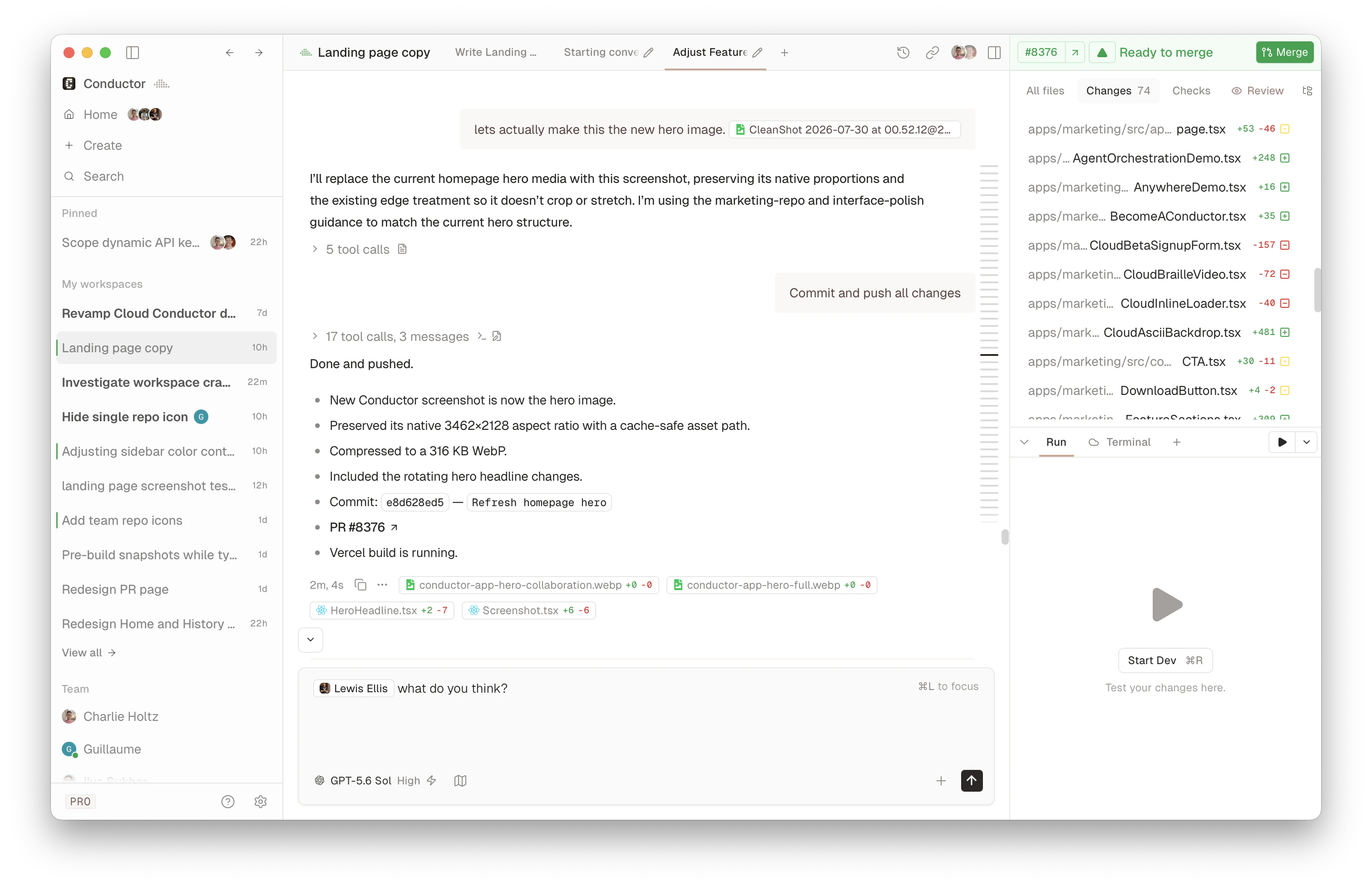
In a June 2026 walkthrough, Holtz showed how that day felt from his desk. A cheap gooseneck microphone let him speak quietly to the computer in an open office. He moved among agent tasks, reviewed work, and described why he wanted a visual interface. The software had to accommodate a person following several activities, each with its own state and next decision.
“humans are spatial visual creatures”
Charlie Holtz, discussing his coding setup
He also described limits on what he would delegate. Architecture and carefully made interface details still called for human judgment. Certain files received particular protection. His enthusiasm for generating software sat alongside choices about where to slow down and look closely.
The baton leaves the desk
On March 30, 2026, Holtz and de Campos announced a $22 million Series A from Spark and Matrix, with participation from other backers. Their stated ambition extended beyond small teams of agents on MacBooks to much larger AI organizations, accessible across devices and infrastructure.
Conductor’s announced Series A financing.
October brought a concrete extension of that ambition. Conductor’s iOS release let users chat with agents and merge pull requests in cloud workspaces. On October 23, a remote-control release added access to local Mac workspaces from an iPhone, including reading chats, sending messages, choosing models, and stopping agents.
The settings and release notes are a long way from ShlinkedIn’s hoped-for wall decoration. They belong to the same working life, though: find an idea worth trying, build an interface around it, and discover the complications when somebody uses it. Holtz has moved from a computer describing his cup to computers helping write software. There are more participants now. He is building somewhere to keep an eye on them.