Chuck Winner had an awkward opinion about a useful source of income. He made a living helping people win ballot campaigns, yet he thought the initiative process was being abused. In 2006, he put the difficulty with admirable economy: “They’re good for me, maybe, but bad for the country.” A consultant had delivered a verdict that would have made a rather unhelpful advertisement for his own services.
His objection concerned responsibility. Legislatures, he argued, could use ballot measures to avoid controversial decisions. Voters were being asked to settle questions their representatives ought to confront. The criticism came from someone who understood how a campaign was assembled, from research and advertising to the effort to get supporters to vote. He knew the machinery well enough to have doubts about where it was taking people.
That is a useful place to meet Charles “Chuck” Winner. The founder of Winner & Associates moved through politics, corporate communications and Thoroughbred racing. Across those settings, he worked close to decisions that other people would have to accept, reject or live with. His career rewards attention to the gap between securing a result and being satisfied with the arrangements that produced it.
The job that interrupted UCLA
Winner’s political education began early. At John Marshall High School in Los Angeles, he joined the Young Democrats. By 1958, he was working for Pat Brown’s gubernatorial campaign. California politics gave him an entrance into a profession whose practical work often takes place well away from the person making the speech. He would eventually serve Brown as Southern California secretary and travel secretary in 1965 and 1966.
Before that came an invitation with consequences for his university plans. While attending UCLA, Winner worked with the Democratic National Committee. After the 1960 Democratic convention, Kennedy’s team offered him a place on the nominee’s political advance operation. He took the job and left school. The choice changed his working life, although it did little to diminish his affection for UCLA. He remained a Bruin supporter.
The sequence afterward was less cinematic and more instructive. From 1966 to 1969, he was a founder and partner at Cerrell Winner and Associates. From 1969 to 1975, he consulted on local, state and federal campaigns. These were years spent inside the practical business of politics. The later corporate adviser had first worked among people who could receive a very direct public answer on election night.
Twenty-five years without a brochure
In 1975, Winner founded Winner & Associates. A quarter of a century later, the firm had an unusual distinction for a public relations business: it had never printed a promotional brochure. In March 2000, when Publicis acquired a majority interest, a website was still a proposed addition. Someone advising other people about their public image had allowed his own business a remarkably modest wardrobe.
There was a substantial operation underneath. The firm disclosed $7.3 million in 1999 revenue when the acquisition was announced. Winner continued as president and chief executive. He had already worked with Publicis on international projects and said he had not been seeking a buyer when the idea was put to him. He considered it, agreed, and kept his leadership role. The purchase price was not disclosed.
Winner & Associates’ disclosed 1999 revenue.
A company figure, in the year before its Publicis deal.
The firm’s work crossed reputation, public affairs, litigation communications and advertising. Its stated approach began with a client’s business objectives and the relationships affected by a problem. That description helps explain why the founder’s political experience remained relevant. A company facing public disagreement has audiences with different interests, just as a campaign does. A neat message must still encounter people with reasons to question it.
Winner also founded Winner & Mandabach Campaigns, dated to 1985 in his later appointment biography. The ballot practice and the corporate consultancy belonged to the same professional life. His criticism of initiatives therefore had a particular weight. He was willing to question an institution while continuing to understand and work within it. That position is uncomfortable, which is part of what makes it interesting.
Washington, translated in Tokyo
His work acquired an international setting. In September 2007, Publicis Consultants and Akin Gump announced an alliance for responding to legal, political and communications problems across borders. China was the first focus market. Winner was named the chief manager for the Publicis side, bringing together his Los Angeles presidency and his leadership of the network’s crisis response team.
The timing mattered. Beijing’s 2008 Olympics and Shanghai’s 2010 World Expo were approaching. Winner anticipated closer American and European scrutiny of multinational companies’ activities in China. The alliance joined lawyers and communications specialists around problems that could travel between jurisdictions. For a consultant who had begun in California campaigns, the audience had grown geographically larger and institutionally more complicated.
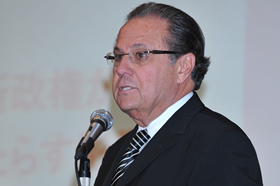
In February 2009, he addressed Japanese business executives at the Industry Club of Japan in Tokyo. Roughly 100 participants attended the seminar. Obama had just entered the White House, and Winner explained priorities including economic stimulus, employment and energy policy. His advice included understanding American government and Congress, building relationships and communicating with decision makers. The invitation was to pay attention before events forced the issue.
The photograph catches him at a microphone, glasses on, mid-explanation. It is an ordinary working image, which suits the occasion. His assignment was to help an audience understand a political environment affecting its business. The task had recognizable roots in his earlier career: learn the institutions, identify the people involved and understand the decision they are approaching.
A lunch, a flight, a filly
Another part of Winner’s life began with lunch. A conversation with a friend led him and his wife, Annie, to buy their first racehorse. His involvement in racing dated to the mid-1980s. An introduction became a sustained interest, and the interest required study. He bought books and read about horses’ conformation and bloodlines. A horse offers its owner plenty to learn and limited opportunities to bluff.
He wanted to inspect prospective purchases himself. When horses in Newmarket were recommended, he flew to England to look. Among his choices was Magical Fantasy, a filly by Diesis. She went on to win four Grade 1 races for Winner and his partners, David Bienstock and Paul Mandabach. Their campaign with her produced more than $1 million in earnings before she sold at auction for $1.8 million.
The figures belong to a racing partnership, rather than a measure of Winner’s personal fortune. The more revealing detail is the flight. He could have treated ownership as a distant financial interest. Instead, the inspection became part of his participation. Mandabach, a name already attached to his campaign business, was also there in the ownership of a racehorse. Professional and sporting connections overlapped.
His other partnerships included Daytona, Domestic Dispute, The Pamplemousse and Walkslikeaduck. The names provide some welcome relief from the vocabulary of strategic communications. By 2019, his racing involvement also included an advisory position with the California Retirement Management Account. That August, The Jockey Club announced his election among six new members. The lunch conversation had acquired a long aftermath.
“I try to make a real commitment.”
Chuck Winner · 2012
A seat on the other side of the table
Governor Jerry Brown appointed Winner to the California Horse Racing Board in 2012. In December 2013, his fellow commissioners elected him chairman, effective January 6, 2014. He succeeded David Israel. Bo Derek was elected first vice chair and Richard Rosenberg second vice chair. Winner’s place in racing now included public responsibility for the industry in which he owned horses.
The change of seat matters. A consultant works for a client; a commissioner takes part in decisions made under public authority. The board’s annual report described a seven-member body, with at least four members required to concur in official action. Whatever experience Winner brought to the chair, the office operated through colleagues, meetings and collective decisions. An adviser’s familiarity with a field had become one contribution to its regulation.
He was reappointed in 2015 and completed his second term in July 2019, having decided against seeking another appointment. Looking back, he called the seven years challenging and fulfilling. He died on March 24, 2022, aged 81, leaving Annie and four children: Justyn, Ethan, Nicole and Zach. His career had extended from campaign work in the 1950s to international counsel and a public board.
The affection around him could accommodate a joke. Remembering Winner, David Israel made room for his devotion to the Los Angeles Clippers alongside his family, California and horses. It is a pleasingly local detail in a career that reached overseas. There were institutions to advise, races to watch and a basketball team that still commanded his loyalty. Public life did not occupy every seat.
Winner’s farewell to the board ended with a modest hope that he and his colleagues had made a positive difference. It sits well beside his doubts about ballot politics years earlier. A victory can be counted. The value of the system producing it takes longer to judge. Winner had spent much of his working life helping people win, while retaining enough interest in the larger question to ask it aloud.