Cathleen Kuo's first American history lesson arrived before she could understand much of American history. She had grown up in Taiwan and came to the United States with little English. In that first classroom, she has recalled, the language narrowed to two reliable islands: “hello” and “thank you.” It is the sort of detail that turns an abstract phrase like language barrier into something physical. A teacher is speaking. A room is moving forward. You are present, alert, and still standing outside the meaning.
Kuo learned English. Her parents did not become fluent, and the family organized parts of life around places where they could be understood. Years later, during her medical training, she encountered the same problem from the other chair. The setting had changed from a school desk to clinical rooms, but the awkward machinery was familiar: a person with something important to say, a professional who needed to understand, and an interpreter who might take time to arrive.
That distance between presence and comprehension became the problem around which Kuo built Opalite Health. The San Francisco company supplies real-time AI medical interpretation inside existing clinical workflows. Its premise is practical. If communication is part of the work, the interpreter should be available when the conversation begins. The challenge is equally practical: in medicine, a nearly right sentence can be a very wrong sentence. Speed earns attention; reliability earns a place in the room.
“Before we could even think about the market, we had to get the model right: the data, the training, the validation.”Cathleen Kuo, on building Opalite
A researcher before a pitch deck
Kuo did not arrive at software by becoming bored with science. She arrived through science, carrying its habits with her. At Tulane University she studied neuroscience, worked in a research lab, and led supplemental instruction for calculus-based physics. At the University at Buffalo's Jacobs School of Medicine and Biomedical Sciences, she trained as a physician while working with the university's neurosurgery researchers. She also spent time with the Johns Hopkins Neuro-Oncology Surgical Outcomes Lab.
The publication count attached to her name is startling mainly because of the variety beneath it. Her public research profiles list more than 200 works crossing neurosurgery, radiology, clinical outcomes, machine learning, and related fields. One paper put her in a co-first-author role on a meta-analysis of randomized trials. Other projects examined predictive scores, treatment outcomes, and online calculators designed to make complex evidence usable. The connective tissue is not a single specialty. It is the conversion of messy clinical information into a decision someone can use.
There is an occupational difference between admiring artificial intelligence and validating it. Kuo's record belongs to the second camp. Her name appears on a patent filing for detecting hallucinations in large language models and another for applying machine learning to medical prognoses and outcomes. Both point toward the same instinct: clever output is insufficient when the user needs to trust what happens next.
The respectable path, deferred
In May 2025, the University at Buffalo commencement program listed Cathleen Chenyu Kuo among its MD candidates. Beside her name, where a residency destination would ordinarily appear, were two words: deferred residency. They hold an entire career decision in miniature. Medical school produces a famously legible next step. Kuo chose a less legible one and continued building the company she had co-founded with Alex Mehregan.
This was not her first experiment with entrepreneurship. She had co-founded Med-DX, a medical education venture, and joined Foundation Capital's Build Cohort in 2024. Those experiences put company-building vocabulary around a problem she already knew intimately. Research asks whether an intervention works. A startup adds other impolite questions: Will anyone adopt it? Can a small team deliver it? Does it fit the budget, the shift, the software, and the five minutes a user actually has?
Mehregan supplied a complementary biography. He had worked at Apple on Siri and system experience, writing software used at enormous scale. Kuo knew clinical environments, research design, and the emotional geometry of speaking through a third party. Their pairing made the company's central tension unusually clear. Conversation should feel effortless, while the system underneath it must handle latency, terminology, privacy, context, and the possibility of error.
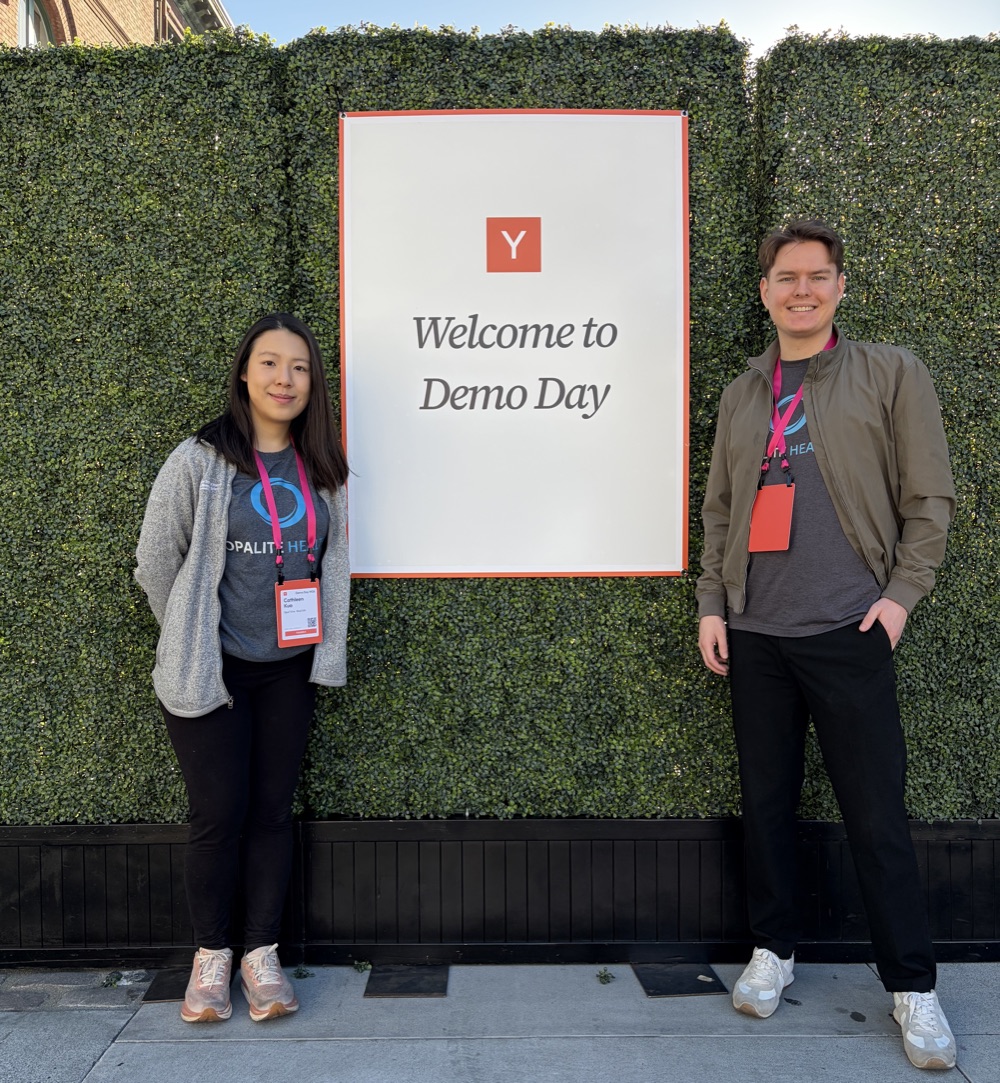
Opalite joined Y Combinator's Winter 2026 batch. Its public description emphasized software that works inside the tools providers already use, an unglamorous product choice with considerable consequences. Workflow is where good intentions go to acquire passwords, permissions, and a queue. A useful clinical product cannot merely demonstrate intelligence. It has to appear at the right moment without creating a fresh ritual around itself.
Founder-market fit can be a stack, not a single credential: lived context, domain training, evidence habits, and a partner whose skills fill the missing edge.
What a small company chooses to measure
Opalite's company principles offer a concise view of Kuo's operating philosophy. The team talks about users first, measurable impact, higher standards, integrity, and curiosity paired with decisive movement. Corporate values are famously easy to typeset. Their usefulness appears when they force an inconvenient choice. In interpretation, the inconvenience is everywhere. A system can be fast but clumsy with a clinical term. It can sound fluent while dropping a negation. It can be impressive in a demo and awkward during an ordinary appointment.
Kuo's answer has been to make evaluation part of the company story rather than a technical appendix. In spring 2026, research comparing AI medical interpretation with certified human interpreters was presented at the Pediatric Academic Societies Meeting in Boston. Her public posts from the meeting focused on responsible adoption and language access, with thanks to physician collaborators who helped present and advise on the work. The posture is revealing: build, test, bring other experts into the argument, then keep building.
The interesting unit is not a translated word. It is a conversation that preserves meaning, arrives on time, and fits the work already happening.The operating problem behind Opalite
That approach also explains why her research background matters beyond biography. A publication is an invitation to have a claim examined. A clinical AI company needs a version of the same temperament, because fluency can disguise uncertainty. Kuo's career has trained her to ask how an answer was produced, which data shaped it, what outcome was measured, and where the model is likely to fail. Those are less cinematic questions than “Can the machine do it?” They are also the ones that determine whether anybody should use it.
A year of public proof points
The founder story goes on air
Kuo joined the Vesting podcast to talk about moving from the physician track into a Y Combinator startup.
Research reaches the conference floor
Collaborative validation work on AI medical interpretation was presented at the Pediatric Academic Societies Meeting.
A new accelerator
Opalite was selected for Tampa Bay Wave's Tech|X Accelerator, powered by The Nielsen Foundation.
Another institutional backer
The company announced an investment from Robinhood Ventures Fund II and outlined plans to expand language coverage and integrations.
The milestones show a founder moving through several rooms at once: the research conference, the accelerator cohort, the investor announcement, the customer conversation. This is the operator portion of Kuo's job, less visible than the origin story and more decisive over time. A CEO must translate between technical claims and organizational needs, between a product roadmap and what a clinician can use on a Tuesday afternoon. In a pleasing bit of symmetry, the founder of an interpretation company has become an interpreter among disciplines.
The sentence beneath the company
Kuo has said that Opalite began with watching her parents struggle with language barriers and later seeing the same barriers during medical training. The statement does something tidy founder stories often avoid: it places two kinds of authority beside each other. She knows what it is to belong to the family trying to be understood. She also knows what it is to be the professional responsible for understanding. Neither view is complete alone.
Her aspiration is broad: make healthcare communication universal. The daily work is narrower by necessity. Improve the model. Validate it. Fit it into existing systems. Cover another language. Listen to another clinical team. A grand mission survives by submitting to a long list of small, testable verbs.
This makes Kuo's story useful beyond healthcare or AI. Careers are often explained as a sequence of titles, but hers reads better as accumulated attention. A childhood spent noticing where language opened and closed doors. Undergraduate years learning how evidence is made. Medical training spent watching information move through institutions. Research that converted data into tools. Early startup work that exposed the difference between an idea and an operation. None of these chapters announced Opalite in advance. Together, they made it possible.
The result is a company built around a modest human hope: when someone speaks, the person across from them understands. Technology likes to advertise the future. Kuo's project is concerned with the next sentence. That may be the right scale at which trust begins.