It is 2:14am in a 280-room hotel in Houston. The phone rings. A guest, somewhere on the fourth floor, needs an extra pillow, a 6am cab, and possibly a human being. The night auditor is already on another call. The line does not go to voicemail. It goes, instead, to Canary.
The voice that answers is conversational, unhurried, and aware that the cab is forty-eight minutes out. It books the cab. It logs the pillow request to housekeeping's queue. It does not breathe heavily. The guest, who has had a long day, says thank you to a machine and does not seem to mind.
This is the bet Canary Technologies has been making, quietly and then loudly, since 2017: that the front desk - the most analog place in a fundamentally analog industry - is actually a software problem.
01The Problem They Saw
Hospitality is a $4 trillion industry that still asks guests to fax credit card authorizations. That is not a joke. Until very recently it was company policy at chains you have heard of. Hotels lose serious money to chargebacks, no-shows, abandoned upsells, and the strange institutional inertia that keeps a fax machine plugged in next to a Square reader.
The deeper problem is staffing. A modern hotel has fewer people on duty than it did in 2019 and more channels through which guests expect to communicate: SMS, WhatsApp, webchat, voice, kiosk, app. The math does not work. Either the guest experience degrades or someone builds software that takes the calls.
02The Founders' Bet
Harman Singh Narula and SJ Sawhney met as friends. They became co-founders because Narula - Cornell Hotel School, Wharton MBA, ex-Bain, ex-Starwood - had spent years watching the back office of hospitality and concluded the most important workflow in the industry was an Excel sheet. Sawhney had built and sold technology before, including a stint leading product at Stayful.
Their first product was deliberately unglamorous: digital credit card authorizations. PCI Level 1 compliant. The pitch to hoteliers was not "we will change your life" but "you will stop getting sued." It worked. Independents signed first, then management companies, then, eventually, the brands.
The unsexy wedge.
Canary started by selling something a CFO could approve in under five minutes. By the time anyone noticed, the company had a Salesforce-backed sales motion and a wedge inside thousands of properties. The AI came later - which is, of course, the right order.
Wedge first, vision second. The reverse rarely works.
// Milestone timeline
03The Product
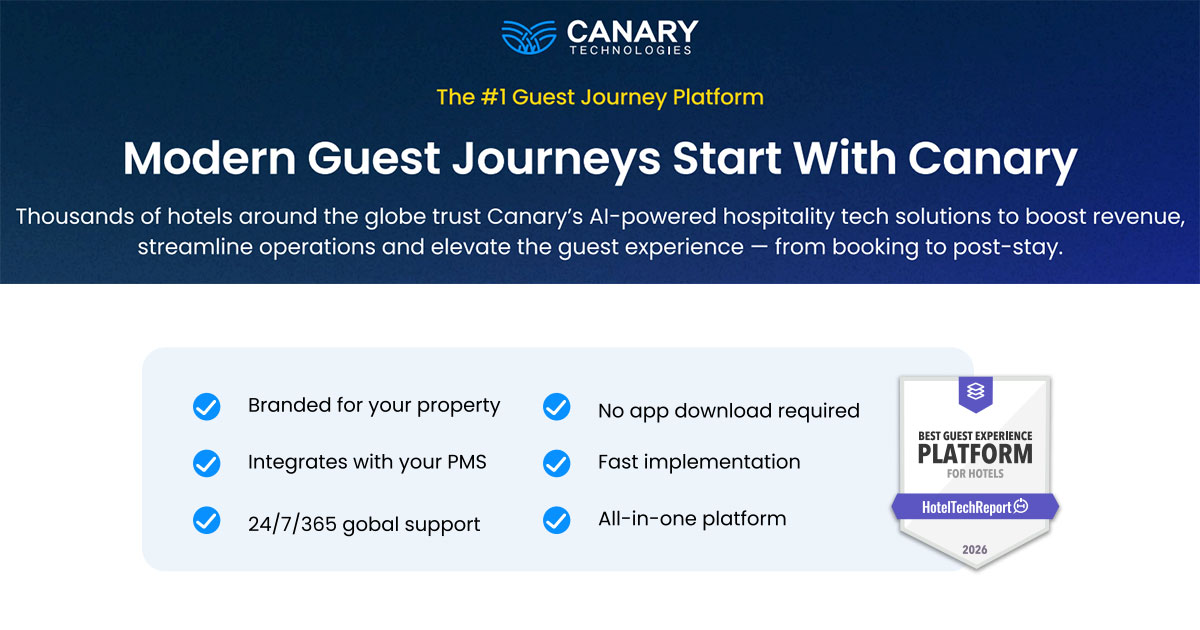
What Canary sells today is best described as an operating system for guest interactions. There are seven product lines and they tend to be bought in sequence. A hotel starts with Digital Contracts because it solves a legal problem. It adds Mobile Check-In because guests started expecting it after 2020. It adds Dynamic Upsells because the math is hard to argue with. Then, when the staffing shortage gets sharp enough, it adds AI Webchat and AI Voice.
AI Voice
The headline product of 2025. It handles bookings, modifies reservations, surfaces upsells, and routes the calls a human should actually take. It picks up on the first ring. Read the product page.
AI Webchat
The chatbot that resolves roughly 90% of inbound guest questions on a hotel's website - and nudges the remaining 10% toward a direct booking, which is the only kind of booking a revenue manager actually loves.
Mobile Check-In, Upsells, Digital Tipping, Messaging
Adjacent products that all share one ambition: replace the small frictions that used to require a person standing behind a podium with a smile and a name tag.
04The Proof
The customer list is the part that makes investors nod. Marriott International. Wyndham Hotels & Resorts. Four Seasons. Choice Hotels. Best Western (BWH). IHG. Aimbridge. TUI. The kind of logos that take eighteen months to close and then never leave.
// Canary funding stack
Series A through Series D, in millions USD.
Brighton Park led the most recent round. Insight, F-Prime, Thayer, Commerce, and Y Combinator stayed in.
The lighter proof is the reviews. HotelTechReport, which is the hotel industry's Consumer Reports, has named Canary AI Voice the Best Hospitality Solution. The heavier proof is the renewal math nobody outside the company has seen, but which $80M in Series D capital tends to imply.
05The Mission
If you ask Narula what Canary is, he will say: the operating system for hospitality. This sounds like the kind of phrase a founder uses when they have raised a Series D. It is also the strategically correct phrase. PMS systems own the room ledger. CRMs own the email list. Nobody, until now, owned the conversation - the phone call, the webchat, the SMS, the check-in tap, the upsell decision.
That layer, if it exists at all, is where Canary intends to sit. It is a smaller business than a PMS replacement, but it is a faster one to deploy and a stickier one to remove. Every additional product compounds the lock-in, which is a phrase venture capitalists love and product managers should be honest about.
06Why It Matters Tomorrow
Voice AI will be the first consumer-facing AI most people use without realizing they are using it. Hotels are the perfect environment for that bet: high-volume, repetitive inquiries; clearly defined success criteria; thin margins that reward automation; and a workforce already squeezed thin. The chains that adopt now will, in two years, look like the chains that adopted online check-in in 2012. The ones that do not will look like the ones still asking guests to fax things.
Canary's competitors - Akia, Duve, Revinate, Operto, the messaging features inside PMS incumbents - are not standing still. The race is on for a layer of the stack that did not exist three years ago. Whoever wins it gets to charge a small toll on every guest interaction at every hotel on earth. That is the kind of business you raise $80M to build.
Back in Houston, the guest on the fourth floor has hung up. The cab arrives at 5:58am. The pillow is delivered before 3am. The night auditor, who never picked up because she did not have to, finishes the audit at the time it was supposed to be finished.
None of this is dramatic. That is the point. The best software is the kind that disappears into the workflow it replaced. Canary Technologies is busy disappearing into hotels at a rate of several thousand a year. By the time anyone looks up and asks who built this, the answer will already have been obvious for a while.
07The Files
Where to go next.