The first thing to understand about Bravo Group is that it does not really sell press releases. It sells the moment after the press release - the vote, the signature, the appropriation, the parent who comments on a proposed regulation. This is a useful distinction in an industry fond of measuring how many people might have glanced at something. Bravo's favorite unit is movement.
The firm sits in Harrisburg, two blocks of political weather away from Pennsylvania's Capitol. Chris Bravacos founded it in 1999 after working for members of Congress, running the state Republican Party and serving in Governor Tom Ridge's administration. His founding proposition was borrowed from campaigns: decide what victory looks like, find the people who can produce it, learn what moves them, then coordinate every available instrument until the result arrives.
That proposition now supports a privately held strategic communications business spanning government relations, advocacy, research, branding, creative, media, digital marketing and fundraising. Bravo works for corporations, causes and governments, especially in the regulated, politically exposed worlds of health care, life sciences, education, energy and infrastructure. Its own 25-year accounting lists 592 clients and 350 employees and interns cumulatively through 2024. The supplied company estimate puts annual revenue near $11.5 million.
The campaign hiding inside the brief
A conventional agency might divide a problem into departmental trays: research over here, media over there, government relations down the hall. Bravo's argument is that public problems ignore the trays. A legislator hears from a lobbyist, reads the newspaper, notices constituent email and checks the public mood. The client therefore needs one campaign rather than a neat pile of deliverables.
Consider 143K Rising, a coalition Bravo created when proposed changes threatened funding for Pennsylvania's 143,000 charter-school students. The firm recruited families through partners and digital advertising, amplified their individual stories, and trained parents to advocate. The funding cut did not happen. Later, more than 1,000 parents commented on proposed charter regulations. The work traveled from audience research to storytelling to organized action and finally into the public record.
The same logic appears in Bravo's longer scorecard: work with the American Cancer Society on Pennsylvania's Clean Indoor Air Act; a campaign supporting a $70 million fund that brought broadband to public schools; help establishing an education tax-credit program that had grown to $500 million by 2024; and a push with Comcast Spectacor to legalize charitable 50-50 raffles at sporting events. These are claims made by the firm, but they are also revealing choices. Bravo recounts laws, dollars and actions. It does not lead with impressions.
“Focus on action, not just awareness.”Bravo Group's advice for choosing a marketing partner
What failed first was the telephone
Every campaign depends on listening. By the middle of the last decade, the old listening device was failing. People had abandoned landlines and learned to treat an unfamiliar number as a small electrical threat. Phone-survey response rates had fallen sharply. A poll could still produce decimals, but reaching a representative set of humans was becoming harder and slower.
In 2015, Bravo built Beagly, its own digital opinion platform. Owning the machinery gave the firm control over questionnaire structure, participant recruitment and data validation. Surveys could meet respondents on mobile devices, use several recruitment routes and return directional insight quickly. Bravo says its research spotted danger for Senator Bob Casey's seat in October 2022, two years before he lost it, and that a small digital sample accurately called Larry Krasner's 2017 Philadelphia district-attorney primary victory.
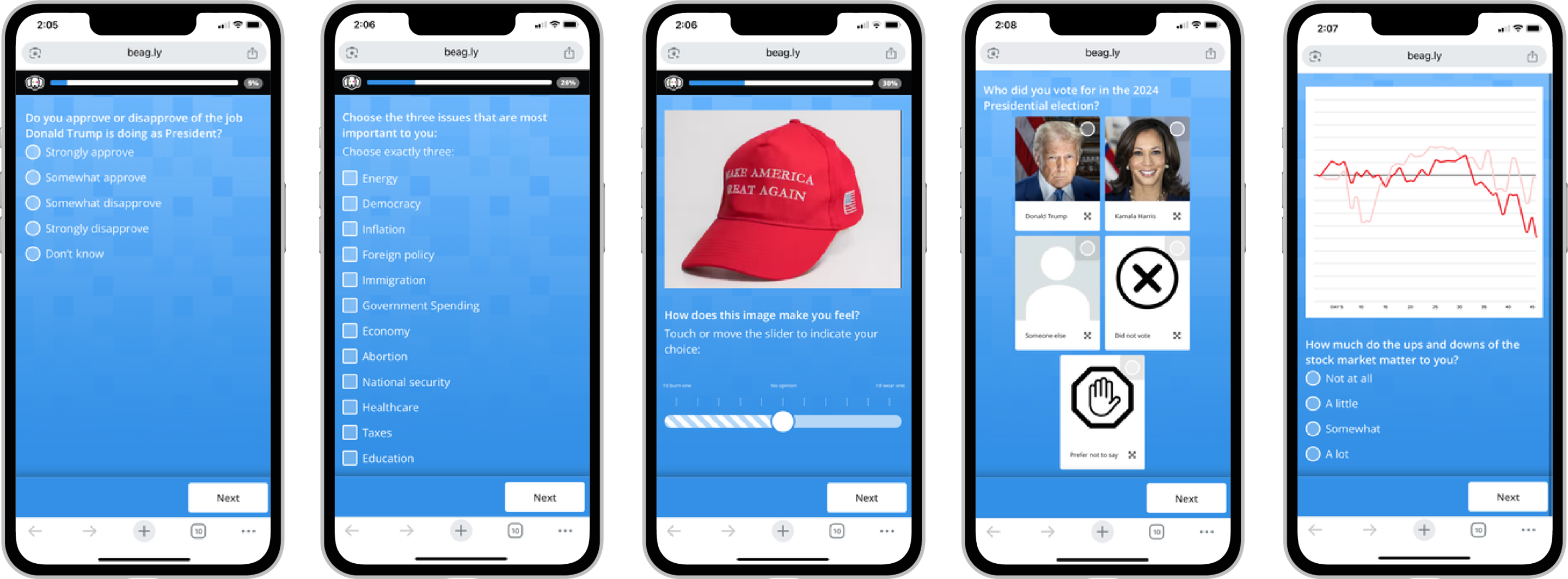
The strategic turn matters more than the software. Bravo decided the legacy method no longer matched human behavior, then made research infrastructure part of its differentiation. A client can hire a pollster, a lobbyist and a creative agency separately. Bravo offers one shop that can ask what people think, decide which opinion matters, shape a message around it and carry that message into a policy fight.
Scrapple becomes the shop window
For a decade, Beagly mostly lived behind client work. In March 2025, Bravo put a public product on top of it: Morning Scrapple, a monthly survey of Pennsylvania opinion named for the state's beloved and disputed breakfast meat. The newsletter and interactive dashboard track approval, elections and issues while letting readers cut results by region, party and demographic.
The move is clever because it turns marketing into evidence. Instead of telling prospective clients that Bravo can field research quickly, the firm publishes a fresh example every month. Polls typically take 48 to 72 hours to field. The inaugural edition was cited by The Philadelphia Inquirer. By early 2026, PennLive had signed on as co-branding partner, receiving 48 hours with the results before they were released publicly.

The transparency is unusually interesting. For its August 2026 wave, Morning Scrapple reported 711 completed surveys, 335 starts, 502 quality or logic terminations and 33,535 invitations that produced no entry - a 2.1 percent response rate. The sample was weighted by age, gender and party. The result came with a model-based credibility interval, not the margin of error associated with a probability sample. Bravo also publishes questionnaire wording and describes speed checks, device validation, duplicate screening and patterned-response detection.
Those numbers do not make digital polling magic. They make it inspectable. An opt-in survey is strongest when the target population can be reached online, the weighting variables are sound and the desired answer is directional rather than falsely precise. It is less persuasive for tiny or poorly connected populations, questions with weak benchmarks, or decisions that demand probability sampling. The useful habit to copy is not “put every poll online.” It is to expose the method, the rejected data and the uncertainty alongside the result.
A company built like a campaign room
Bravo describes its culture in five short rules: move fast, keep individual ego low, lead, use less hierarchy and put integrity first. They sound like operational necessities. A policy fight does not pause while a deck tours seven layers of approval. The person closest to a sudden development needs permission to speak. Credit is less useful than coordination.

The business still depends on relationships. Its government-relations roster includes people seasoned in state agencies, legislative offices and regulated industries. In 2024, State Street Advisors principals Dick Hayden and Jeff Sharp joined, adding depth in health care, life sciences, energy, insurance and environmental matters. A Washington practice gives the firm a federal line of sight. The creative and research sides keep those relationships from becoming the only product.
That is where Bravo fits in the market: larger in capability than a lobbying boutique, more politically fluent than a general marketing agency, and more execution-minded than a research vendor. It is not the right machine for every assignment. A quick consumer promotion may not need coalition mapping; a neutral academic study should not begin with a preferred policy result. But when reputation, regulation and public behavior collide, the campaign room makes sense.
Twenty-seven years after its founding, Bravo's most instructive product is a bowl of polling named after leftovers. Morning Scrapple works as research, media property and continuous sales demonstration. It shows that the firm can find an audience that no longer answers the old call. More importantly, it shows the call was never the point. The answer was.