Healthy Aging · Health-Tech Profile
BOLD.
Movement, prescribed. A fitness company that treats aging like the medical event it actually is.
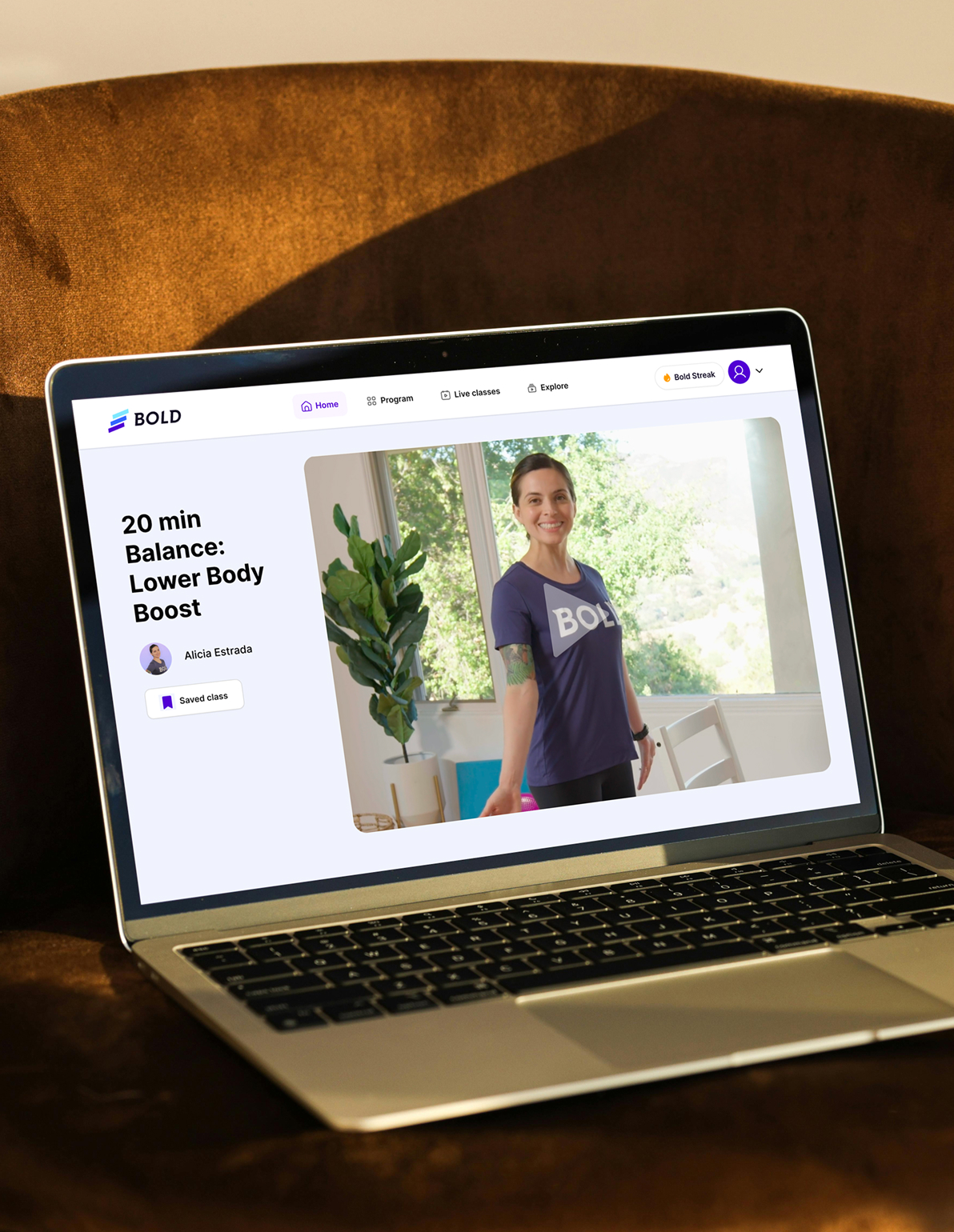
Movement, prescribed. A fitness company that treats aging like the medical event it actually is.
Somewhere, a 73-year-old is standing on one foot in front of a television, following a coach she has never met, doing the single most cost-effective thing in American healthcare: staying upright.
That is Bold's whole business, and it is stranger than it sounds. The company does not sell a gym. It does not sell a wearable. It sells the idea that the next fall - the one that turns an independent life into a hospital bill - can be prevented by a few minutes of the right movement, delivered to the right person, before anything breaks. Roughly 12 million Medicare members can now access Bold at no cost. Most of them have never heard the phrase "movement as medicine." They just know they feel steadier.
Bold doesn't sell exercise. It sells the fall that never happened./ The thesis, in one line
The American system is built to react. A senior falls, an ambulance arrives, a hip is replaced, a rehab is billed - and the machine performs beautifully, at enormous expense, after the worst has already happened. The part nobody got paid to do was the cheap part: keeping the person strong enough not to fall in the first place.
Aging, of course, is not a disease. It is the one condition every customer is guaranteed to develop, which is presumably why the industry spent decades pretending it wasn't a market. Falls are the leading cause of injury for older adults. Strength and balance decline quietly, for years, with no alert and no claim code - until there is suddenly a very large claim code.
Prevention has always been the best medicine and the worst business model. Bold's bet was to fix the second half./ On the economics of staying well
Bold's founders looked at a generation of people aging at home, mostly alone with their decline, and saw not a sad inevitability but a design problem. The tools existed. The science existed. What was missing was a way to put both in the living room - and a payer willing to fund it.
Amanda Rees was in her 20s, caring for her grandmother, when she learned what the brochures leave out: that the terror of aging in place is not dramatic. It is the slow administration of small risks - a rug, a step, a moment of unsteadiness - any one of which can end independence. She had a Princeton degree and a front-row seat to a problem nobody had productized.
She teamed up with Hari Arul, whose background spanned healthcare software and venture capital - the rare combination of someone who could both build the thing and understand who would pay for it. Their bet was specific and a little contrarian: that older adults would happily exercise if a program met them where they were, and that Medicare plans would happily fund it if the math worked. Both halves had to be true. Neither was obvious in 2019.
Princeton '12. Became a caregiver in her 20s, then turned that experience into a Medicare-scale platform. The North Star she keeps repeating: make people's healthspan match their lifespan.
Came from healthcare software and venture capital - the person who could translate a clinical mission into a business plan that payers would actually sign.
Bold was designed to increase healthspan for older adults - accessible, easy-to-follow programs that improve strength, reduce falls, and promote lifelong well-being./ Amanda Rees, Co-Founder & CEO
"Exercise for seniors" usually means a single program pointed at a 40-year age range as if everyone in it had the same knees. Bold's premise is the opposite: it assesses the individual - their balance, their pain, their arthritis or diabetes - and builds a routine for that body, then adapts it as the body changes. The output looks simple from the couch. The personalization underneath is the point.
Science-backed routines for balance, strength, mobility, and pain - tuned to chronic conditions like arthritis and diabetes, and re-tuned as you progress.
Thousands of classes, expert talks, and badges. Balance training, quietly turned into something you want to come back to.
Age-friendly telehealth with doctors and physical therapists, clinical assessments, and navigation - so movement connects to medicine.
Nutrition guidance and weight-loss support, including GLP-1 prescription pathways through virtual care.
Most apps ask older adults to adapt to the software. Bold built the software to adapt to the older adult./ On why personalization is the product
Amanda Rees and Hari Arul found Bold in Los Angeles to make movement accessible medicine for older adults.
Andreessen Horowitz leads a $7M seed round; Khosla Ventures and Primetime Partners join the cap table.
Bold lands inside plan benefits like UnitedHealthcare's Renew Active and partners with providers including Ochsner Health.
Rethink Impact leads a $17M Series A with Samsung Next and existing backers - total funding reaches $27M.
A health-system analysis shows a 40% reduction in falls and related hospitalizations among Bold members.
Bold is available at no cost to roughly 12 million Medicare members nationwide, with exercise, care, and nutrition under one roof.
A wellness company can claim almost anything. A company billing Medicare plans has to show its work. Bold's case for being funded as preventive care rests on outcomes that partners can put against their own claims data - and so far, the math has held.
Bold has been life changing for me physically, cognitively, and emotionally.— Sarah M., 67, Bold member
Now I can do five 45-minute live classes.— Greg L., 73, Bold member
The distribution is the other half of the proof. Bold doesn't ask seniors to find it; it arrives inside benefits they already have - Renew Active, One Pass, provider partners like Ochsner Health. The member pays nothing. The plan pays for an outcome. It is the kind of alignment that healthcare keeps promising and rarely builds.
We added years to life and forgot to ask what those years would feel like. Bold's mission is to close that gap - to make the extra decades ones people can actually stand up and live in.
Backed by Andreessen Horowitz, Khosla Ventures, and Rethink Impact, the company is wagering that prevention can be a real business when it's paid for by the people who'd otherwise pay for the emergency. The vision is unglamorous and enormous: build prevention into the system, one balance class at a time, for everyone who reaches an age the industry would rather not discuss.
Every day, more people cross into the age bracket Bold serves. The bill for treating their decline reactively is already unaffordable and getting worse. A company that can prove - in claims data, not press releases - that movement keeps people out of the hospital isn't selling fitness. It's selling a discount on the most expensive part of getting old.
The cheapest medicine in healthcare might turn out to be a chair, a screen, and someone counting you through ten more reps./ Why the bet gets bigger from here
Go back to that living room. The 73-year-old finishes her class, steadier than she was twenty minutes ago, and turns off the screen. Nothing dramatic happened - which is exactly the point. The fall that didn't occur leaves no trace, files no claim, makes no headline. Bold's entire achievement is invisible by design: a generation aging at home with a little more strength than they had yesterday, and a healthcare system slowly learning that the railing was always cheaper than the ambulance.