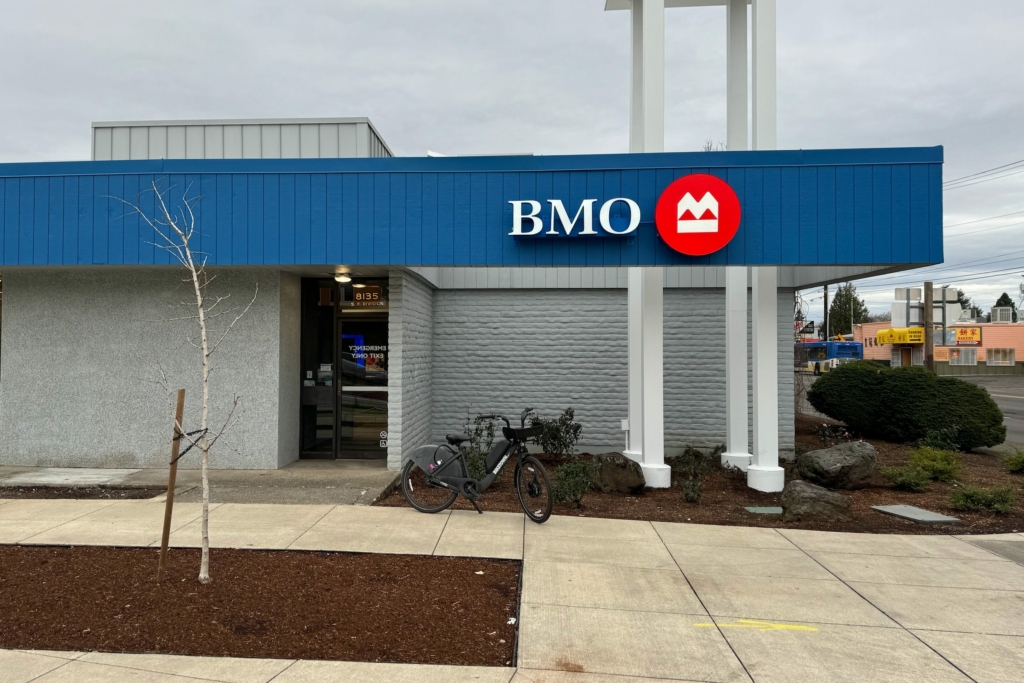
On a September weekend in 2023, BMO asked roughly two million Bank of the West customers to wake up inside a different bank. Their balances had moved. Their branches wore new blue signs. Their familiar green app had become a blue one. Behind the scenes, BMO called it the largest customer conversion in Canadian banking history. On the customer side, the achievement could be measured in smaller, less ceremonial units: a password that worked, a bill that got paid and a linked budgeting app that still knew where the money lived.
This is the contradiction at the center of BMO. It is Canada's first bank, founded in Montreal in 1817, and it is also a giant technology-and-distribution company whose product must work before breakfast. The firm now serves about 13 million customers through consumer and business banking, commercial lending, wealth management and capital markets. At January 31, 2026, it reported C$1.5 trillion in assets. Its competitors are the familiar Canadian heavyweights - RBC, TD, Scotiabank, CIBC and National Bank - plus the national, regional and digital players crowding the United States.
The product is a stack of promises
To a household, BMO sells chequing accounts, credit cards, mortgages, investments and advice. To a business, it sells cash management, credit, payments and a banker who understands the client's industry. To wealthy families and institutions, it offers portfolio management, private banking, insurance, estate planning and custody. To corporations and governments, BMO Capital Markets supplies underwriting, trading, research and advice. This mixture matters: when one corner of banking slows, another can carry more weight.
The business model is equally plain. BMO earns interest on loans and securities, pays interest on deposits and other funding, and keeps the spread. It adds fees from payments, deposits, asset management, brokerage, underwriting, advisory and trading. In fiscal 2025, C$21.5 billion of its C$36.3 billion in reported revenue came from net interest income; C$14.8 billion came from non-interest revenue. The balance is the point. BMO is not a single clever product. It is a regulated bundle of recurring financial relationships.
The $13.8 billion shortcut
BMO wanted more of the United States, especially California and the western states where its Chicago-centered franchise lacked density. Building that network one branch and one relationship at a time would take years. So in December 2021 it agreed to buy Bank of the West from BNP Paribas. When the deal closed on February 1, 2023, the cash purchase price was US$13.8 billion. The acquired bank brought nearly 1.8 million customers at announcement, 514 branches and offices, and a commercial franchise with roots across the West.
The spreadsheet argument was direct: enter attractive markets at once, cross-sell BMO's broader capabilities and remove duplicated expense. At announcement, BMO projected roughly C$1.7 billion in pre-tax merger and integration costs and C$860 million - about US$670 million - in annual pre-tax cost savings. It expected all of those savings to be executed by the end of the first year after closing. This was growth purchased wholesale.
A bank acquisition is priced by the balance sheet. It is remembered by the first Monday morning.The migration problem in one sentence
What failed first was not the strategic logic. It was the seam between systems and habits. Public customer reports after conversion described login failures, trouble reconnecting third-party finance apps and bill-payment disruption. Anecdotes cannot measure the whole conversion, and BMO celebrated the migration as an operational milestone. But they expose the right failure mode: customers do not experience a merger as synergy. They experience it as a changed username and a transaction that may or may not clear.
The financial cost was visible too. By the third quarter of 2023, BMO reported C$1.209 billion in pre-tax acquisition and integration costs for that quarter, alongside an initial C$705 million allowance for credit losses on the purchased performing loan book. Through that period, Bank of the West had contributed C$2.123 billion in revenue and C$244 million in net income, excluding the initial credit allowance and acquisition-related costs. A deal can be strategically sound and still make the income statement look bruised while it settles.
The U.S. map, rewritten
What changed BMO's mind
There was no public confession that the acquisition thesis had collapsed. The evidence points to something more useful: the bank refined the map. In October 2025, BMO agreed to sell 138 branches across a band of Plains and western markets to First Citizens. Those locations carried about C$5.7 billion in deposits and C$1.1 billion in loans. At the same time, BMO said it would open 150 branches over five years, chiefly in California and other core markets where it could achieve critical mass.
That is not a retreat from physical banking. It is a change in what a branch is supposed to accomplish. A lonely branch can service transactions. A dense local network can support referrals among personal banking, commercial lending and wealth management, make advertising more efficient and give a regional executive enough presence to matter. BMO's new plan swaps breadth for concentration. The bank still wants growth; it simply wants each dot on the map to strengthen the dots around it.
The distinction is worth stealing. Distribution is not the count of places where a product exists. It is the number of places where awareness, service, trust and economics reinforce one another. Retailers, clinics and marketplace operators can make the same mistake as banks: celebrating coverage before measuring density.
The quieter technology bet
BMO's more interesting digital work avoids trying to make banking entertaining. BMO Sync, launched with fintech partner FISPAN in 2025, puts balances, payments and reconciliation inside software such as QuickBooks Online and Sage Intacct. A business can connect in under 30 minutes, then initiate payments and see near-real-time cash positions without bouncing between the accounting ledger and a bank portal. It attacks a boring task people repeat every day. That is good product taste.
Inside the bank, Lumi Assistant uses generative AI to help frontline staff retrieve policies and procedures quickly. Mortgage forecasting combines time-series methods and deep learning; BMO says it reduced prediction errors by as much as 50 percent. My Financial Progress turns goals into adaptive plans in online and mobile banking. By late 2025, BMO reported more than 235 million AI-powered customer insights and 2.5 million AI-enabled interactions through BMO Assist.
The differentiator is not that BMO has AI. Every large bank is buying models and hiring data teams. It is where the technology enters the workflow. A useful banking AI narrows a decision, finds a rule or spots a next action. It should not pretend that regulated advice, empathy or accountability can be automated away.
Put the product inside the system customers already open. BMO Sync wins by removing a tab, not adding a destination.
Model market density, not footprint size. Adjacent distribution points can share trust, staff and referrals.
Treat migration as product work. Test logins, recurring payments and third-party connections as user journeys.
Budget for the invisible price. Integration, support load, credit marks and customer patience sit beyond the deal headline.
When the playbook breaks
Buying distribution works only if the acquired customers stay, the systems can be joined safely and the combined economics exceed the cost of capital. It is a poor strategy when cultures reject each other, regulators delay the closing, deposits flee, technology cannot preserve basic routines or management uses projected savings to excuse weak customer experience. Density also fails when local demand is too small, the offer is undifferentiated or digital channels have already made proximity irrelevant.
BMO carries another constraint: trust. Its climate institute and sustainable-finance teams can help clients plan for energy resilience, but a major lender must reconcile those ambitions with financing decisions across carbon-intensive industries. Its AI systems can personalize offers, but customers will judge consent and transparency as fiercely as convenience. Its scale creates expertise and resilience; it also enlarges the surface area for operational failure.
Still, the 208-year arc is instructive. BMO began because merchants needed a stable medium for trade. It financed canals, telegraphs and a transcontinental railway because infrastructure made customers more reachable. Now the infrastructure is part branch, part API and part machine-learning model. The strategic question has barely changed: where can the bank place capital so that more useful exchange happens?
BMO's answer after Bank of the West is refreshingly unsentimental. Keep the western ambition. Sell the scattered pieces. Build harder in the places where the whole bank can show up. And remember that the customer does not care how historic the conversion is. The customer cares whether the password works.