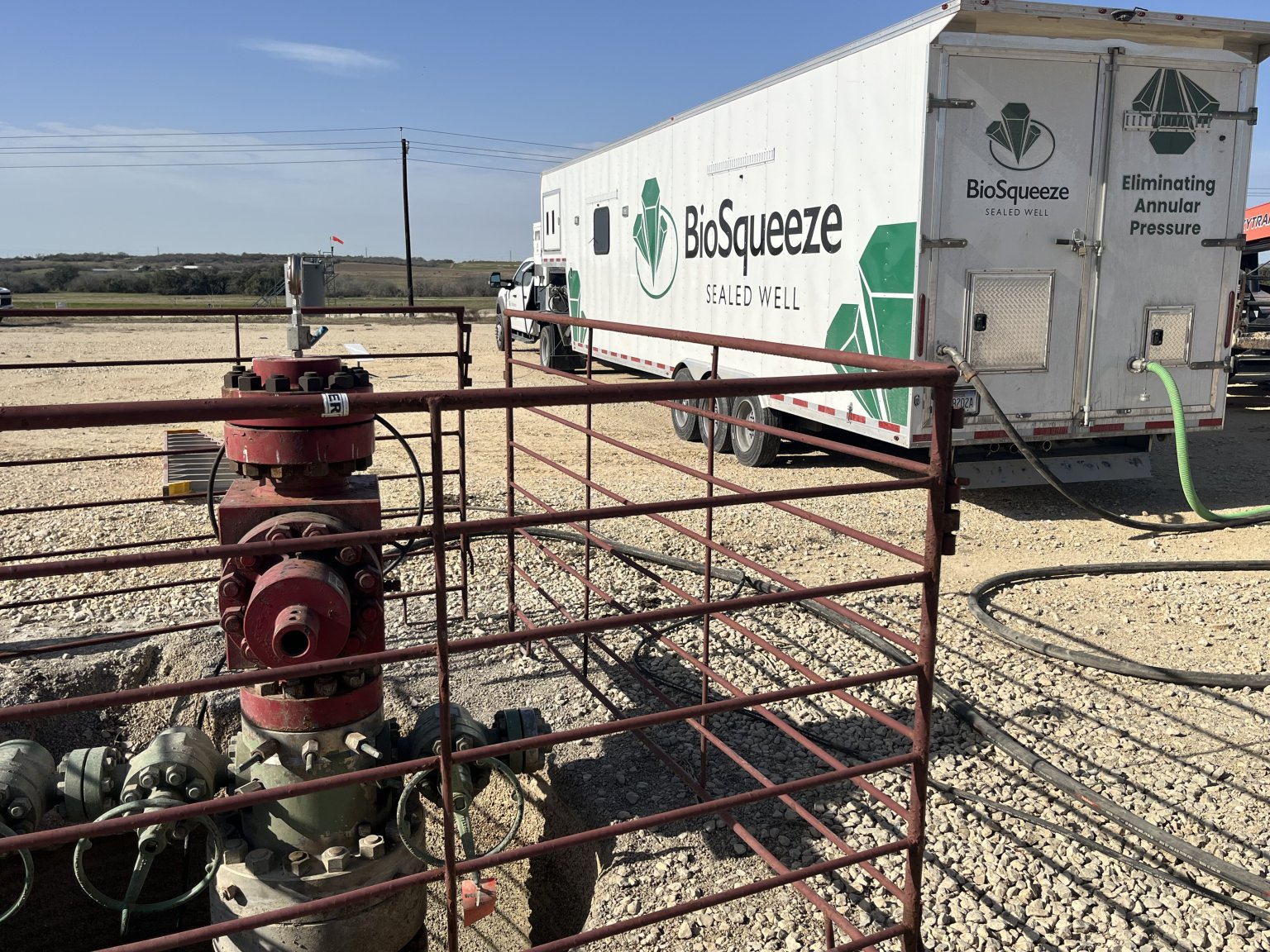
Somewhere in the Permian Basin, a red wellhead sits behind a livestock gate while a white trailer hums beside it. Inside that trailer, bacteria are doing the work that cement could not. Over a few days, microbes pumped a mile underground pull calcium out of solution and lay down crystal after crystal of limestone, filling a crack thinner than a human hair. When the crew packs up, the pressure gauge reads zero. The leak is gone. Not patched - sealed, with rock the well grew itself.
This is BioSqueeze, and the trailer is the whole pitch in one image. The company calls itself the world leader in commercial biomineralization, which sounds like a phrase invented to win a grant. It mostly means one thing: they have figured out how to seal a leaking oil or gas well using biology, and they have done it more than 400 times.
Cement cracks. Resin fails. BioSqueeze grows rock.
The elevator pitch, minus the elevatorThe Problem They Saw
01A leak too small to fix
Every drilled well is a tube of steel set in a sheath of cement. The cement is supposed to keep oil, gas, and water in their lanes. Cement, being cement, does not always cooperate. It shrinks. It cracks. It pulls away from the casing and leaves a gap - a micro-annulus - that you cannot see and cannot easily reach. Gas finds the gap. Pressure builds at the wellhead. Operators call it sustained casing pressure, and it is one of the quieter scandals of the oil patch: a slow exhale of methane that no one wants on their books.
The conventional fix is to pump more cement, or a polymer resin, into the hole. The trouble is geometry. Cement particles are coarse; a micro-annulus can be one micron wide. You cannot push a gravel truck through a keyhole. So the leak stays, the gas keeps migrating, and the well becomes a candidate for the abandonment pile - of which North America has roughly 120,000 orphans waiting.
You cannot push a gravel truck through a keyhole. So the industry stopped trying - and BioSqueeze sent something smaller.
On why cement was never going to winThe Founders' Bet
02What if the patch were alive?
The science did not start in a garage. It started in 2014, in a Department of Energy project at Montana State University's Center for Biofilm Engineering, where researchers were studying how to seal wells for carbon sequestration. The idea was almost suspiciously simple: certain soil bacteria, fed the right nutrients, precipitate calcium carbonate - the same mineral that makes limestone and seashells. Let the bacteria do that inside a leak, and the gap fills itself with stone.
Turning a decade of lab work into a service company took someone willing to bet on it. That was Mark Ranalli, BioSqueeze's president and CEO, a repeat founder who took the technology out of the university in 2021 and sealed the first commercial wells with it. The wager was contrarian: in an industry that reaches for bigger machines and stronger chemicals, BioSqueeze reached for something microscopic and biological - and argued it would outperform both.
Our technology provides the oil and gas industry with a desperately needed tool critical to reducing methane emissions.
Mark Ranalli, President & CEOThe Product
03Low-viscosity fluid, high-stakes chemistry
Here is the mechanism, stripped of the marketing. BioSqueeze pumps a low-viscosity, self-diverting fluid carrying naturally occurring bacteria into the well. Because the fluid is thin and water-like, it flows where gas flows - into channels, pinholes, and micro-annuli that cement could never enter. Then the chemistry kicks in. The bacteria precipitate crystalline calcium carbonate, steadily dropping the permeability of the gap until it is gas-tight. The result is a barrier the company describes as caprock - and one that, unlike cement, cannot be gas-cut.
In January 2025 the company split that capability into a product line, sorted by the size of the gap you need to close:
MacroSeal
A fast-crystallizing fluid for the larger defects - up to about 10 mm - forming an impermeable limestone barrier the company says is stronger than existing cement.
MicroSeal
The self-diverting workhorse. It flows into channels, micro-annuli, and pinholes in an existing barrier and forms a gas-tight seal.
NanoSeal
Sub-micron particles that chase the smallest gaps - capable of traveling thousands of feet - and gentle enough for environmentally sensitive jobs.
Advanced Cement Imaging (ACI)
The diagnostic half of the story: imaging that finds the leakage pathway before treatment and confirms the seal after.
Sealing the range cement can't
Approx. defect width each product targets · micron scale (log)
The point isn't that BioSqueeze fills big holes - cement does that fine. It's the left edge: the sub-micron gaps where conventional materials simply can't go. Widths are approximate and illustrative.
The Proof
04The receipts
Biology is a lovely story until someone asks whether it works at depth, in the cold, on a real operator's schedule. BioSqueeze's answer is a count. Since sealing its first well in 2019, the company reports more than 400 successful treatments, a success rate north of 90%, and jobs completed across nine U.S. states and two Canadian provinces - on producing wells, drilled-but-uncompleted wells, plugged-and-abandoned wells, and gas storage and sequestration wells alike. Often, it says, it seals multiple leaking annuli in a single application.
The money followed the count. A $4M seed round in 2021 from Next Frontier Capital and Frontier Angels got the company off campus. Then, in February 2023, a $7.4M Series A led by Valo Ventures - with Zero Infinity Partners, Riverstone LLC, and Next Frontier Capital - pushed total funding to roughly $11.5M and paid for mobile leak-sealing units and a remote operations push out of Butte. Two government bets came alongside the venture money: a DARPA Phase II SBIR grant in 2022 and a U.S. Air Force Phase II SBIR grant in 2023.
400 treatments and a 90% success rate is not a science fair. It's a service line.
What the numbers actually argueMilestones
From a DOE lab to the oil patch
The Mission
05Methane is the point
It would be easy to read BioSqueeze as a clever oilfield service and stop there. The company frames it bigger. Methane is roughly 80 times more potent than carbon dioxide over a 20-year window, and leaking wells are a steady, invisible source of it. Sealing a micro-annulus is not just a maintenance ticket; it is emissions abatement with a measurable before-and-after on a pressure gauge. That framing is why a climate-minded investor like Valo led the round, and why the Air Force and DARPA care about a Montana bacterium.
The aspiration the company keeps returning to is the orphan well: the 120,000-plus abandoned wells across North America that no operator wants and many states cannot afford to plug properly. A cheaper, more permanent seal changes that math. The company's own slogan - value "from spud to plug" - is a tidy way of saying it wants to be there at the beginning and, increasingly, at the end.
A seal that can't be gas-cut, on a well no one wanted. That's the unglamorous frontier of climate work.
On the 120,000 orphan wellsWhy It Matters Tomorrow
06The skeptic's column
A fair reader should keep a few caveats in hand. BioSqueeze is small - around 44 people and an estimated $2M in revenue - selling into an industry that treats new chemistry with suspicion until it has decades of failures behind it. The success figures are the company's own. Biology at depth is harder to standardize than a cement recipe. And the addressable market depends partly on regulation that pushes operators to actually fix leaks rather than tolerate them.
But the core idea is sturdier than the marketing. The leaks are real, cement genuinely cannot reach the smallest of them, and a thin fluid that grows stone in place is a legitimately different tool - not a better version of the old one. Whether BioSqueeze becomes a standard line item or a well-regarded niche will be decided one pressure gauge at a time.
Back at that wellsite in the basin, the trailer pulls away. The red wellhead looks exactly as it did before - rusted, unremarkable, fenced off from the cattle. The only difference is the one you cannot see: the crack a mile down is now limestone, and the gas that used to escape it is staying put. BioSqueeze's whole business is that invisible difference, repeated 400 times, with the meter reading zero.