The campaign ended in an engine room. Bill Thomas had filed to return to the Alaska House in 2024, twelve years after a recount had removed him from it by 32 votes. He was 77, a Republican challenging Representative Andi Story for a district that stretched from the capital into the upper reaches of Southeast Alaska. Then the turbo on his 34-foot fishing boat went bad. The aftercooler joined the rebellion. Repairs swallowed weeks. His halibut quota remained uncaught, gillnet season was arriving, and the tides were wrong for safely putting gear in the water.
There are candidates who withdraw after an unfavorable poll or an embarrassing revelation. Thomas withdrew because the machine he built in 1987 would not run. “That’s the only income I have, is fishing,” he said. With one sentence, the costume of politics fell away. Here was the blunt arithmetic of his life: fish first, because fish pay.
He had spent 55 years making that calculation. Politics might be in his blood, as he once told a Haines radio reporter, but salt water had long since reached the rest of him.
Keep the belt on
William A. Thomas Jr. was born in Haines in 1947, when Alaska was still a territory. He grew up in the Chilkat Valley and is of Tlingit descent, with deep ties to nearby Klukwan. Fishing was less a career choice than the local grammar. Great-uncles, a grandfather, uncles - nearly every man he knew worked around fish.
At 12 or 13, Thomas joined his uncles on the water. His assignment was not cinematic. A fan belt drove the mechanism that pulled in the net. The boy sat in the cabin and watched it, making sure the belt stayed on the engine. Other hands watched the water and the catch; he watched the part that allowed the work to continue.
That is an unusually neat first lesson in operations. The visible prize depends on an uncelebrated mechanism. If the belt slips, nothing else matters. Thomas later worked at the local cannery and on a tender. He graduated from Haines High School in 1965, briefly attended the University of Alaska, and was drafted into the Army in 1966. His official legislative biography records two years of military service, including Vietnam. When he returned in 1969, he went fishing with his friend Larry Albecker. He kept going for the next half-century.
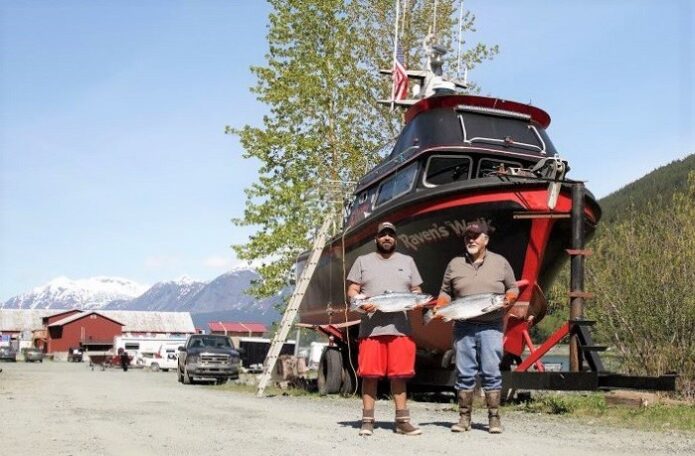
From Klukwan to the finance table
The public career accumulated the way working lives often do in a small place: one responsibility led to another. Thomas served four years on the Haines School Board and four on the borough assembly. He was a council member of the Chilkoot Indian Association and became chairman and chief executive of Klukwan, Inc., the village Native corporation. In the early 1990s he began lobbying in Juneau, usually for small communities across Southeast.
Those roles made a kind of regional map. A school budget touched families. An assembly decision touched streets and docks. Native corporate leadership joined cultural obligation to commercial reality. Lobbying meant translating the needs of distant, scattered towns into a language the capitol might act upon. Southeast Alaska is a geography of water and interruption. A ferry cancellation is not an inconvenience with a rideshare waiting outside. It can be the disappearance of the road.
Thomas entered the state House in January 2005 after winning his first race by 59 votes. District 5 spread across rural and semi-rural communities, a constituency that rewarded his habit of knowing people and the circumstances behind their requests. He served four terms. His assignments ranged through fisheries, transportation, education, military and veterans’ affairs, and community and regional affairs. He joined the House Finance Committee and eventually co-chaired it, moving from the belt in the cabin to one of the state’s central budget mechanisms.
“I believe that people should eat first.”Bill Thomas, speaking on subsistence in 2015
The sentence reveals the recurring friction in his work. Thomas is a commercial fisherman, yet he told a federal subsistence hearing that subsistence users should have priority. He described growing up with a Tlingit way of gathering and sharing food, including taking harvests to elders. Commercial livelihood, cultural continuity, individual access, conservation - Alaska forces these claims into the same room.
Thomas’s answer was characteristically plain. People eat first. It does not solve every allocation dispute, but it makes clear which end of the equation he watches.
A career with two recurring currents
What 32 votes can change
Redistricting rearranged Thomas’s political water in 2012. His new district included Sitka, where challenger Jonathan Kreiss-Tomkins lived and where roughly half the constituency was concentrated. Thomas raised more money. Kreiss-Tomkins, 23 and on leave from Yale, built the upset. The result went to a recount. Thomas lost by 32 votes.
A margin that small is cruelly personal. It is a few conversations cut short, a handful of people who stayed home, one room in which the case did not land. Thomas returned to lobbying and remained present in Haines civic affairs. In 2020, Governor Mike Dunleavy hired him as a special assistant for Southeast Alaska. His mornings in Juneau began before dawn at the Driftwood Hotel. He walked to a 7:30 meeting with policy directors, cutting through the DMV parking lot to save time, and sometimes worked until eight at night.
His first stated concern in the job was the Alaska Marine Highway System. The issue suited him: an essential, complicated mechanism that residents agreed was not working. Thomas’s formulation was more shop floor than seminar: everybody was upset, so “figure out how to make it work.” The boy assigned to the fan belt had found another machine.
The heir apparent has rules
On the water, Thomas has worked both salmon gillnets and halibut longlines. His son Cole started alongside him at about 12, the same age Thomas had been when his uncles brought him out. Thomas calls Cole the “heir apparent,” with a wink broad enough to cover both affection and an operator’s succession plan.
Cole is particular about quality. He will not let the boat stay out beyond three days; the fish must be delivered fresh. His father teases him about taking over. “Just because I’m a legend in my mind doesn’t mean you have to be,” Thomas has said. The joke does useful work. It removes the heroic burden while preserving the standard. The younger fisherman need not imitate the older one, but the boat has a reputation and the fish still have to arrive properly.
“It’s all about making sure the fish get up the river and spawn and they come back in four, five, six years.”Thomas on the practical meaning of sustainability
For Thomas, sustainability is not decorative language. Alaska’s managers open and close salmon fishing areas according to escapement goals, allowing enough fish upriver to spawn. Halibut works through quotas. A fisherman’s short-term opportunity sits inside a longer biological clock. The rule is both constraint and promise: leave enough life in the system for it to return.
That principle reaches beyond fisheries. Public institutions, family businesses, even reputations survive only when the present does not consume the future. Thomas has spoken about vocational scholarships, veterans, ferries, and the next generation of his family. His careers keep circling the same practical question: what must be maintained so people can stay?
Smell the roses, fix the aftercooler
When Thomas abandoned the 2024 race, he allowed that perhaps it was time to smell the roses. He hoped somebody would pick up his ideas. Then his immediate plans returned to engine fumes, missed halibut, and tide cycles. The roses never had much of a chance.
The moment is funny because it is so perfectly proportioned to him. He did not leave public life with a polished farewell. He had equipment to mend and a season moving without him. The withdrawal also spared the story a false ending. Thomas had already moved between boat, boardroom, assembly chamber, capitol committee, lobbying corridor, and governor’s office. None had erased the others.
His life offers no tidy division between “real work” and public service. The fishing grounds supplied his income, his metaphors, and much of his authority. Politics supplied another way to tend the systems surrounding those grounds. Haines and Klukwan remained the fixed points.
A campaign asks a candidate to insist that the moment belongs to him. A fisherman knows better. The tide belongs to itself. The engine has opinions. The fish do not wait for a speech. Bill Thomas chose the boat, which may be why the unfinished campaign says more about him than a victory might have done.