Robson Amorim could build things. He had spent his teenage years in the noisy, ingenious world of robotics competitions, where a clever machine can speak for you. An American university interview was different. English had to come out of his own mouth. In a later interview, he said his first application failed because his command of the language was not strong enough. He studied, reapplied and eventually made it to California. The experience left a stubborn question: how do you get enough speaking practice when travel, tutors and tidy classroom hours are out of reach?
Three friends from the same robotics circuit had a version of that problem. Felipe Silva noticed during a stay in the United States that ordinary conversations taught him more than formal classes. He and Felipe Tiozo built a first version of an English conversation product inside WhatsApp. Amorim and Luan Cavallaro joined them, and in April 2023 the four founded BeConfident. Their idea was almost embarrassingly practical: let people rehearse English in the messaging app they were already using.
- BeConfident offers AI English mentors by voice note, text and live call, with corrections and guided practice.
- It began on WhatsApp, then added a fuller app with lessons, progress paths and community features.
- The company says it now serves more than 200,000 students across 100-plus countries.
- The useful idea to copy: make the first practice session as easy as sending one message.

A classroom with no door
The customer is easy to picture. She understands a meeting until someone asks for her opinion. He knows the vocabulary for a trip until the hotel clerk asks an unexpected question. Both may have studied English for years. What they lack is a place to be clumsy in public without feeling public. BeConfident lets them practice with an AI mentor before the real encounter: a job interview, a presentation, a restaurant order, a bit of professional small talk.
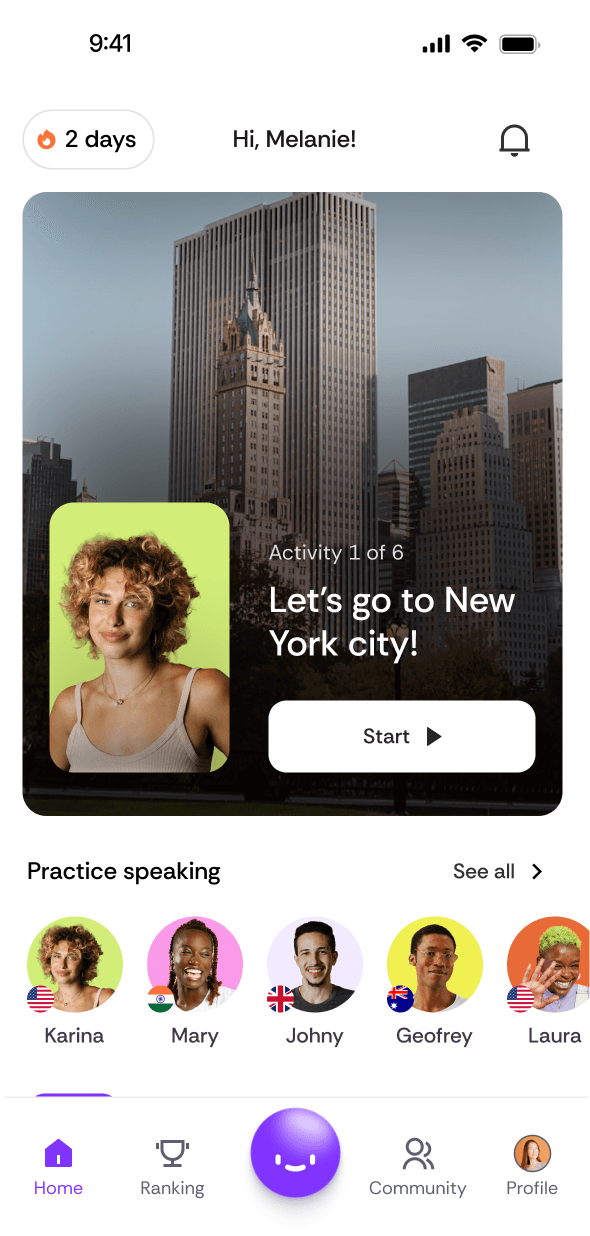
On WhatsApp, a learner sends text or audio and gets a response, with feedback on wording, grammar and pronunciation. The tutor can be summoned at an odd hour and a call can make the exchange feel more like speaking than composing. The dedicated app adds structured modules, activities, real-time conversations, certificates and social features. CEO Amorim said in May 2026 that app use had overtaken WhatsApp use. The doorway remained useful; the house got larger.
This distinction matters in a crowded language-learning market. Duolingo, Babbel, Speak, human tutors and local schools all promise progress, though through different routines and price points. BeConfident's initial edge was a distribution decision: put the first lesson inside an existing habit. Its later bet is that chat can lead a learner toward a richer course without losing the ease that got that learner to speak in the first place.
What a sentence costs
The service is sold as a subscription after a free trial. On its Brazilian site, BeConfident advertises an annual plan at R$598 paid at once, or 12 installments of R$59.90. That is the price of access, rather than a charge for each conversation. Plans and included channels can vary by country and offer, so a buyer should check the checkout screen for the exact terms. The company also lists in-app purchases on Apple's App Store.
A learner's time is the other cost. The company recommends roughly 10 to 20 minutes of conversation a day, plus guided activities in the app. No software can make those minutes happen. It can, however, remove the scheduling problem. You need neither an appointment nor a willing friend who will listen patiently to the same sentence for the fifth time.
Pick a situation
An interview, a trip or an ordinary conversation supplies a reason to talk.
Say something imperfect
A voice note or call turns recognition of English into production of it.
Use the correction
Feedback arrives while the sentence, and the embarrassment, are still fresh.
A small experiment gets large
The early figures were modest. Around the April 2024 HackBrazil competition, reporting counted about 5,400 BeConfident learners across 26 countries. The startup won that year's contest, held as part of the Brazil Conference associated with Harvard and MIT. By the end of 2025, investor Prosus said the company had reached 3 million total users and 160,000 paying students across WhatsApp and its app. The definitions differ - a user is not necessarily a paying student - but the leap in paid adoption is still the notable part of the story.
Prosus Ventures led an approximately US$15.8 million Series A announced in February 2026, intended to support expansion into the United States, Europe and Asia. Forbes Brasil reported a R$530 million valuation and R$60 million in 2025 revenue. These are reported company and investor figures, useful as signposts rather than audited proof of learning outcomes. A subscriber count says that people paid to try a routine; it cannot tell us whether they passed an interview six months later.
The scale changed; so did the measure
Reported figures. The bars illustrate magnitude, not a like-for-like conversion rate.
The next conversation
BeConfident has moved beyond a single patient chatbot. Its site now offers AI versions of named professionals, including investor Gina Gotthilf and entrepreneur Brian Requarth, so a student can practice English while talking through a topic that actually interests them. The app adds friend challenges, rankings and live events. It is a sensible extension of the original insight: a conversation is easier to sustain when there is something worth saying.
The risk is that convenience can be mistaken for mastery. AI feedback may make rehearsal cheap and frequent, but a real interviewer can interrupt, misunderstand or ask a question no scenario predicted. A teacher or human speaking partner can hear the social meaning of an answer as well as its grammar. BeConfident is strongest as a practice room for people who will use it repeatedly, especially where cost, embarrassment or schedules have kept them silent. A learner who needs a formal credential or deep human coaching will need more than a friendly voice in a phone.
For other builders, the transferable move is wonderfully small. Start where the user already spends time. Ask for one action that proves the product's value - here, an imperfect voice note - before asking for a new habit. Then give feedback quickly enough that the user wants to try again. BeConfident's founders did not remove the fear of speaking English by arguing with it. They made the first sentence easier to say.