The useful thing happened before there was a pitch deck. Auston Larson introduced ChatGPT to his mother, Kara Roberts, a speech-language pathologist. She began testing it against the unglamorous weight of her job: making therapy materials, planning sessions, turning quick observations into formal notes. Larson watched. Where she saw a tool that could help, he saw friction around the tool itself. The prompts were flexible, but the ritual was inconsistent. A clinician should not need a side career in prompt engineering to get a decent first draft.
So Larson began wrapping that general-purpose technology in a narrower, calmer experience. The project became SLP Tools, a software platform built for speech-language pathologists. The premise is deliberately modest. It does not conduct the session or replace the specialist's judgment. It helps with the work that collects around the work: a tailored exercise, a plan for the next appointment, notes reshaped into a familiar format.
This distinction tells you a good deal about Larson. He is a software engineer in Casper, Wyoming, employed at Greenhouse Software since 2025 and building SLP Tools as its CEO and co-founder. His career is full of technology, but his public explanations return to users, tasks and time. The machine may be interesting. The hour it gives back is the point.
Hide the cleverness. Keep the person in charge.
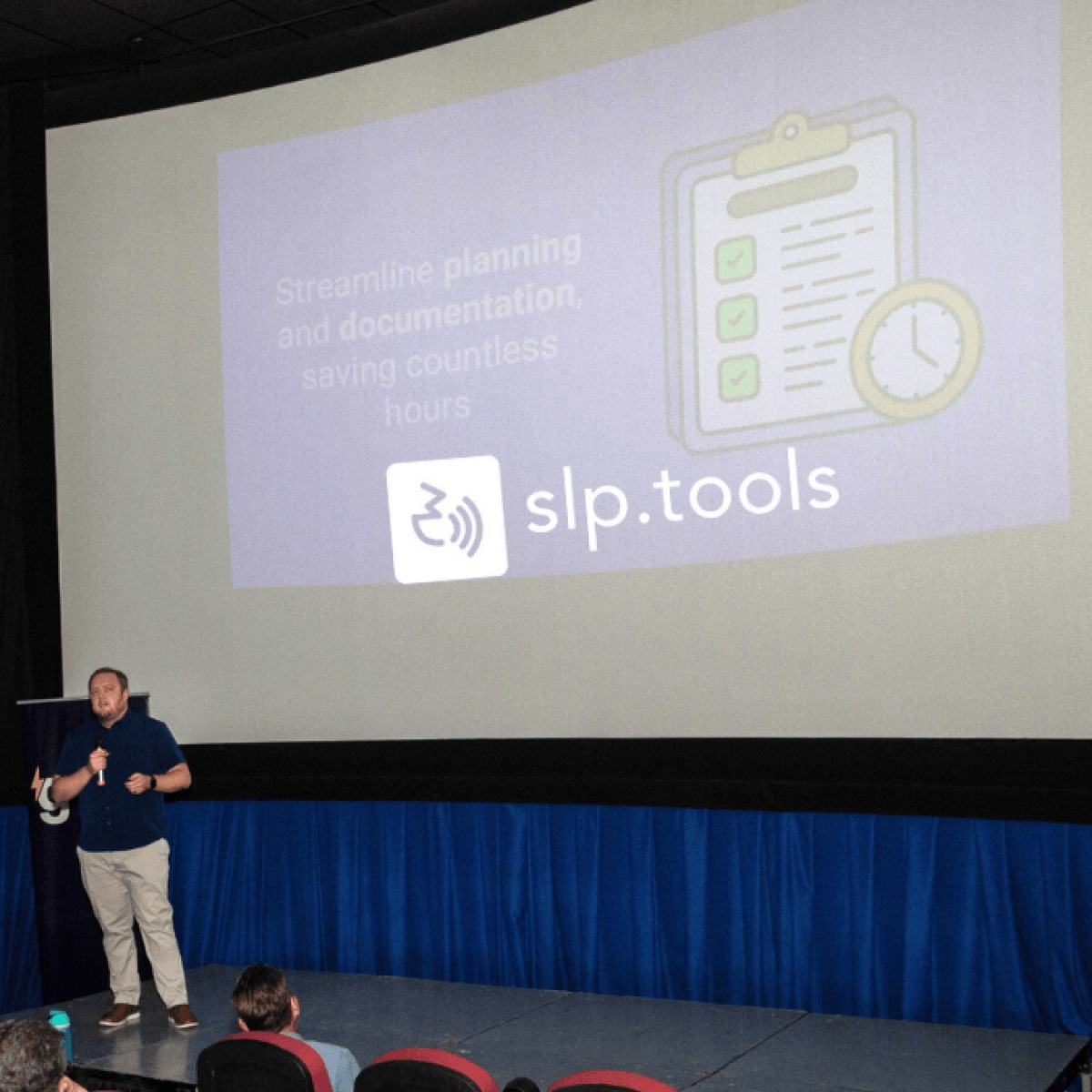
Larson organized SLP Tools around three kinds of burden. Therapy resource creation generates material suited to a client's needs. Session planning considers goals, past work and progress, then proposes what a clinician might do next. Documentation tools take rough notes and arrange them into professional structures, including SOAP notes. None of those jobs sounds cinematic. Together, they can consume the margins of a workday.
The SLP Tools workflow
His preferred design trick is concealment. Larson has said he wants the system to be approachable enough that a nontechnical user need not think about the AI running underneath. This is the opposite of the carnival-barker school of software, in which every button must announce the miracle happening behind it. For a specialist with a caseload, invisible sophistication is usually the kinder choice.
“This is supposed to serve as a starting point.”Auston Larson on AI-generated work
He is equally plain about the limitation. AI makes mistakes. Larson's ideal may be output that is exactly right nearly every time, but his operating advice is to review what it produces. The tool begins; the professional decides. That sentence, “This is supposed to serve as a starting point,” may be the least flamboyant claim in the AI business. It may also be among the more durable ones.
Before speech therapy, there were food trucks and municipal bonds
Larson's route to this particular problem began at the University of Wyoming, where he studied computer science with a concentration in big data and pursued statistics alongside it. He completed his bachelor's degree in the fall of 2019. The record of his student work reads less like a single obsession than a habit of looking for places where software could close an awkward gap.
At the 2018 WyoHackathon, he joined a team exploring municipal bonds on a blockchain. Larson researched the ERC-20 token standard and a Wyoming bill, then helped connect the technology to the machinery of public finance. The project won the MetaX challenge. It belonged to a particularly speculative season in technology, yet his role was grounded in implementation and policy. Even a token needed somewhere credible to live.
A year later, he and Treavor Trouchon presented Streats at the university's Undergraduate Research Day. Food trucks, they argued, often lacked an affordable way to keep customers current on menus, locations and specials. Their platform paired a customer app with a vendor website. Owners could update menus, send notifications and manage location information without commissioning a bespoke product. The blockchain had disappeared; the service pattern remained.
Public finance prototype
Researches token standards and Wyoming law for a MetaX-winning hackathon project.
Streats and graduation
Presents a food-truck platform and earns a computer science degree from the University of Wyoming.
Production engineering
Builds software at Trihydro and Flowstate Solutions.
SLP Tools
Co-founds a vertical software company rooted in a clinician's daily workflow.
Greenhouse Software
Works as a software engineer at the hiring-platform company.
Professional work followed at Trihydro Corporation, first as an assistant developer and then as a software developer. In 2020 he moved to Flowstate Solutions, a Casper software company serving the pipeline industry. The small-team environment demanded range. One old recruiting post he shared described the need to wear many hats and help carry a beta product toward commercialization. In 2025, Larson joined Greenhouse Software. His title there is software engineer, while the chief executive title attached to his name belongs to SLP Tools.
There was an early teaching stop, too. In 2016 Larson worked as an instructor at iD Tech Camps. It is a small entry on the timeline, but it belongs there: explaining a technical idea to someone who has not yet learned its vocabulary is its own engineering discipline. Years later, SLP Tools asks for the same translation at product scale. The interface must understand enough of the professional context to be useful without requiring the professional to learn the machinery beneath it. Code may make the feature possible. Clear explanation makes the feature usable.
Casper is part of the business model
SLP Tools took shape inside a small but organized Wyoming startup network. Larson and business partner Camdin Hinkel reached the 2024 Casper Start-Up Challenge finals. The event offered more than the possibility of funding. Larson praised its mentorship, connections and public stage, calling it a beacon for people considering a local business. It was a generous description of an ecosystem that later returned the favor.
In 2025, the Wyoming Business Council named Larson and Hinkel in materials recommending a $50,000 Kickstart award for SLP Tools. The program's money is non-dilutive. For a young software company, that can fund experiments without turning ownership into confetti. Larson had already described what he would do with early capital: bring in temporary development help, improve the product and reach speech-language pathologists inside and outside Wyoming.
The geography matters because software can be exported without packing a truck. A Casper company can sell to a specialized profession across the country, or beyond it, while hiring locally and returning revenue to the state. Larson has said that is the ambition. The great Wyoming resource in this case is not buried underground. It is a useful piece of software that can leave without going away.
“We're trying to help ease that burden. We're trying to help people.”Auston Larson on the purpose of SLP Tools
There are now several people in the origin story. Roberts supplied the clinical view and the first revealing use case. Hinkel joined Larson on the startup stage and in the state award. The Casper programs provided a room, a deadline and a set of demanding listeners. Larson supplied the translation layer between a flexible new technology and a profession with precise habits.
That translation is more important than it sounds. General software likes to boast about everything it can do. Professional software earns trust by knowing which things matter, what format they take and where a human must check the result. A SOAP note is not simply text. A therapy exercise is not merely content. They belong to a practice, a vocabulary and an accountable person.
Find the drag in a workflow and make it lighter
Larson's Greenhouse role and his founder role occupy different corners of software, but they share a practical concern. Hiring platforms organize decisions, communication and records around a consequential human process. SLP Tools organizes preparation and records around another. Both are systems where the administrative layer can either clarify the work or smother it.
His public career is still relatively short, and its most interesting outcomes are unfinished. SLP Tools has advanced from a family experiment to a pitch-stage company with state backing. It still has to prove that its three-part toolkit can become a habit for working clinicians. Larson has to balance ambition with the caution he already voices about generated output. The useful question is not whether AI can write something. It is whether a busy professional will trust the workflow enough to use it again tomorrow.
The answer will come through ordinary repetitions: prepare, plan, record, review. If Larson succeeds, the technology will recede. The speech-language pathologist will have the right material, a workable session and a cleaner set of notes. A client will receive more of the attention that paperwork once absorbed. Nobody will need to admire the engine. They will notice that the day fits a little better.