The googly eyes measured twelve feet across. In August 2019, Austin McChord, Ryan Sasloe, and Ed Lundblad earned a Guinness World Record for building them in Norwalk, Connecticut. They had received some ordinary googly eyes in the mail and decided to improve upon the scale. This is a perfectly defensible engineering brief, provided nobody asks too many questions about the customer.
McChord had recently stepped aside as chief executive of Datto, the data backup company he founded in 2007. A person looking for a tidy retirement story might have found the enormous eyes inconvenient. There would be more inconveniences: a robot fighting league, a venture fund, a former power plant, and eventually another backup company. Finishing one undertaking seemed to leave him available for several more.
On October 14, 2026, Slide announced that McChord would become its interim CEO. He had co-founded the business with fellow Datto veteran Michael Fass. The return places him in a familiar position, responsible for helping other businesses recover when their technology stops cooperating. Between the basement beginnings and that announcement sits a career unusually crowded with things that need assembling.
The product was ready. The customers weren’t.
McChord grew up in Newtown, Connecticut, and studied at Rochester Institute of Technology. His degree, completed in 2009, was in bioinformatics. The company had already begun. During his college years, he worked on a backup device in the basement of his father’s office building, combining hardware with his own software. The surroundings were modest; the problem was quite consequential to anyone whose small business depended on a server.
A working device did not produce a working sales operation. When the first product was ready in early 2008, McChord built a website and an online store. Nothing happened. He tried listing it on Amazon. Nothing happened there, either. The internet had supplied him with two separate ways to be ignored.
He began emailing the technology press. By his later account, he contacted Engadget repeatedly until the publication agreed to cover the product. The resulting attention helped bring the first fifteen orders. It was an early lesson in the distance between having something useful and persuading anybody to look at it.
Datto’s more durable route to customers came through managed service providers, or MSPs. These are the businesses that manage technology for other businesses: keeping systems running, answering calls, and dealing with failures. Datto could supply the backup and recovery tools while those partners handled the customer relationship. By late 2011, McChord was describing a partner base just short of 2,000.
A product reaches further when the people installing it already know the customer.
The expensive pleasure of saying no
In 2013, an unnamed security company offered $100 million for Datto. McChord was still its sole shareholder. He considered the proposal for about a week and turned it down. His lawyer pointed out that any regret could be enjoyed from a private island. Financial advice rarely comes with such pleasant scenery.
McChord wanted to keep building the company. That September, Datto announced $25 million in growth financing led by General Catalyst, its first outside venture funding since its founding. The stated uses were international expansion, product development, and better services for existing customers. Accepting investment meant sharing ownership; it also supplied resources for the larger operation he had chosen to pursue.
By 2015, Datto’s valuation exceeded $1 billion. Vista Equity Partners acquired it in 2017 and combined it with Autotask. McChord continued as CEO of the combined business before stepping aside in October 2018. At that point, Datto counted 1,400 employees and more than 14,000 MSP partners, with reach in 132 countries.
The corporate story continued after his operating tenure. Datto went public in 2020, and Kaseya completed its $6.2 billion acquisition in June 2022. Those milestones belong to different chapters of the company. McChord’s own attention was already spreading beyond the job that had occupied him since college.
A gift with other names on the doors
In December 2017, McChord announced a $50 million gift to RIT, the largest donation in the university’s history at the time. Former RIT president Bill Destler had encouraged him to think about giving back. The agreement had been worked out before the payout arrived; the eventual company sale allowed McChord to fulfill it.
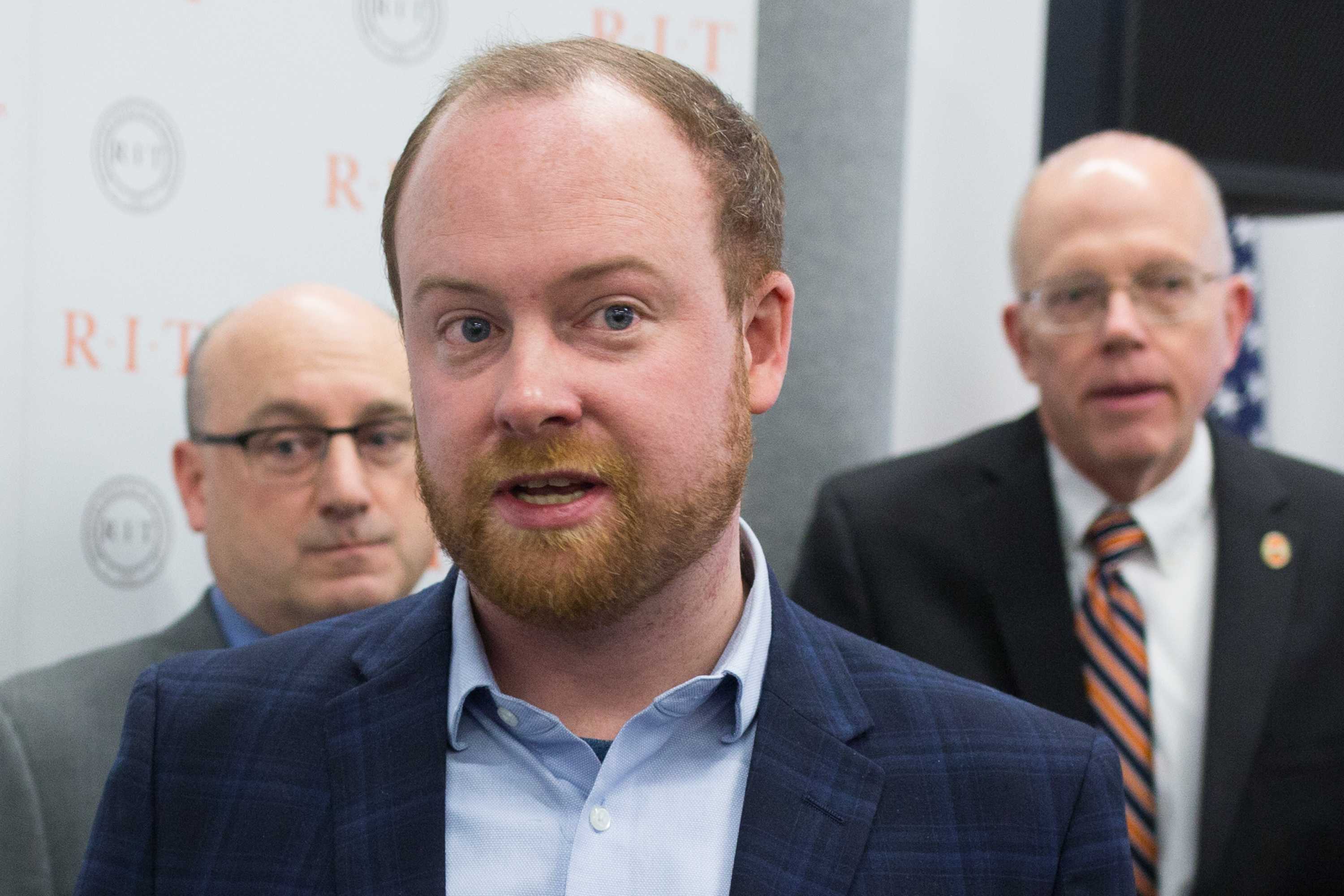
The money had specific destinations. Thirty million dollars would support creativity and entrepreneurship, including $17.5 million toward a new making and learning complex. Another $20 million would support cybersecurity and artificial intelligence. Equipment, faculty positions, scholarships, and entrepreneurial gap-year fellowships were part of the plan. The gift provided both places to work and ways to buy people more time to work.
McChord did not want the whole exercise to become a collection of buildings named for him. He wanted others recognized, including teachers who had helped him. His interest in making spaces also came with a practical complaint: impressive equipment behind a locked door offers limited encouragement to the student outside it.
There was a smaller prop at the announcement. McChord had once described wanting to earn enough from a company sale to buy an Audi R8, the car associated with Iron Man. RIT presented him with a miniature version in tiger stripes. Universities have many ways of keeping their alumni’s ambitions within budget.
Please repair your robot before the next fight
McChord founded the National Havoc Robot League in 2018. Robot combat offered an appealingly direct relationship between an idea and its consequences. A machine enters an arena with another machine. Whatever happens next supplies information that a design meeting might take considerably longer to obtain.
The league grew into an organization with events, production equipment, broadcasts, and leadership of its own. Kelly Biderman became CEO in 2021. McChord’s original interest extended beyond building robots to improving the experience of watching them. Getting more people to care required cameras, scheduling, and a show that viewers could follow.
“You have to design for failure.”
Austin McChord, discussing combat robots in 2021
That observation sounds especially apt from someone who built a business around recovery. In robot combat, repairs are part of competition. A machine that performs once still has to be ready for another fight. The builder’s ingenuity includes the ability to replace what breaks, under time pressure, while the tournament keeps moving.
By June 2026, the league’s ambitions included a professional tier, Academy programs, and broadcast partnerships. Its CEO described plans to strengthen local entry points as well as professional competition. The question had expanded from whether McChord could put on a better event to how a sport could make room for newcomers and support competitors who wanted to take it further.
The next project has a shoreline
Investing gave McChord another way to stay near unfinished things. After a period as a venture partner at General Catalyst, he co-founded Outsiders Fund in 2020. Its stated focus is early-stage companies bringing technology to overlooked industries. The firm concentrates on seed and Series A investments in the United States and Canada.
The subject matter fits his experience. Backup technology was hardly a fashionable consumer pastime when he began Datto. It became valuable because customers had a stubborn problem. Outsiders Fund looks for similarly neglected work, where an unfamiliar founder or an unglamorous market might contain something worth understanding. Its interests stretch across software, industrial systems, and hardware.
Closer to home, Austin and his wife Allison are backing a project with a much longer physical horizon. Manresa Wilds would transform the former Manresa power plant site in Norwalk into a publicly accessible park. The site covers 125 acres. Plans call for 1.75 miles of new public waterfront access, alongside ecological restoration and spaces for learning and gathering.
The ambitions come with a timetable. The final vision was unveiled in February 2026 after community engagement. The published plan projects the first 28 acres of Northern Forest opening in 2027, followed by later phases through the 2030s, with parts subject to approvals. This is a project whose progress will be measured in land returned to use.
“It’s a chance to do something with a lot of permanence,” McChord said in 2025. The sentence carries a different timescale from a funding round. A park has neighbors, seasons, maintenance, and future visitors who may never know the company that helped pay for it.
Back to the business of getting back to work
Slide brings the story back to the people responsible for keeping business technology running. Launched in 2025 by McChord and Fass, it offers backup and disaster recovery for MSPs. McChord initially served as co-founder and chairman. In interviews, he discussed the chance to build on a different technical foundation and the importance of maintaining alignment with partners.
In March 2026, Slide announced a $70 million Series B led by General Catalyst, along with a UK office opening and a dedicated German data center. The company was expanding into markets far beyond the basement scale at which McChord once worked. The task of earning customers’ trust remained familiar.
His October appointment as interim CEO followed Fass’s departure. Slide said it had grown to serve more than 1,000 MSP partners worldwide. McChord thanked his co-founder for building the product, team, and relationships. He now takes responsibility for the next stage of a company selling recovery, while his other projects occupy arenas and shoreline.
For a career commonly introduced with an acquisition price, there is a surprising amount still under construction. The googly eyes, at least, were completed to a measurable specification. The rest requires people to keep turning up: engineers, students, robot builders, partners, neighbors. McChord has given himself quite a few reasons to join them.
Follow the unfinished work
Companies, conversations, and a waterfront taking shape.
- Austin McChord on LinkedIn ↗
- Austin McChord on Twitter/X ↗
- His Outsiders Fund biography ↗
- Slide’s October 2026 leadership announcement ↗
- The Manresa Wilds plan ↗
- Watch: McChord’s RIT gift announcement ↗
- Watch: the Norwalk Havoc AMA ↗
- Listen: building Slide and lessons from Datto ↗
- Read: McChord’s business essays ↗