The interesting thing about a silver Audi A4 is how uninteresting it becomes when every car in the lot is a silver Audi A4. There is no upgrade to negotiate, no smaller substitute to inspect, no mystery concealed inside the words “or similar.” For Silvercar, the company that became Audi on demand, this sameness was the point. The customer had already made enough decisions before the plane landed.
- Silvercar began with a single-model fleet and smartphone booking.
- Audi invested, then acquired the company in 2017.
- Airport locations closed in 2020; dealerships became the focus.
- The U.S. Audi on demand program ended September 30, 2024.
Read its history through the pickup address and a pattern emerges. A company built to simplify the last leg of a flight became a service offered by car dealerships. Both rented Audis. But a traveler leaving an airport and a neighbor borrowing a car are buying different kinds of convenience.
The cure for “or similar”
Silvercar was incorporated in March 2012. Its co-founders, Todd Belveal and Bill Diffenderffer, had an unusually concrete answer to rental frustration: narrow the product until the promise became easy to understand. CEO Luke Schneider described the target customer as the connected business traveler. This customer wanted a premium experience and, crucially, consistency.
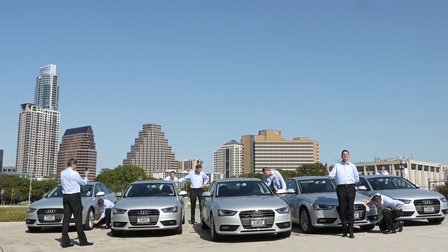
The first operating location opened at Dallas/Fort Worth International Airport in January 2013. The fleet consisted of silver Audi A4s. A rental company ordinarily arranges vehicles into categories; Silvercar made its early inventory almost a sentence. The name told you what would be waiting.
“No lines, no counters, no upsells.”
Luke Schneider, CEO, 2012
It was a clever exchange. Customers surrendered variety and received certainty. The operator could simplify a fleet built around one model. For someone who wanted a small economy car or a vehicle for a large group, the bargain was less attractive. A clear promise also draws a clear boundary around whom it serves.

The app had a fleet behind it
Customers could reserve through a smartphone and use a QR code to begin their rental. The technology reached beyond the screen. Travelport’s 2014 announcement described wireless fuel-level and return information feeding automated receipts. Navigation, satellite radio and a Wi-Fi hotspot were included features. The car itself helped finish the transaction.
Distribution remained a human business. Silvercar signed a multi-year agreement with Travelport, making its rentals available to U.S. travel agents connected to Worldspan. An app could reach the person driving; a travel-agent system could reach the person arranging the trip. The partnership acknowledged both.
The funding followed. An $11.5 million Series A arrived in 2012, followed by a $14 million Series B in 2014. In January 2016, Audi led a $28 million Series C with existing investors including Austin Ventures and Eduardo Saverin. Silvercar was entering its twelfth market. Audi acquired the company in 2017.
For the manufacturer, the attraction extended beyond airport rentals. The Series C announcement also proposed Audi Shared Fleet for corporate campuses. Software that coordinated access to cars might support several settings. Yet the original business still collected money in a familiar way: charging customers to rent vehicles. A phone did not remove the fleet from the balance of the operation.
Then the airport disappeared
The first major retreat in this story was geographic. In November 2020, Silvercar confirmed that all airport locations would close by December 6. It cited the changing travel environment and said it would concentrate expansion on in-town locations, particularly Audi dealerships. The counter-free airport proposition had lost its airport.
The dealership argument had practical appeal. Facilities, staff, vehicle knowledge and customer relationships were already there. In his 2022 appointment announcement, executive Monte Nichols pointed to these assets as reasons dealers could succeed in mobility. Sharing existing resources looks more economical than building another destination from scratch.
For the original traveler, however, the destination mattered. A convenient booking still required a convenient handoff. A dealership could be useful to a local renter while adding another journey for someone arriving by air. This is the tradeoff the company’s history invites us to examine, rather than proof that any single decision caused its closure.
In November 2022, Silvercar by Audi became Audi on demand. Audi announced 38 participating dealerships, the addition of the electric e-tron Sportback and some rentals lasting up to a year. Its stated uses now included extended test drives, local transportation and bridges between leases. The customer problem had widened beyond a business trip.
Luxury still had a daily rate
Prices depended on place, car and dates. A November 2022 Carscoops booking check at Audi South Coast quoted an e-tron SUV at $141 for a day, $942 for a week and $3,904 for 30 days. These were historical examples, not a national price list. Flexibility carried a bill.
The app handled profiles, reservations, coverage, agreements and receipts. But the service did not permit one-way rentals between locations. Its support policy explained why: each location had a limited fleet. The rule protected the next reservation by restricting the current customer’s freedom.
That placed Audi on demand in a particular corner of the market: premium, brand-specific temporary access. Large rental chains offered wider networks; vehicle marketplaces offered broader menus. Audi’s proposition suited someone seeking an Audi, provided a participating location and its inventory matched the trip.
The part worth copying
The U.S. program ended September 30, 2024. Its closing notice said reservations would neither be accepted nor honored beyond that date. This history supports a useful design lesson: remove uncertainty where customers feel it, then measure the complete journey required to deliver the promise.
The practical test for a similar service is straightforward. Can a customer collect the promised vehicle without adding a troublesome trip? Can the fleet accommodate the booking without sacrificing tomorrow’s reservation? Is the customer paying for a particular car, or simply for transport? These are questions about the service design. The answers can change when an airport rental becomes a neighborhood rental, even if the app looks familiar.
Silvercar made the vehicle predictable. Its later incarnation showed how much else still needed to line up: local inventory, pickup access, return rules and the customer’s purpose. Anyone can copy the narrower menu. Making the car easy to reach requires a map.
The keys to the archive
Explore the company’s public record and watch how it presented the rental experience.