Knut was having a bad appointment. The dog was uneasy, the veterinarian was busy, and a keyboard kept demanding its tribute. Arman Karégar watched the clinician divide attention between the animal in the room and the record on the screen. It was an ordinary little failure of modern work: a trained professional present in body, partly absent in practice. For Karégar, it became a product brief.
He called Max Henry Xie, his close friend of more than a decade and already his co-founder once before. The pair had met at KTH Royal Institute of Technology in Stockholm, where Karégar studied industrial engineering and management. They had built Blankt, a design engine intended to make creation easier for merchants and artists. Now the obstacle was not a difficult poster or customizable water bottle. It was the thicket of notes, summaries, follow-ups, and forms growing around veterinary work.
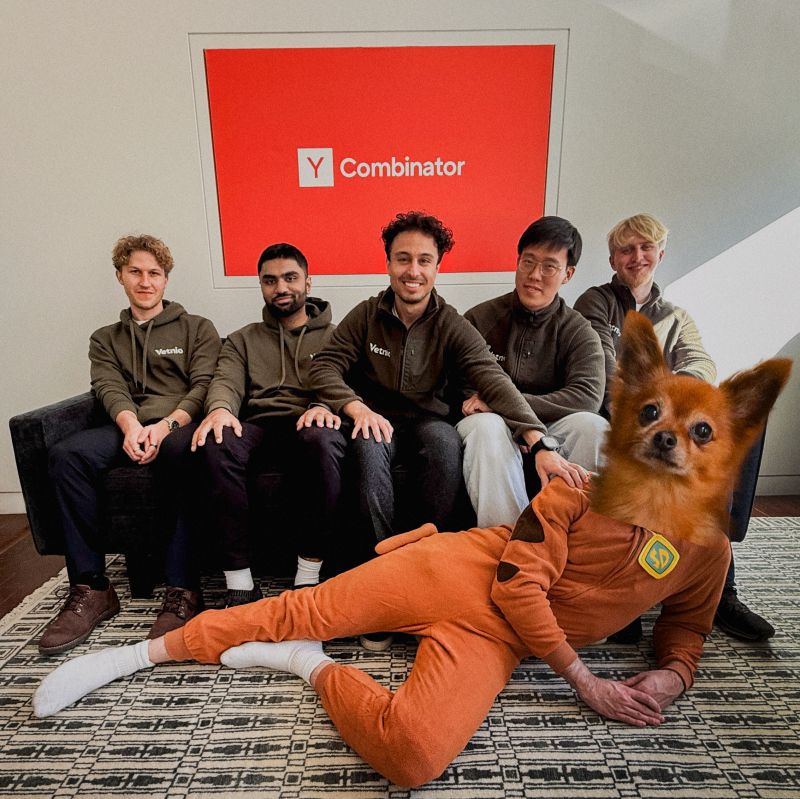
The charming version of this origin story gives Knut an executive promotion. On Vetnio's company page, he is the CCO - Chief Canine Officer - with a lifetime of experience in the pet space. The serious version begins with attention. Karégar saw a clinician's attention leaking into administration and wondered how much software could give back.
The sixth application
By the time Vetnio appeared, Karégar had accumulated a résumé that refuses to behave like a straight line. He had worked with music and audio processing for roughly two decades, learned to shape sound with oscillators and envelopes, served as an elected politician while at university, sat on the boards of municipal companies, analyzed data at Visma, and founded multiple businesses. A 2021 master's thesis used regression, machine learning, and open-banking data to examine debt-collection outcomes. One could call this eclectic. A kinder word is rehearsal.
Karégar had also applied to Y Combinator five times with other ideas and failed five times. When Vetnio's application went in on the deadline, the answer arrived four days later. The compressed turnaround makes a neat founder legend, but the more useful detail is what preceded it: years of attempts and, finally, a problem specific enough to explain in a breath.
“If you're on the fence about applying - take the shot.”Arman Karégar, reflecting on Y Combinator
Part of the team moved to San Francisco for the Winter 2025 batch. Karégar later described an atmosphere of founders swapping introductions, code, and last-minute feedback without much ceremony. The Vetnio crew amassed so many photographs of him asleep in front of his computer that it made an album. On Demo Day, they freestyled the pitch.
Improvisation suits a person with a music background, though it is often mistaken for the absence of preparation. Musicians improvise because the structure has become muscle memory. Karégar and his team could depart from a script because they had spent their preparation elsewhere: inside the workflow, with the people who would have to trust the thing.
A room, not a pitch
The path from Knut's appointment to a working product did not begin with a theatrical sales deck. Karégar and Xie approached IVC Evidensia, the international veterinary group, with the observation. The group gave them a room in one of its larger animal hospitals. There was no finished product and, in Karégar's telling, no formal sales pitch. There was a shared question: how do you return time to veterinarians without adding another burden to the day?
The product loop: where attention goes
The loop is deliberately unglamorous. Useful software begins with the work as it is actually done.
That room matters because it set the terms of the company. Vetnio would listen to a consultation, generate a structured clinical note, assist with follow-up communication, and fit into systems a clinic already used. The ambition was expansive, but the interface had to be modest. A tool meant to reduce friction cannot arrive carrying a wheelbarrow of its own.
Karégar kept going into the field. On World Veterinary Day in 2026, he shadowed a swine veterinarian in the Netherlands who used Vetnio. Group treatments and farm visits differ from small-animal appointments; language, species, and local routines produce new edges. His public question was blunt: how can builders understand those workflows if they do not put themselves in the user's shoes?
That is customer research stripped of conference-room perfume. Spend the Saturday. Watch where a sentence gets repeated. Notice when a clinician corrects the output. See which part of the visit the software cannot understand because the founders have never stood in that kind of room.
The old obsessions return
Vetnio makes Karégar's earlier chapters look less random. Audio processing trained his attention on what can be extracted from sound. Industrial engineering trained it on systems. Data analysis supplied a respect for patterns and evidence. Politics exposed him to institutions that change slowly and serve many constituencies. Blankt taught him to build with Xie, whose technical background complemented Karégar's leadership and creative instincts.
Their first startup together came from an abandoned e-commerce idea. They had wanted to sell customizable water bottles and discovered that handling designs, licensing, freelancers, and marketing assets was cumbersome. Years later, the irritation returned as Blankt: make the design machinery easier for businesses and creators. In 2021, the company won Solna's Young Business Idea of the Year. Karégar joked afterward that pandemic restrictions had probably been introduced to keep admiring crowds from stopping the founders for selfies.
The joke reveals a useful trait. His public writing is ambitious but rarely solemn for long. A failed application becomes a numbered anecdote. Exhaustion becomes a team photo album. A dog becomes an officer. Even the work of removing keyboards from exam rooms comes with a slogan simple enough to put on a sweatshirt: let vets be vets.
The trick is to earn the room
For founders, the stealable part of Karégar's story is not the dog, the accelerator badge, or the four-day reply. It is the sequence. First, find a moment in which a professional is plainly doing two jobs at once. Second, resist polishing the observation into a sweeping theory. Third, ask for enough access to learn why the obvious fix may be wrong. The hospital room gave Vetnio something a survey could not: corrections in context. Clinicians could react while the details of the consultation were still fresh.
That sequence also explains the patience behind a company moving quickly. Karégar and Xie had already learned together that the first framing of a problem can be disposable. Their customizable-water-bottle idea vanished; the design bottleneck survived and became Blankt. With Vetnio, the first observation survived, but the product widened as the team saw documentation connected to client messages, referrals, billing, and the clinic's existing software. The durable thing was not a feature list. It was the promise to reduce the administrative claim on attention.
His offer to review roughly ten YC applications is another small clue. The founder who had collected five rejections chose to turn the experience into office hours for strangers. It fits a career that has moved repeatedly through communities - municipal service, a university incubator, Y Combinator, and veterinary practices. Karégar seems to prefer networks that produce work, not merely contacts. The distinction is the difference between knowing a veterinarian and spending Saturday following one around a farm.
From one hospital to three markets
In May 2026, Vetnio and IVC Evidensia announced an agreement to begin rolling out the software in Sweden, Spain, and Portugal. The wider group operates thousands of clinics across many countries; the published agreement did not specify how many locations would receive Vetnio. The distinction matters. Founders are paid in possibility, but readers deserve the invoice in facts.
The reported result in earlier use was concrete: as much as 15 minutes saved during a 45-minute consultation at a large Nordic animal hospital. Vetnio's public ambition goes further. Karégar wants veterinary professionals focused on the animal and client, with the keyboard receding from the encounter. Software often announces itself by demanding new behavior. His preferred end state is closer to disappearance.
“Our goal is to let vets be vets.”Arman Karégar
There is a temptation to tell this story as an inevitable march: music to audio, engineering to AI, dog visit to company, rejection to acceptance, hospital room to international agreement. Lives are only that courteous in retrospect. Blankt changed direction from its earliest idea. Five YC applications went nowhere. The sixth happened to meet the right problem at the right level of readiness.
Karégar's own phrase for the Evidensia chapter is better: “The rest isn't history yet.” The rollout still has to work across languages, species, clinical habits, and institutions. The feature that dazzles in a demo must survive the bored Tuesday afternoon. A generated note must be easy to inspect. Time saved must stay saved after onboarding. Trust arrives consultation by consultation.
What remains is the habit that got Vetnio this far. Go into the room. Listen carefully. Bring the engineer you have trusted for a decade. Give the dog a title if morale requires it. Then keep removing whatever steals attention from the work people came to do.