Breaking
ArkeaBio builds the first methane-reducing vaccine for cattle Series A: $26.5M led by Breakthrough Energy Ventures Livestock methane = ~6% of global greenhouse gas Target reduction: 20%  //  cost under $100/ton AgriZeroNZ doubles down in Sept 2025 First product in market targeted for ~2028 ArkeaBio builds the first methane-reducing vaccine for cattle Series A: $26.5M led by Breakthrough Energy Ventures Livestock methane = ~6% of global greenhouse gas Target reduction: 20%  //  cost under $100/ton AgriZeroNZ doubles down in Sept 2025 First product in market targeted for ~2028
Boston, Massachusetts // Climate Biotech

The company trying to vaccinate the cow

ArkeaBio is betting that the cheapest way to fight climate change runs through a cow's stomach - one tiny shot at a time.

ArkeaBio logo Founded 2022 ~37 people
ArkeaBio - cattle and the methane-reducing vaccine
FIG. 1 - The patient who can't fill out a consent form. ArkeaBio's customer chews, digests, and quietly emits about 6% of the planet's problem.
The Scene // 2026

A barn, a syringe, and a very large number

Somewhere in Texas, a beef cow gets a shot. It is an unremarkable moment - the kind of routine that has happened on farms for a century. The cow doesn't flinch much. Nobody films it for the news. And yet, if ArkeaBio is right, that small jab is one of the more interesting things happening in climate technology right now.

ArkeaBio is a Boston company with a single, stubborn idea: train a cow's own immune system to fight the microbes that make methane. Not a feed additive you have to mix in every day. Not a genetically engineered animal. A vaccine. The same boring, scalable, century-old delivery system that wiped out smallpox, pointed at the warming planet's most overlooked source of emissions.

The company has raised roughly $45.5 million, hired scientists away from gene-editing and animal-tech startups, and started moving its work out of the lab and toward real herds. As of 2026, it is the first company to show that a vaccine can actually lower methane output in cattle. That is either a footnote or the beginning of something large, depending on how the next two years go.

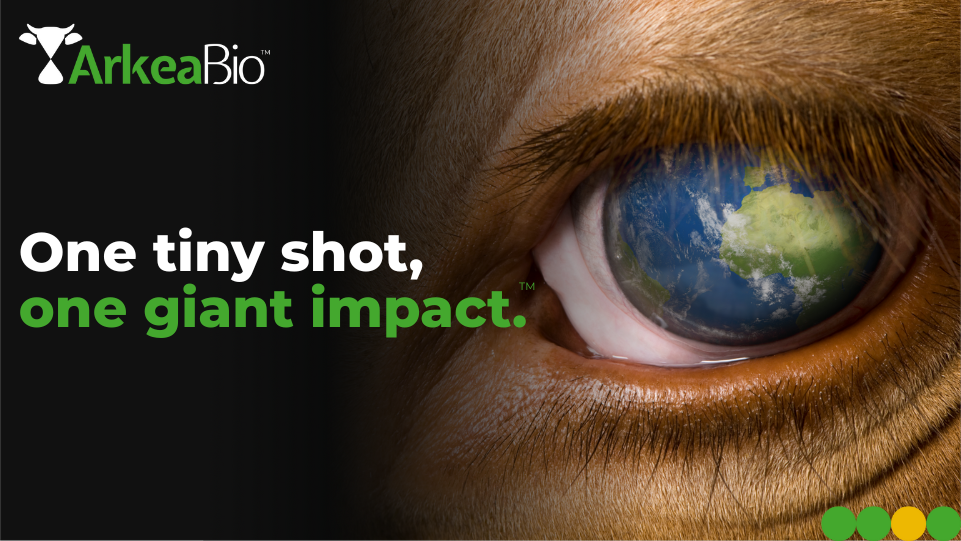
"One tiny shot, one giant impact."ArkeaBio's company tagline - and, conveniently, its entire thesis
The Problem They Saw

Cows are a climate problem nobody wants to talk about

Here is the part that sounds like a joke until you read the numbers. Cattle burp. A lot. Inside a cow's rumen - the largest of its four stomach compartments - live microbes called methanogens that turn the byproducts of digestion into methane gas. The cow exhales it. Multiply that by roughly 1.5 billion cattle, and you get about 6% of all human-caused greenhouse gas emissions.

Methane is the impatient cousin of carbon dioxide. It doesn't linger for centuries, but while it's up there it traps heat far more aggressively - dozens of times more potent than CO2 over a couple of decades. Which means cutting methane is one of the fastest levers we have to slow warming in our own lifetimes. The trouble is the lever has always been awkward to pull.

The existing options each carry an asterisk. Feed additives like 3-NOP can cut methane, but a cow has to eat them every single day - manageable in a feedlot, nearly impossible on open pasture. Seaweed shows promise but is hard to grow and dose at planetary scale. Changing herd genetics is slow. So the world has mostly settled for hoping people eat less beef, which is going about as well as you'd expect.

Methane traps far more heat than CO2 in the short term - which makes the cow's burp one of the fastest climate levers we have, and one of the least glamorous.Why a syringe beats a sermon about eating less beef
The Founder's Bet

A New Zealand dairy kid who kept building biotech

ArkeaBio's founder and CEO, Colin South, did not arrive at cattle methane by accident. He started his career in the New Zealand dairy industry - including time at Fonterra, the dairy giant - then spent 25 years building biotech companies in the United States. He was the founding president of Mascoma, an early cellulosic-ethanol company, and ran ventures like Novogy, Lignol, and enEvolv. He holds a Ph.D. in bioprocess engineering from Dartmouth and a chemical engineering degree from the University of Canterbury.

That résumé is the whole bet in miniature: someone who understands both the cow and the chemistry, and who has spent a career trying to make biology do industrial work. The wager is that the immune system - which already produces antibodies on command - can be pointed at methanogens the way it's pointed at viruses.

To accelerate it, ArkeaBio brought on Dr. Zach Serber as Chief Technology Officer in 2025 and recruited talent from across the ag-tech world. The team blends immunology, microbiome science, bioinformatics, and plain old animal physiology - the unglamorous disciplines that decide whether a clever idea survives contact with a real rumen.

ArkeaBio's name nods to Archaea - the ancient single-celled methanogens it's built to outsmart. Naming your company after your enemy is a confident move.A small detail that tells you what they're actually fighting

The Product

How do you vaccinate against a burp?

The mechanism is elegant enough to fit on a napkin. The vaccine prompts the cow's immune system to produce antibodies. Those antibodies travel through the bloodstream and into saliva, and from there into the rumen, where the methanogens live. Once there, the antibodies bind to the methanogens.

Here's the clever part: the goal isn't to slaughter the microbes. ArkeaBio's antibodies simply impair the methanogens' fitness, so the other rumen microbes - the ones that don't make methane - out-compete them. It's less a war and more a quiet eviction. The cow keeps digesting normally. The methane just has fewer hands making it.

100% scalable

A vaccine fits any herd on Earth, pasture or feedlot - no daily dosing, no special equipment.

< $100 / ton

Target cost per ton of CO2-equivalent reduced, aiming to undercut other methane options.

Non-GMO

Organic-compatible, with no intended safety impact on the resulting meat or milk.

"Vaccination is the lowest-cost and easiest-to-scale livestock methane reduction solution."ArkeaBio's framing of why a shot beats every alternative
Company Milestones

From idea to herd

2022

ArkeaBio founded in Boston by Colin South to develop a methane-reducing livestock vaccine.

2023

Roughly $12M seed funding, with early backing from Breakthrough Energy Ventures and The Grantham Foundation.

May 2024

$26.5M Series A led by Breakthrough Energy Ventures; AgriZeroNZ, Rabo Ventures, Overview Capital and The51 join in.

2024-2025

Cattle trials with Texas A&M University show the vaccine reduces methane - a first for a vaccine in cattle.

2025

Dr. Zach Serber named Chief Technology Officer to speed development.

Sept 2025

AgriZeroNZ invests a further ~$3.5M, expanding animal trials to New Zealand and targeting a first product around 2028.

2026

On track to move from animal studies into full field trials, chasing a 20% methane-reduction target.

The Proof

Numbers, not vibes

Climate startups are easy to love and hard to verify. So here are the parts of ArkeaBio that are checkable. It has demonstrated methane reduction in cattle from a vaccine - the first to do so. It is working with Texas A&M University on the trials. And it has attracted the kind of investors who do technical diligence before writing checks, including a New Zealand public-private venture, AgriZeroNZ, that has now backed the company across multiple rounds.

~6%
Global GHG from livestock methane
20%
Methane reduction target
$45.5M
Total funding raised
~2028
Targeted first product
Funding the bet
ArkeaBio capital raised by round (USD, approximate)
Seed (2023)
$12M
Series A (2024)
$26.5M
Follow-on (2025)
$7M
AgriZeroNZ (Sep 2025)
$3.5M
Bars scaled to round size. Figures are approximate and compiled from public funding reports; totals reconcile to roughly $45.5M raised to date.
"ArkeaBio's vaccine could become one of the most important climate breakthroughs."Breakthrough Energy Ventures, the lead investor since seed

Texas A&M

University research partner running the cattle trials that showed measurable methane reduction.

AgriZeroNZ

New Zealand venture funding trials in NZ and a route to commercial use for its farmers.

Breakthrough Energy

The Bill Gates-founded climate fund leading ArkeaBio's rounds since the very beginning.

The Mission

A boring delivery system for an enormous problem

The mission ArkeaBio states is simple: a safe, cost-effective, globally scalable vaccine that lowers methane from cattle and other ruminants. What makes it interesting isn't ambition - every climate startup has ambition. It's the choice of weapon. Vaccines are the most deployed medical technology in history. The supply chains exist. Farmers already vaccinate. There's no behavior to change and no new machine to buy.

If it works at the cost and scale ArkeaBio is targeting, the appeal is obvious: a rancher gives the same kind of shot they already give, and a measurable slice of methane disappears without anyone eating less beef or rebuilding a farm. The company also has to clear regulators, prove durability of six months or more, and hit that 20% reduction in the field - not just in a controlled trial. None of that is guaranteed.

THINGS THAT AMUSE AND INFORM
  • The vaccine doesn't kill methanogens. It just makes them losers in the competition for the rumen.
  • Most cow methane comes from burps, not the end you'd expect.
  • The company is named after Archaea, the ancient microbes it exists to undermine.
  • Its customer is roughly 1.5 billion animals who will never know they helped the climate.
Why It Matters Tomorrow

Back to the barn

Return to that cow in Texas. The shot is still unremarkable. But picture the same moment a few years out, multiplied across millions of animals - feedlots, pastures, dairy herds in New Zealand. Each one a tiny, repeatable subtraction from the 6% of emissions that nobody had a good answer for.

That's the version of the future ArkeaBio is working toward. It hasn't arrived yet. The field trials still have to deliver, the regulators still have to sign off, and the cost still has to land where they say it will. Skepticism is fair - this is biology, and biology is humbling.

But the shape of the idea is hard to argue with. The cheapest climate tools are usually the ones that ask people to change the least. A vaccine asks a farmer to change almost nothing. If ArkeaBio pulls it off, the most boring moment on the farm - an animal getting a shot - becomes one of the quietest, largest climate interventions we have. One tiny shot. A very large number, finally moving the right direction.

Dig Deeper

Links, news & the record

Share This