The Profile / Healthcare Founders
Aram Salzman
He keeps choosing the things hidden in plain sight - bacteria nobody could grow, then the blood vessels nobody could see clearly.
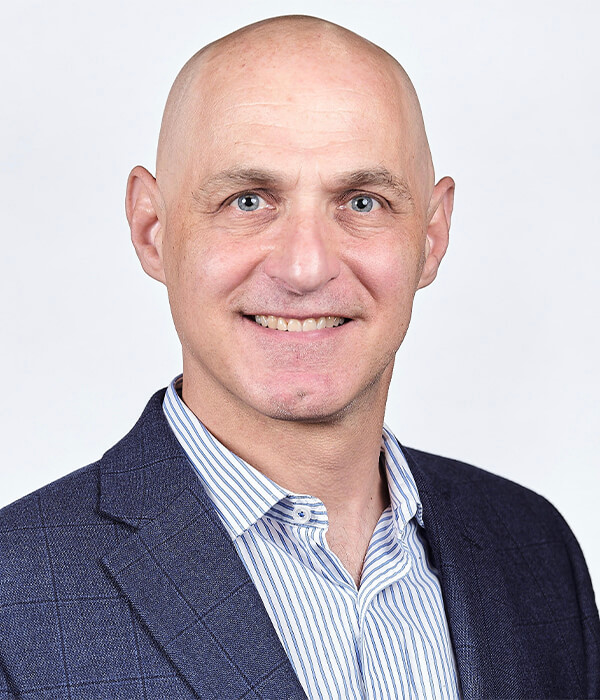
He keeps choosing the things hidden in plain sight - bacteria nobody could grow, then the blood vessels nobody could see clearly.
A cardiologist threads a catheter toward a beating heart, injects contrast dye, and watches a grainy black-and-white movie on a screen. Vessels flicker. Some are clear. Some are guesswork. Aram Salzman built a company on a single idea about that screen: the artery you need to see is already in the picture - it just is not legible yet.
That company is AngioWave Imaging, where Salzman is CEO and co-founder. The product is software, not a machine. It sits behind the angiography equipment already installed in cardiac catheterization labs and post-processes the footage, applying a deep-learning system the company calls AngioWaveNet to sharpen the vasculature in real angiographic cines. No new hardware. No replacing the multimillion-dollar suite a hospital just bought. Just a clearer picture of the thing the clinician is already looking at.
It is a modest-sounding pitch with an immodest amount of math behind it. AngioWaveNet is described as a spatio-temporal, convolutional, deep neural network - which is to say it does not just clean up a frame, it reads motion and time across the whole sequence. The technique gets a friendlier name in the company's materials: STEP, for spatiotemporal enhancement processing. Where a conventional filter smooths noise, STEP tries to understand what is moving and why.
The strange specific worth knowing: the underlying approach did not start in a coronary lab. It started with William Butler, a pediatric neurosurgeon at Massachusetts General Hospital, who explored wavelet and shearlet mathematics - tools for picking signal out of noisy images - and built early versions of the idea. Butler is AngioWave's co-founder and chief scientific officer. Salzman's job was the one founders rarely get credit for: turning a clinician's elegant side problem into a company with patents, clearance, and a path to the bedside.
By 2026, that job had produced results most four-person companies never reach. AngioWave secured FDA 510(k) clearance for its angiography enhancement software. It holds nine granted USPTO patents, with filings extending to the UK, Canada, the EU, Japan, China, Korea, and Australia. And it reported a Series B financing round - about $10 million, backed by the Boston life-sciences investor DRADS Capital. The headcount stayed small. The footprint did not.
He does not invent the camera. He makes the picture worth keeping.
// The AngioWave thesis, in one line
AngioWave is not Salzman's first venture into commercializing hard science - it is at least his third. In 2003 he co-founded NovoBiotic Pharmaceuticals and served as its president and CEO. NovoBiotic worked on a problem the pharmaceutical industry had largely abandoned: discovering genuinely new antibiotics from nature. Most antibiotic-producing microbes refuse to grow in a lab dish, which is why the discovery pipeline had run dry for decades.
During Salzman's tenure, NovoBiotic became the company behind teixobactin - reported in the journal Nature in January 2015 as the first new class of antibiotic discovered in roughly thirty years. Its appeal was structural: teixobactin binds to fatty cell-wall building blocks rather than to mutable proteins, which makes it far harder for bacteria to evolve resistance against. The finding landed in headlines worldwide and fed directly into the policy conversation about antibiotic resistance. It is the kind of result a CEO spends a career hoping to be near once.
Between the antibiotics and the angiograms came two more companies. Salzman founded CRA Health, which built software for cancer risk assessment, and led it as founding CEO before exiting. He also co-founded Boston Lighthouse Innovations, which likewise reached a successful exit. The throughline is not a single technology. It is a disposition - find a piece of difficult, defensible science, and build the commercial structure that gets it out of the lab.
It is a slightly improbable arc for someone who studied International Relations and American Literature at Brown University. Then again, a literature degree is training in reading carefully and explaining clearly - two things a science founder does constantly, whether the subject is an unculturable bacterium or a convolutional neural network. Salzman has spent two decades translating between the people who discover things and the markets that need them.
From bacteria nobody could grow to vessels nobody could see clearly - he keeps choosing the unviewable.
// A pattern across three companies
AngioWave's lean roster - Salzman, Butler, a CTO, a head of AI, a software lead, and a CFO among a handful of others - is not a limitation it is apologizing for. It is the model. Because the product layers onto existing fluoroscopy systems instead of competing with them, the company does not need a sales force selling hardware or a factory building it. It needs the algorithm to be right, the patents to hold, and the regulators to agree. A small team can carry that. The advisory bench does the rest: cardiology names like Deepak Bhatt and Paul Ridker sit close to the company.
There is a clinical case quietly accumulating, too. AngioWave's AI-assisted analysis of septal collaterals - tiny connecting vessels that matter enormously when a cardiologist is trying to reopen a chronically blocked artery from the back side - has begun showing up in the cardiology literature. That is the unglamorous proof that separates a clever demo from a tool a physician will actually trust at two in the morning.
The aspiration Salzman is chasing is deliberately narrow and therefore credible: make AI-enhanced angiography a standard layer in every cath lab, without asking anyone to rip out what they own. Not a revolution in the equipment. A revolution in what the equipment lets you see. For a founder whose last big swing helped reopen the antibiotic frontier, teaching a machine to read a beating heart is a fittingly stubborn third act.
Led the company behind teixobactin, the first new class of antibiotic discovered in roughly three decades - notable for binding targets bacteria struggle to mutate against.
Took AngioWave's AI angiography software to FDA 510(k) clearance with a roster of about four core people.
Founded and exited CRA Health; co-founded and exited Boston Lighthouse Innovations.
Nine granted USPTO patents, with international filings across the UK, Canada, EU, Japan, China, Korea, and Australia.
AngioWave's institutional backing comes from DRADS Capital, a Boston life-sciences and AI investor.
AI-assisted analysis of septal collaterals for chronic total occlusion procedures has entered the cardiology literature.