A checkout page looks like a single thing. Behind it may stand a catalog service, a customer record, payment methods, shipping addresses and a promotion engine. The person building the screen sees one experience. The systems behind it see a committee. Apollo GraphQL's business began with the frustration that follows: somebody has to assemble the committee's answers before the page can appear.
The short version
- Apollo's developer tools help apps ask for precisely the data they need through GraphQL.
- Its paid GraphOS platform helps teams combine APIs, check changes and watch performance.
- PayPal says a graph now powers more than 50 of its products.
- The same governed API layer is being offered to AI agents through Apollo MCP Server.
The company's answer is a graph: a typed, searchable map of data that lets an application request fields in one query. Apollo did not invent GraphQL. It built popular tools around the open specification and then a commercial platform for the organizational mess that appears when the graph becomes important. There is a satisfying progression here. First, make the query pleasant. Then, when several teams depend on it, make changes survivable.
The little problem inside the big one
Apollo grew out of Meteor Development Group's attempt, begun in late 2015, to build a better data layer. In its early telling, a modern application had too much code devoted to fetching, joining, caching and reshaping data. A client might call several REST endpoints, discard most of the response and write its own logic to keep the remainder current. On a single screen this is tolerable. Across web and mobile products, the same plumbing multiplies.
The first obstacle was tooling. Apollo engineer Jonas Helfer later recalled that GraphQL answered the team's query problem, but the available client, Relay, was difficult to fit into their projects and tightly coupled to React. They tried adapting it, then built their own client. It is an instructive origin: the team did not need a new query language so much as a usable path into one that already existed.
The first Apollo tools addressed the developer at the keyboard. Apollo Client manages GraphQL requests and a normalized cache in applications. Apollo Server lets a JavaScript team serve a GraphQL API. Both gave developers a practical way into the specification. The attraction was not an abstract fondness for graphs. It was that a product team could describe the data a screen needed in terms close to the screen itself.
That is also where a common misunderstanding starts. A GraphQL endpoint is not a replacement for every database, REST service or internal ownership boundary. It is a way to ask across them. Apollo's current GraphOS Router sits in front of existing GraphQL and REST services, plans a query and gathers the requested fields. Apollo Connectors can bring REST endpoints into that graph. The old machinery keeps running; its address book becomes easier to use.
PayPal's case was counted in lost hours
PayPal's published account is unusually candid about the starting point. Mark Stuart, then a senior manager of web platform, said UI developers were spending less than one third of their time actually building UI. The rest went into finding, mapping and orchestrating data. Individual network trips cost time too. PayPal had tried custom backends for each front end, but teams repeatedly wrote similar orchestration code.
“We found that UI developers were spending less than one-third of their time actually building UI.”Mark Stuart, PayPal, in Apollo's customer account
The test was not a grand replacement program. Three developers built a new mobile checkout product with a graph in six weeks. PayPal placed it at the edge of existing REST services, so a new interface did not require uprooting core systems. Apollo's case study says more than 50 PayPal products later used a graph. It also says PayPal adopted Apollo's management platform for field-level insight, checks against breaking changes and control over permitted queries. The sequence matters: prove a developer problem on one product, then invest in the shared system when reuse becomes real.
Figures above come from Apollo's published PayPal case study and describe that customer's reported experience.
Expedia Group offers another version of the same problem. Its brands and booking sites grew across different technical stacks. Apollo's customer story describes a cross-brand graph meant to make web and mobile development less dependent on knowing which service owned which field. For a small app with one team and one backend, the benefit may be modest. For a travel group with many brands, avoiding duplicate integrations becomes a different kind of arithmetic.
The product is partly a meeting place
A unified graph sounds tidy until a dozen teams try to change it. One team renames a field; another still ships a mobile client that asks for the old name. Apollo Federation lets teams own separate subgraphs while presenting clients with one composed supergraph. GraphOS adds a schema registry, checks, proposals, usage data and observability. That is the commercial center of the company: an arrangement for knowing what exists, who changed it and whether somebody still relies on it.
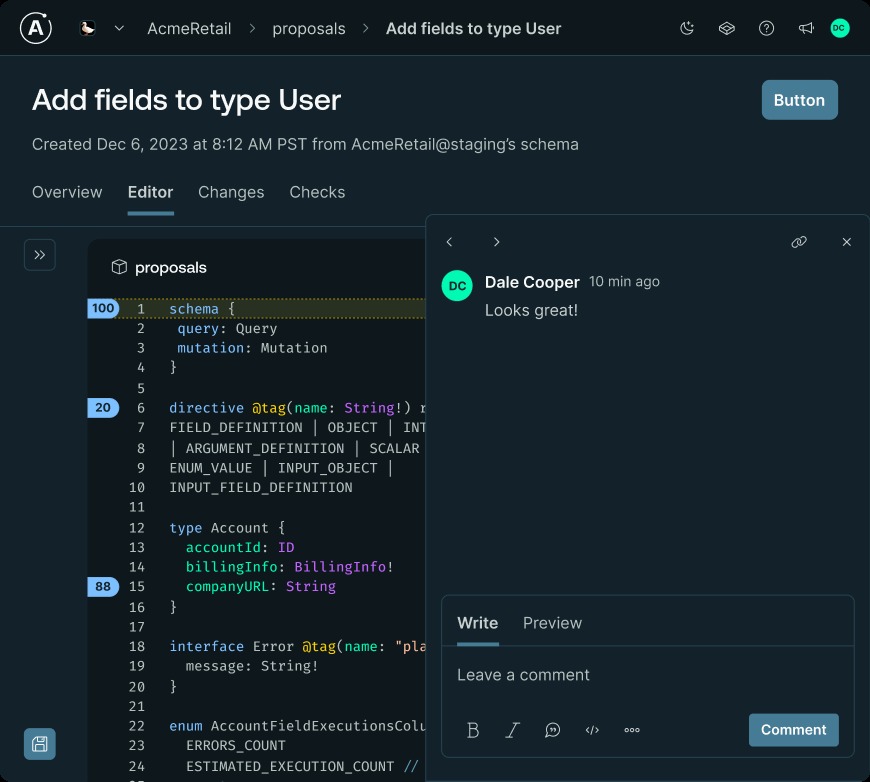
The screenshot of GraphOS Studio's proposal editor makes this surprisingly visible. It resembles a code review because that is largely what it is: a change to the shared contract, with context and discussion attached. Apollo's July 2026 update sharpened the review workflow with improved diffs, comments, conflict handling and webhooks. In May, the company also previewed a Rust-native engine for composing Federation schemas, replacing a JavaScript component that could suffer memory and garbage-collection pressure on large graphs. One improvement is social; the other is mechanical. Both are about keeping a common doorway usable under load.
Apollo's business model follows that split. Developers can begin with open source tools and a free GraphOS tier. Paid Developer and Standard plans charge by operation volume and add capacity and workflow features; Enterprise adds more controls and support. Public pricing puts the first 250 million standard monthly operations on the Developer plan at $5 per million, with volume discounts later. The bill is not for a novel query language. It is for running a shared API contract at scale.
A new visitor at the door
In 2025 co-founder Matt DeBergalis became CEO, while co-founder Geoff Schmidt moved into a role focused on technology and the GraphQL ecosystem. Apollo's new emphasis is AI agents. Apollo MCP Server, generally available in October 2025, turns selected GraphQL operations into tools an MCP-compatible client can call. A saved operation such as fetching a customer's orders can become a named tool without writing a separate wrapper. In July 2026 Apollo added graph-aware tools for inspecting schema checks, launches, router configuration and traffic.
This is an extension of the original pitch, with a more demanding client. An app screen has a developer deciding which data to request. An agent may decide at runtime. The prospect of a single, governed route to existing APIs is appealing, but it raises the value of clear permissions, limited operations and visible usage. Apollo's recent API Awards for GraphOS and MCP Server reflect the company's push into that category; an award alone does not prove the approach works in every installation.
Apollo's alternatives are plentiful. A team can call REST directly, write its own backend for each interface, use AWS AppSync, adopt a database-led GraphQL tool such as Hasura, or use another graph registry and gateway. Apollo's distinction is the connected set: client libraries, federation, router, registry, checks and operational insight. That breadth is useful when several teams and applications need the same underlying data. It is extra machinery when they do not.
There is a copyable lesson beneath the architecture. Start where duplication hurts. Put a narrow graph over existing systems, measure the time spent wiring data before and after, and only then give multiple teams a shared contract. PayPal's six-week test was small enough to finish and concrete enough to persuade. The company that began by asking why a screen needed so much glue code now sells a way to keep the glue from reappearing between departments. The maze has not vanished. At least the door has a name.