A San Francisco startup pointed cameras at the most expensive room in the hospital and asked a question nobody had a good answer to: what is actually happening in there, right now?
A surgical coordinator stands in a glass-walled control room on the third floor of a large American hospital, scanning a wall of dry-erase scribbles that were accurate at 6 a.m. and have been losing accuracy ever since. Case three is running long. Case four hasn't been called back. Somewhere on the second floor, a turnover crew is waiting for instrument trays that nobody told them to expect.
This is the operating room in the year 2026 - hospitals' highest-margin real estate, run on a combination of phone calls, post-it notes, and well-meaning guesses. Apella's bet is that the OR doesn't need another EHR module. It needs eyes.
The average US hospital operating room costs roughly $36 a minute to run. Block schedules are planned weeks out, based on surgeon-submitted case duration estimates that are, to put it kindly, optimistic. When cases run long, downstream cases slip. When cases run short, an hour of capacity quietly evaporates. Nobody is exactly to blame; everybody is exactly tired.
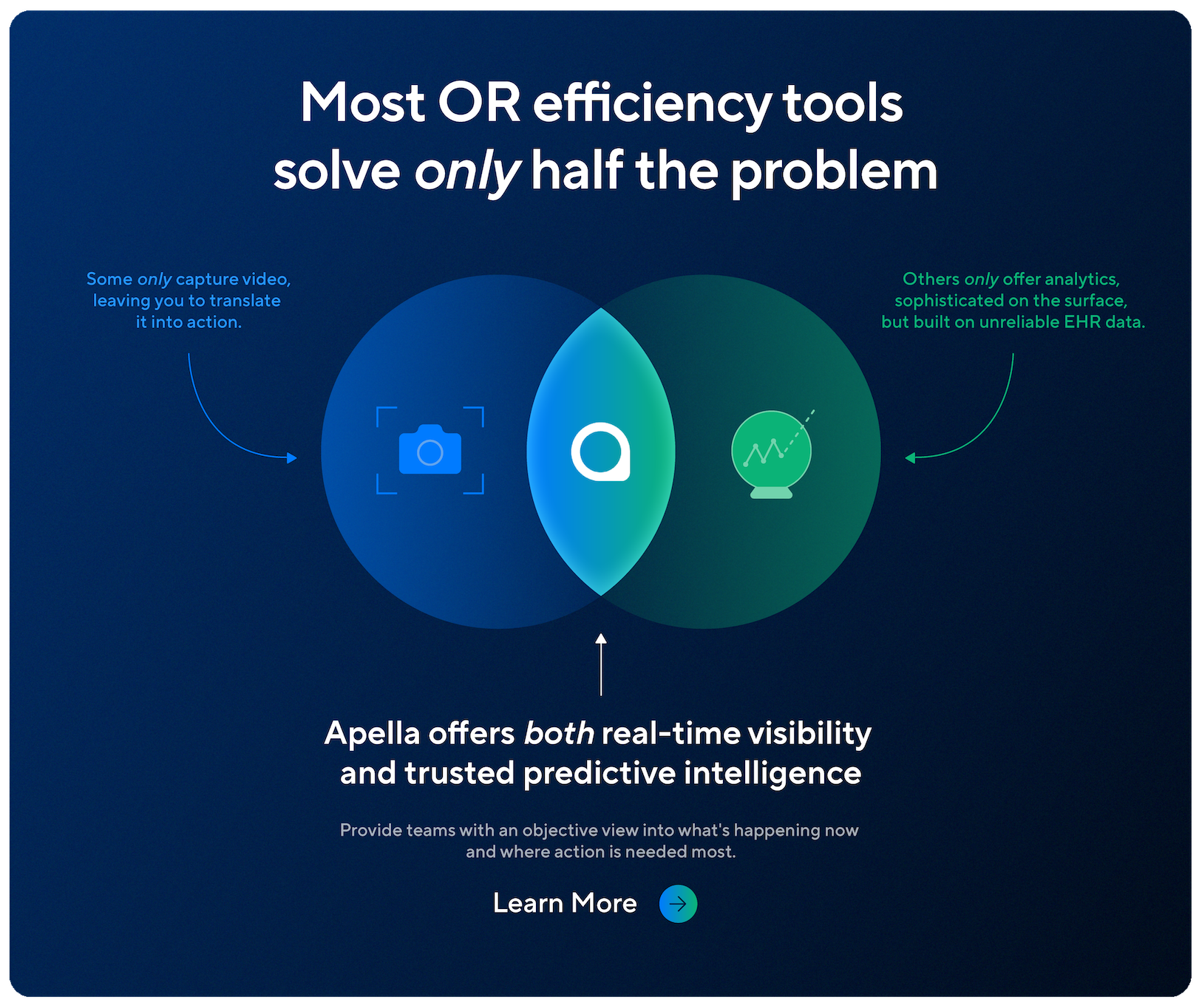
Hospitals have tried to fix this with software for two decades. The dashboards multiplied. The delays did not budge. The reason is unromantic: most OR data is entered by humans, after the fact, into systems designed for billing. The map was never the territory.
Apella was founded in 2020 by David Schummers, a former VP of marketing at Providence Medical Technology, and Cameron Marlow, the data scientist who built Facebook's early data team and holds a PhD from the MIT Media Lab. One had spent years inside surgical sales conversations. The other had spent years figuring out how to extract meaning from messy human signal at scale. They reached the same conclusion from opposite ends of the building: the OR is a sensor problem dressed up as a software problem.
Their gambit was to put ceiling-mounted cameras in operating rooms and train computer vision models to recognize the choreography of surgery - patient in the room, anesthesia started, incision, closing, patient out - without anyone clicking a button. Then write that data back to the EHR autonomously, so the chart stops lying.
It is one of those ideas that sounds obvious in retrospect and slightly insane in advance. Investors apparently agreed on both counts.
In August 2025, Apella launched Apella Horizon - a capacity optimization platform that bundles three things hospitals had previously bought from three different vendors: forward-looking scheduling, real-time day-of coordination, and post-hoc performance analytics. The pitch is unusually clean. One system, one source of truth, one set of numbers everyone in the building can argue about productively.
Underneath Horizon, the ambient sensors do the unglamorous work. They automatically detect up to fourteen distinct case events. They forecast how long the next case will take with an accuracy that, according to the company, beats EHR-only baselines by 24 percent. They notice when turnover is dragging and ping the right pager before the surgeon notices. When the case ends, they write the timestamps back to Epic without a human transcribing anything.
Most healthcare AI lives or dies by whether a CFO believes the numbers. Apella publishes its impact metrics publicly, which is itself unusual. Here are the three that operators tend to circle.
The early customer list reads like a US News spreadsheet: Houston Methodist (nine hospitals, 200+ ORs), Tampa General, the Medical University of South Carolina. Houston Methodist liked it enough to put its own check into the Series B - a small but unsubtle signal that the pilot graduated.
The Apella mission statement does not pretend to cure cancer. It is narrower and, mercifully, more honest. The goal is to let surgical teams serve more patients while improving care quality and letting staff go home on time. In a labor market where nurses are leaving the profession faster than hospitals can hire them, the after-hours charting tax is not a small thing. It is the thing.
The company's broader theory is that ambient AI - cameras and microphones and models that watch the work without interrupting it - is going to do for healthcare operations what GPS did for logistics. You stop guessing where the truck is. You stop guessing how long the case will run. The job becomes recognizable.
The operating room is the easy place to start - high cost per minute, clear workflows, willing CFOs. The procedural areas next door look surprisingly similar. Interventional radiology, cardiology, endoscopy, labor and delivery - all of them are rooms where things happen on a schedule, where the schedule slips, where someone is trying to write down what just occurred while the next case is already being prepped. Apella's January 2026 announcement made the expansion explicit. The cameras are moving down the hall.
If they are right, the long-term picture is a hospital that runs more like an air traffic control tower and less like a Renaissance fair. If they are wrong, they will have built an extremely useful OR scheduler. Both endings are acceptable. One is more interesting.
Back in the glass-walled control room, the surgical coordinator is looking at a live grid of every OR. Case three is running 18 minutes long; the system already knew. Case four has been alerted; the team is moving. The turnover crew has the tray list on a tablet. Nobody is shouting. Nobody is guessing. Nobody, at the end of this shift, will stay until 8 p.m. typing into Epic.
That is not a tidy ending. Hospitals are not tidy. But the room knows what time it is now, and that, as foundational changes go, is the kind that compounds.