Anton Pavlovsky had reached an awkward point for someone who cared about learning: months had passed since he had read a book. Work had occupied the hours that reading was supposed to inhabit. There was no shortage of books, or ambition, or reasons to begin. The missing ingredient was room in the day.
His response eventually became Headway, launched in January 2019 with a team of three. The app offered the central ideas of nonfiction books in short reading and listening sessions. A familiar private irritation became a business proposition: perhaps people would learn more often if getting started required less negotiation with their calendars.
The appeal of this origin is its modesty. Pavlovsky was trying to recover something he valued. He did not begin with a grand pronouncement about the death of the book. He began with the rather embarrassing discovery that a person can be enthusiastic about reading while doing remarkably little of it.
The question that cleared the calendar
The decisive prompt came from “Your Genius Zone,” a test on the blog of Lex Sisney, author of Organizational Physics. It asked him to imagine a life in which success and happiness were assured. With resources and connections already available, what would he choose to do?
Pavlovsky imagined a platform where people could educate themselves, share knowledge, and serve as examples to others. The exercise reversed the order of his thinking. Rather than accumulating the means and postponing the purpose, he considered the purpose first. “In three weeks, I founded Headway,” he recalled in 2024.
There is something pleasingly inconvenient about that answer. A question designed to remove obstacles gave him an enormous new project. The calendar was about to become busier. But the problem he wanted to solve had acquired a shape: learning that could enter ordinary life without demanding that ordinary life be rearranged around it.
“In three weeks, I founded Headway.”
Anton Pavlovsky, 2024
An engineer takes the long way round
Pavlovsky's route to educational software ran through several kinds of work. He earned a master's in IT at Ukraine's National Aviation University, then worked in capital markets and corporate finance. In 2014, he moved into technology and joined Genesis, the ecosystem that builds businesses with entrepreneurs from Central and Eastern Europe.
He started there as a product analyst and rose to Chief Product Officer. Finance had given him experience in planning and business development; product work placed him closer to the choices people make when they encounter software. Headway would emerge with support from that same Genesis ecosystem.
This was a career with turns in it, which makes his interest in continuing education feel less abstract. He had changed fields himself. A university qualification could provide a starting point, but it could hardly prescribe every subsequent job. His eventual business would address adults whose curiosity and working lives kept moving after formal education ended.
The first subscriber was close to home
Headway's early circumstances were practical. Genesis supplied help with recruiting, operations, accounting, and legal work. That support let the small team spend more of its effort on the product and the assumptions behind it. Pavlovsky later identified Genesis co-founder Volodymyr Mnoholetniy as the app's first paying customer.
By September 2021, the Headway app had recorded seven million downloads across more than 140 countries. The team had grown to 90 people. Pavlovsky described book summaries as a way to encounter an idea and decide whether to explore it further, including by reading the complete book.
That distinction gives the format a more interesting job than simply making everything shorter. A summary can be an invitation. The small encounter may help a reader choose the larger commitment. The book survives this arrangement quite comfortably; it merely acquires a more compact calling card.
The team at launch in January 2019. By September 2021: 90 people and seven million Headway app downloads.
A manager's reading list
In June 2020, Pavlovsky published a reading list about communication at work. His selections included Ray Dalio's Principles, Kim Scott's Radical Candor, and Marshall Rosenberg's Nonviolent Communication. The list reveals a founder working on the mechanics of being understood.
He described an early difficulty in management: how to ask for results from people he respected without treating them carelessly. Becoming tougher had seemed like an answer, but the idea sat badly with him. Scott's combination of personal care and direct challenge offered a more usable approach.
He also wrote about the difficulty of applying a structured approach to feedback in an actual conversation. Knowing the steps and managing to use them are separate achievements. This is a revealing admission from someone selling access to useful ideas. Reading can supply a method; the reader still has to practice it when the meeting gets awkward.
His management interests bring the story back to the original problem. Learning mattered because he wanted to do something differently afterward. The useful book was the one that followed him into work.
The journey back to Kyiv
In February 2022, Pavlovsky was in London when Russia launched its full-scale invasion of Ukraine. He helped organize relocation for his team and returned to the Kyiv office. A business designed for an international audience now had to make immediate decisions about the people building it.
Later, during interviews for selection into the Endeavor entrepreneur network, he received a standard founder question about what kept him awake. His answer was “Rockets and missiles.” The usual startup conversation had encountered a reality for which its customary vocabulary was poorly equipped.
In a 2026 account of wartime leadership, Pavlovsky emphasized acting without waiting for complete information. His team had been moved into a hotel in a safer area. Choices about accommodation and continuity belong to a different register from app design, but they became part of his job.
For a founder, saying that people matter is easy to put on a slide. Organizing somewhere for them to go makes the statement concrete. Pavlovsky's return also anchored his international ambitions to Kyiv, the city from which he wanted to build.
Fifteen minutes, several doors
As Headway grew, the company moved beyond a single book-summary product. Nibble offered short lessons across subjects including mathematics and art. AddMile brought coaching into the portfolio. Impulse supplied short puzzle sessions. Different formats gave people several ways to enter the same broad territory of personal learning.
In April 2024, Pavlovsky said nearly 40 percent of the company's educational app downloads came from the United States. Britain, Brazil, Mexico, and Canada were also priority markets. He spoke about Spanish localization and Latin America, describing growth in terms of languages and audiences as well as company size.
That year, he also described the free Essence of Ukraine collection: 32 summaries of books by Ukrainian authors, available in Ukrainian, English, and Spanish. The collection put his home country's writing before an international readership. The same compact format used for personal development could carry a country's ideas across borders.
Short sessions sound almost comically small beside such ambitions. But their size is precisely the proposition. A lesson has to find a place in someone's life before it can become part of that life.
From a reading problem to an international portfolio
- 2019Headway launches with three people
- 2021Seven million Headway app downloads
- 2025150 million downloads across the company portfolio
- 2026A conversation about AI and lifelong learning at ASU+GSV
Different milestones, different measures. App downloads in 2021 and portfolio downloads in 2025 are distinct totals.
Outside capital enters the story
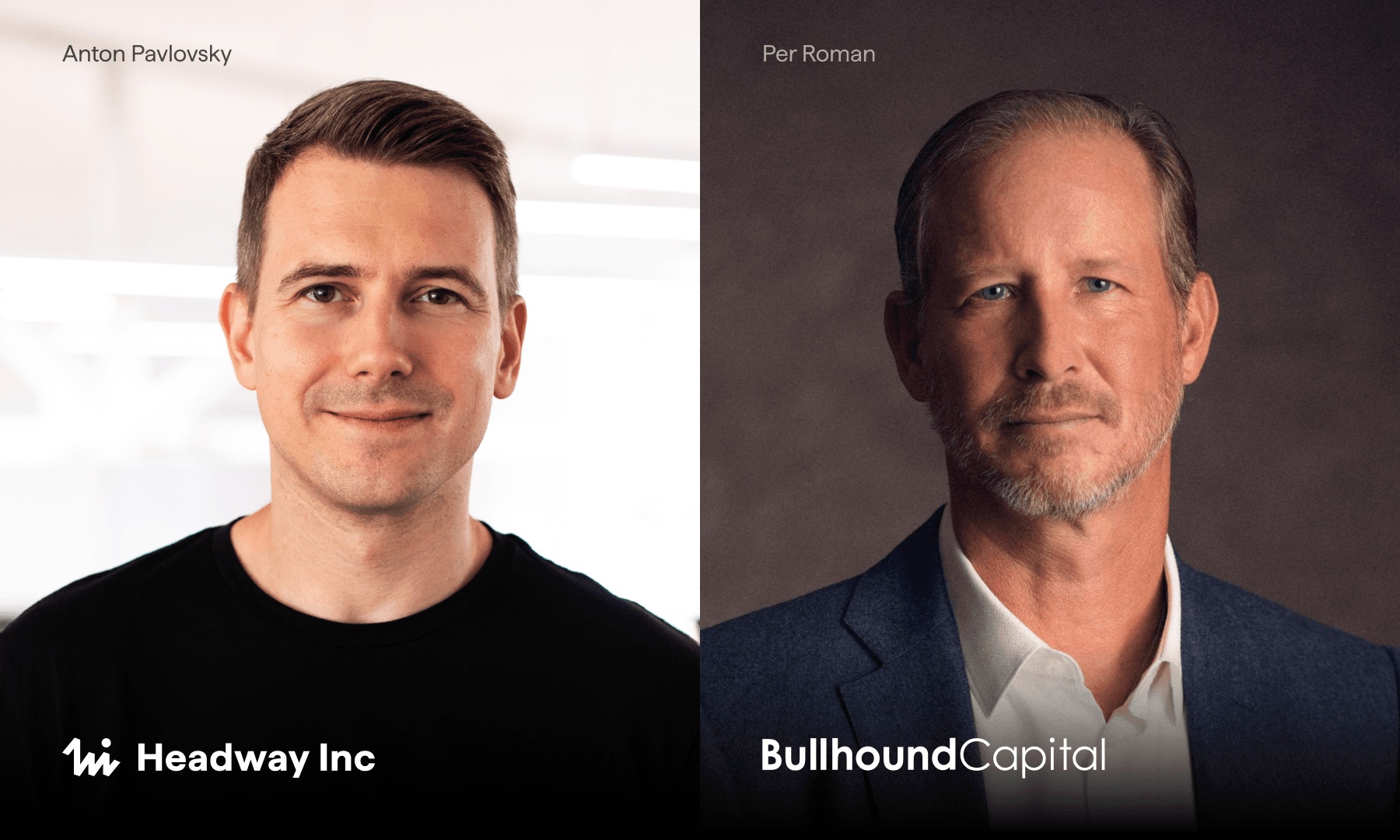
In July 2025, Headway Inc announced Series A investment from Bullhound Capital. The announcement reported 150 million downloads across more than 170 countries for the company's portfolio. It also described plans for a European hub in Madrid and the appointment of Bullhound founder and managing partner Per Roman to the board.
The investment changed the cast around Pavlovsky. An outside institution would now participate in the company's direction. Growing a collection of subscription products also meant building the governance and relationships required to support a larger organization.
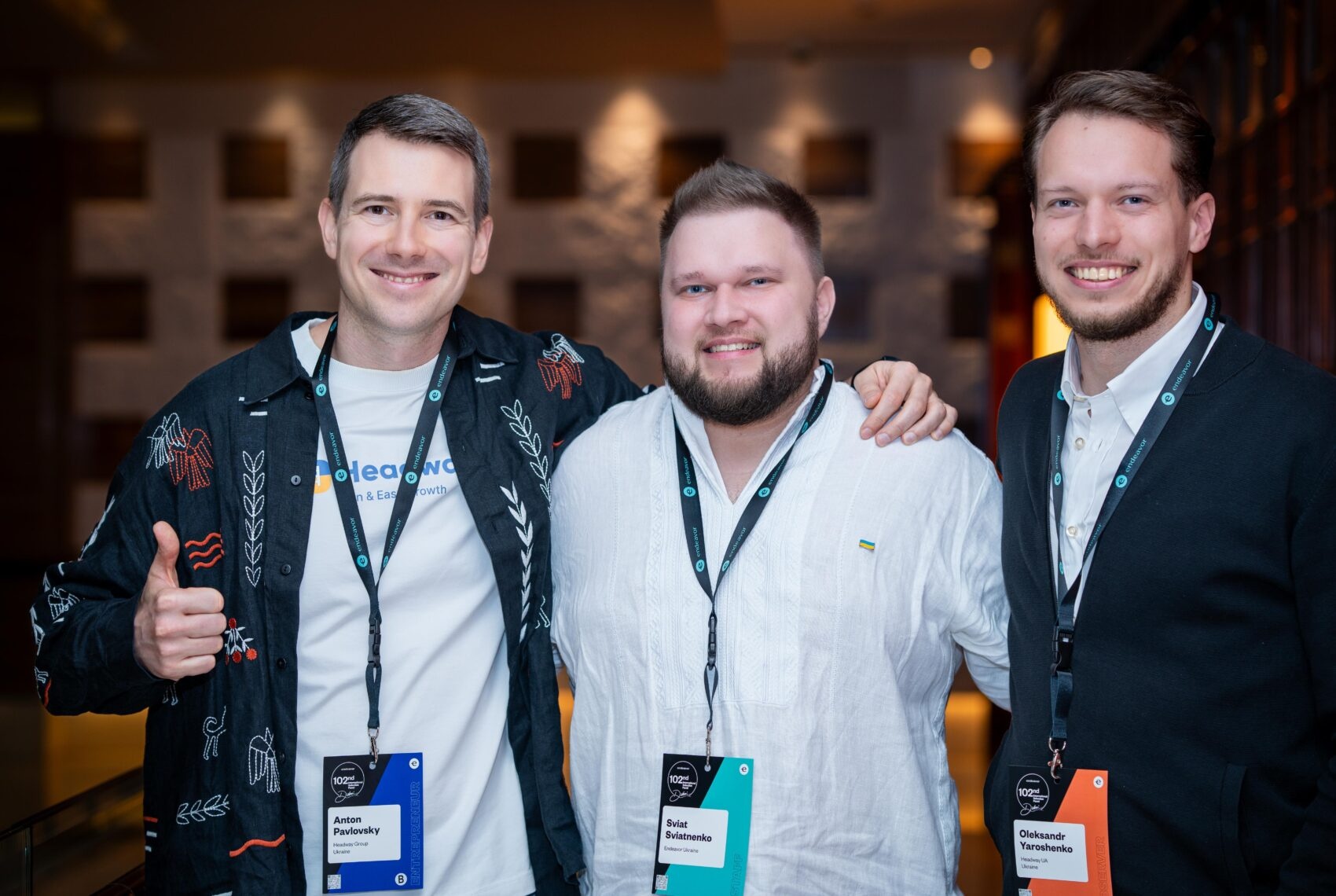
Earlier that year, he had become Endeavor's first entrepreneur selected from Ukraine. His connection to the network had an unusually long prelude: a month after founding Headway, he had discovered a podcast featuring Endeavor CEO Linda Rottenberg and Reid Hoffman and shared it with friends. Years passed before the organization opened in Ukraine and he joined it.
Leave room for a bad idea
By September 2026, Headway Inc was among the international category winners in Fast Company's Best Workplaces for Innovators. Pavlovsky's explanation of the company's culture included a memorable institution: the “Garage of Fuckups,” where costly mistakes could be discussed and lessons shared.
The name has the virtue of discouraging a polished presentation. A mistake brought into a garage sounds like something that might be examined and repaired. His description of cross-functional retrospectives put learning inside the company as well as inside its products.
He also described HUGE, a proprietary engine for generating and improving personalized user journeys. Tools developed across growth, product, analytics, and engineering had become part of how the business operated. His account emphasized giving employees enough ownership to pursue ideas, alongside room to get them wrong.
For Pavlovsky, the difficulty of learning extends to an organization. A company needs ways to keep examining its habits after those habits have brought it success. Otherwise, its experience can become a surprisingly expensive collection of assumptions.
The founder remains a reader
At the 2026 ASU+GSV Summit, Pavlovsky discussed AI-first product development, consumer learning, and the future of continuing education with GSV Ventures' Luben Pampoulov. The agenda reflected how far the business had traveled from one book-summary app.
His own reading interests supplied a different route into those questions. In a public post, he pointed to Isaac Asimov's Profession, a novella imagining knowledge transferred directly into people's minds and work assigned by a system. He asked what happens to curiosity and independent choice when information becomes instantly available.
It is an apt reading choice for someone building faster access to ideas. The speed of delivery raises a question about what people do with what arrives. Pavlovsky's business began when he wanted to make room for learning. Its future leaves him with a larger version of that problem: how to help people keep choosing to learn when answers grow easier to obtain.
The founder who once had trouble finding time for a book is still using books to think through his work. The calendar has become considerably more crowded. The curiosity has kept its appointment.