The closing bell is a wonderfully tidy invention. A day of noise, argument and money moving in opposite directions ends with one satisfying sound. Television can cut away. The companies still need investors tomorrow. Annabelle Zhang’s career has increasingly concerned itself with that less photogenic part of the story: what happens when the broadcast is over and the conversation has to continue.
Before she founded International Elite Capital, Zhang was a producer and presenter at Wall Street Multimedia. Today, IEC identifies her as its founder and CEO. She is also the founder and CEO of Allin AI, a platform built around company intelligence and capital formation. Across those roles, the recurring task is communication. The assignment has grown from explaining a trading day to helping a business make itself understood over time.
A broadcaster changes the assignment
Zhang’s earlier work included stock-market wrap programs and interviews with floor traders. She also produced and hosted a program about Alibaba’s listing and the lifestyle special New York Today. That is a useful combination for understanding her subsequent career: markets supplied the subject, while television required a person on the other side of the screen to follow it.
Her responsibilities extended beyond presenting. They included organizing intensive classes for executives from Chinese financial institutions and coordinating private discussions between American investors and Chinese companies listed in the United States. In other words, the audience was sometimes in the room. A program needed a running order; a visiting executive needed a productive exchange. Both required preparation before anyone started speaking.
There is a small, appealing detail in the description of that work. Zhang’s smile helped executives relax during demanding classes. Alongside that observation sit the more conventional assessments: attention to detail and an ability to work under pressure. The smile supplies the human scale. Financial communication can involve serious people trying very hard to look as though nothing is difficult.
“I’m a good storyteller”
Annabelle Zhang, in her March 2026 leadership interview
In that interview, Zhang described being born in China and becoming the first generation in her family to live in the United States. She recalled watching China’s economic expansion during her teenage years. Her account also raised a question about whom she wanted her storytelling to serve. Reporting and representing a company carry different responsibilities. Her later work put her directly inside the exchange between a business and its investors.
The company in two rooms
Founded in 2014, IEC has a New York headquarters and an office in Shenzhen. Its stated cross-border purpose connects Asian businesses with global investors and helps international investors understand Asian markets. Those locations give Zhang’s work a concrete geography. A company can operate in one place while seeking attention, understanding and capital in another.
That arrangement puts the company story before different audiences. An executive may know a business intimately while an investor is encountering it for the first time. What seems obvious to one person may require careful explanation to the other. Zhang’s career sits in that space between familiarity and first introduction, where a fluent presentation still has to answer the questions of someone who has no reason to take anything for granted.
IEC’s listed office locations. Geography, rather than a measure of deal flow.
The firm describes a service that changes with the company. An early-stage business may need help with a pitch deck and investor targeting. A public issuer may need analyst engagement or earnings communications. An asset manager has its own reporting and positioning needs. The practical point is that the audience and the occasion determine what useful communication looks like.
IEC’s account of its approach emphasizes learning the client’s business, competitive position and goals before choosing a strategy. Some clients seek financing; others want to develop recognition over a longer period. Those are distinct assignments. A calendar packed with activity can look impressive while leaving the original question unanswered. The firm’s stated preference is to define the objective first, then make the work accountable to it.
IEC also addresses the investors receiving those introductions. Its investor-facing materials describe access to company leadership, competitive analysis and opportunities across stages. The signup questions ask about investor type, stage preferences, sector and investment size. Even a simple form makes the matching problem visible. Someone interested in an early financing and someone following public companies may both be investors, but the same introduction will not necessarily serve both. The questions establish differences before the conversation begins.
May 16, 2022: the microphone is still on
A specific date makes the job easier to see. On May 16, 2022, Zhang hosted Datasea’s third-quarter fiscal 2022 results call as its principal U.S. investor-relations contact. The opening was procedural: welcome the audience, identify the participants and explain how the call would work. It was the orderly front door to a discussion about a public company’s performance.
The call included Chinese remarks followed by English translation, with questions accepted in both languages. Zhang explained that arrangement before handing the discussion to management. She also introduced the caution around forward-looking statements. The hosting role kept the different parts of the event legible to the people listening, rather than assuming that everyone already understood the format.
Such details reveal why the broadcast background belongs in this story. A live financial discussion needs timing, introductions and clear transitions. The people with the operating knowledge must be heard; the audience must know who is speaking and on what terms. An earnings call gives those production skills a different setting, with shareholders rather than television viewers waiting for the next sentence.
Zhang hosts Datasea’s quarterly results call as principal U.S. investor-relations contact.
For Amber International and Raytech, Zhang is listed as an IEC investor-relations contact. In that role, she is a point of contact between an issuer and the people following it. The work extends past a single announcement: a company needs a way for investors to reach the people handling its communications. That continuing access is part of the assignment.
There is another audience inside Zhang’s business: the people working there. In her leadership interview, she connected growth with responsibility for employees and the design of compensation. It is a grounded concern for a founder whose profession involves presenting companies to outsiders. Building the organization also involves obligations to the people within it. The interview’s emphasis gives the founder role a practical dimension beyond the next presentation or public appearance.
The next introduction comes early
A June 2, 2026 New York Tech Week event listing placed Zhang on a panel about the route from startup to IPO candidate. It identified her as Allin AI’s founder and CEO as well as IEC’s founder. The listed panel brought together company-building, venture-investing and public-market perspectives. Her subject had expanded beyond communicating the latest results to the decisions that shape a company’s future capital options.
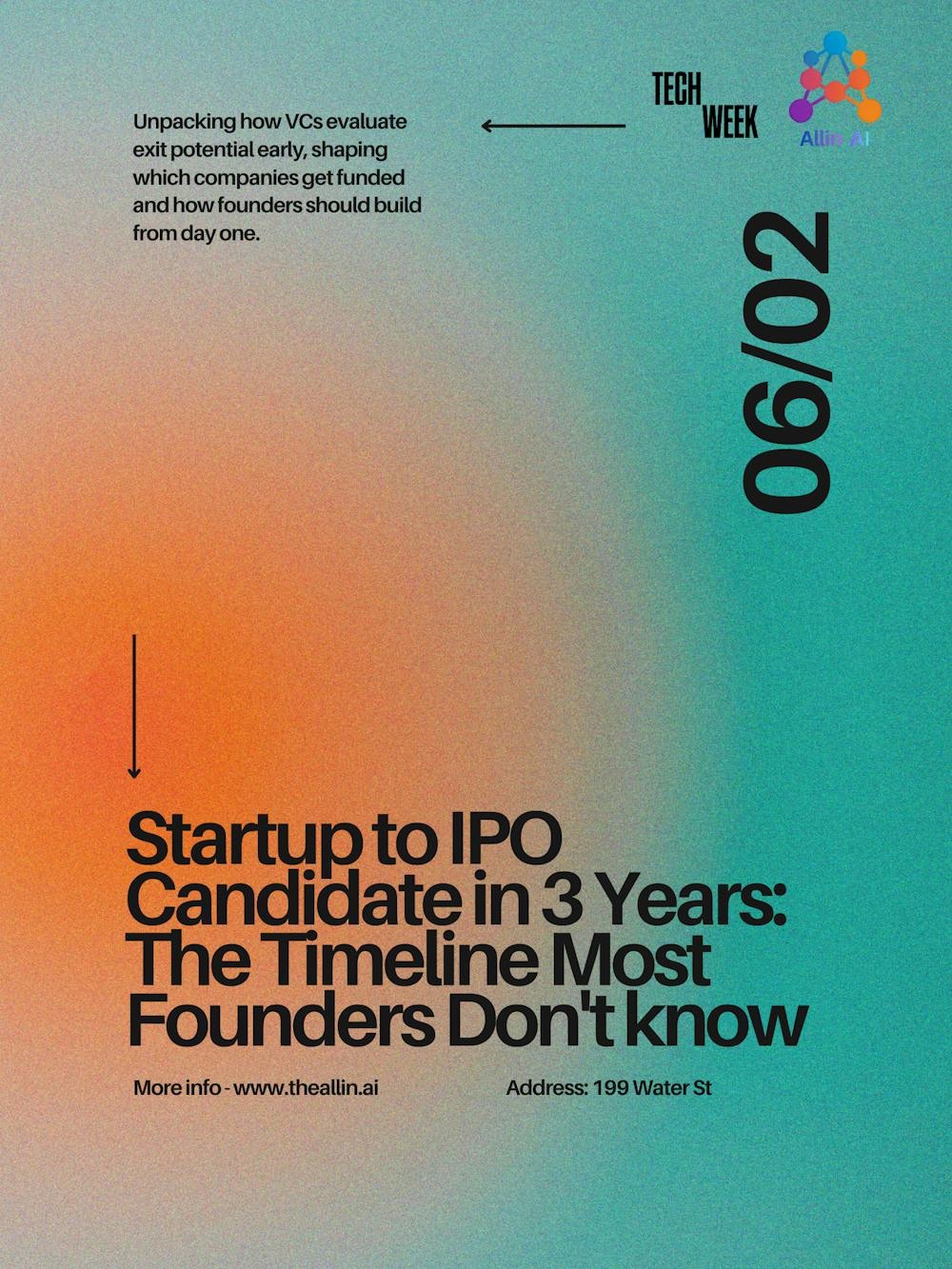
The poster is brisk about its ambition: a startup becoming an IPO candidate in three years. The phrase is a discussion topic, rather than a timetable promised for any particular business. What makes the appearance relevant to Zhang’s career is the range of the conversation. The company seeking its first capital and the public issuer explaining its next move occupy different stages of a continuing relationship with investors.
A business that remembers
Allin AI gives that continuity a software form. Its advertised Capital Brain combines information about a company with its capital-markets context. The platform describes investor matching, term-sheet benchmarking, active fundraising management and communication after a financing closes.
One especially telling part of the proposed design is interaction memory: keeping track of engagements, responses and signals so that subsequent contact can use what came before. It is a recognizable extension of Zhang’s earlier work. An introduction starts a conversation. A record of what happened next can make a later introduction less of a fresh start.
- UnderstandCompany information and narrative
- MatchInvestor preferences and fit
- ContinueEngagement history and ongoing IR
A conceptual diagram of the product’s stated functions, not a performance chart.
There is a practical question inside the ambition. Advisory work accumulates understanding through repeated contact. Software has to decide which parts of that understanding can be recorded, kept current and made useful to another person. The platform’s emphasis on company information, investor preferences and past interactions shows where Allin AI is directing that effort.
The move also brings Zhang back to the question of an audience. A presenter needs to know what listeners can follow. An investor-relations executive needs to know what investors need to understand. A software founder has to turn those needs into something people can use repeatedly. Each role asks for a different kind of delivery, while retaining the problem of making information useful to someone else.
The closing bell remains a good place to end a market report. Zhang’s work has followed the company beyond it: into an executive class, an investor meeting, an earnings call and now a platform intended to carry information between conversations. The story continues because the audience does. Somewhere after the broadcast, someone still has a question.
Follow the conversation
International Elite Capital · Allin AI · IEC on LinkedIn
Wall Street Multimedia team biography · Leadership interview with Phil La Duke · New York Tech Week event · Datasea’s May 2022 call transcript