The fish did not have a driver’s license. It did, however, have a tank mounted on a remote-control car chassis, a camera watching its position, and a student team willing to translate its movements into motor commands. The project was called IneFISHency. On his public project page, Ankush Gola described the arrangement with the cheerful precision of someone who had already accepted that the best explanation would sound improbable: a robot controlled by a fish. It was a Princeton hackathon project in 2015, and it offers a useful introduction to the engineer he would become.
A decade later, Gola helps run a company whose products sit inside a very different kind of contraption. LangChain gives developers tools to build applications around large language models. Gola, its co-founder and chief technology officer, focuses on making those applications work after the first impressive demonstration: when they need memory, permissions, a record of what happened, and a way to recover when the answer goes sideways. The fish tank and the agent trace belong to different technological eras. Both require somebody to care about the connections between the clever parts.
The pleasure of making things move
Gola studied electrical engineering at Princeton, finishing in 2015. His undergraduate thesis, still visible on his GitHub profile, concerns binocular stereo vision with quadrotor aircraft. That description is the tidy academic version of an interest visible elsewhere in his student work: sensing a messy world, processing what has been sensed, and getting a machine to do something useful with the result. The fish robot was less solemn. Its design relied on a camera tracking the animal in its tank and a microprocessor converting that position into signals for the car below. The project’s short account also records a less theoretical problem: circuits kept frying.
There was an automatic bike transmission called Byke, too. Later, at a 2017 hackathon at MIT, Gola built Produce-AR, an augmented-reality music app connected to a Bluetooth shoe peripheral. A player could register sound hits, switch instruments by hovering over the shoe, and walk through a composition to hear it play. The project page describes the delicate choreography of Bluetooth, animation, sound, and computer vision running at once. In its accomplishments section, Gola gave a verdict that any maker recognizes: “Got it working!” It is three words of triumph, and probably a summary of an exhausting weekend.
These projects are enjoyable partly because their premises are so strange. They also show a consistent preference for systems with several moving pieces. Gola did not have to choose between software and hardware, input and output, the playful idea and the practical wiring. He could make them meet. The physical prototypes became a kind of rehearsal for a later problem in which the components would be models, tools, data stores, and human decisions.
The colleague who became a co-founder
After Princeton, Gola went to Facebook. He spent four years there as a software engineer, later described by Princeton as a senior engineer. The details of individual Facebook projects are less prominent in the public record than the next move. He joined Robust Intelligence, a startup working on AI systems, and met Harrison Chase. They would eventually build LangChain together. It is an almost ordinary origin for a technology company: two people work together, learn how the other thinks, and discover that the relationship can carry a larger bet.
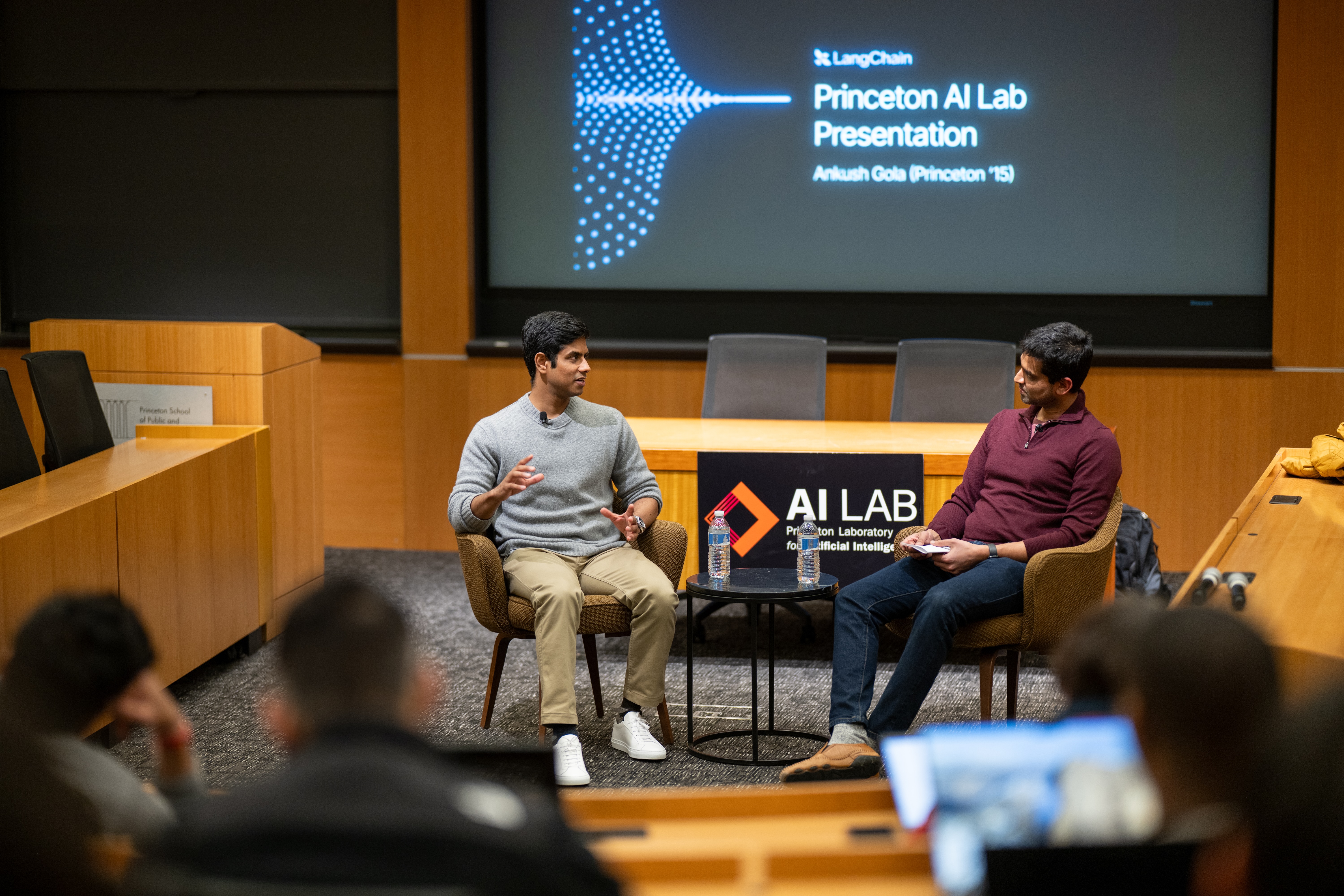
When Gola returned to Princeton for an AI Lab founders conversation in March 2026, his advice to students put this part of the story in plain view. “Surround yourself with really smart people,” he said. In the same conversation he described the value of getting to work with good collaborators again. The remark sounds practical because his own career supplies the example. Chase was a colleague before he was a co-founder.
The first version of LangChain appeared in a GitHub repository in 2022. Gola and Chase built a framework for connecting language models to the other pieces an application needs. Developers began to use it. The pair followed that interest into a company. The sequence matters because it explains why so much of Gola’s later work reads like an answer to a developer’s next question. A library can help someone assemble a prototype. A production application introduces a much longer list of concerns, and the list keeps growing as the prototype encounters users.
What happens after the first answer?
In the earliest public announcement of the company’s financing, Gola described LangChain as a company formed around open-source Python and TypeScript libraries. Its goal, he wrote, was to help developers build and maintain useful language-model applications. The word “maintain” does a lot of work. Once an application is in other people’s hands, the novel question becomes an operational one: who can access it, how can its behavior be inspected, and what should happen when it makes a mistake?
His articles for LangChain give a running account of those concerns. He has written about adding semantic search to LangGraph memory, custom authentication and resource-level access control, a common protocol for agents built with different frameworks, and a functional API that lets programmers use LangGraph features through ordinary functions. None of these topics promises a magic sentence that will solve every problem. They are the joins and fasteners of an application, which developers notice most sharply when one is missing.
In a 2024 post about the company’s documentation, Gola noted that LangChain’s Python library had reached more than seven million downloads a month. The figure was a snapshot from that year, rather than a current traffic claim. His point was that growth had made the documentation harder to navigate. The company redesigned it to make the material easier to find. For a developer tool, documentation is part of the product. It is where thousands of private experiments meet the public instructions, and where a confused reader can quietly become a future contributor or leave altogether.
“We pride ourselves as a company in being experts in building agents.”Ankush Gola, Princeton AI Lab, 2026
LangSmith, the company’s platform for testing and observing applications, brought a more demanding version of the same question. Agents can call tools, retrieve information, pause, retry, and produce a sequence of nested steps before a user sees a response. If a result is wrong, looking only at the final answer is rather like judging the fish robot by its parking spot. The route matters. Developers need traces that show what the system did and data they can search when a pattern emerges across many runs.
A database for the messy middle
In May 2026, Gola introduced SmithDB, a database built to support LangSmith’s agent observability work. His explanation began with a change in the shape of the data. Earlier language-model applications often had relatively short chains of actions. Newer agents can create hundreds of nested spans, carry large and varied payloads, and run for extended periods. A system designed to inspect those traces must keep up with both the volume and the odd shape of the records. SmithDB was built around that workload.
The technical posts that followed are unusually revealing of his day-to-day interests. Two June pieces, written with colleagues, describe the design and construction of full-text search for agent traces stored in object storage. They discuss indexes, merging, deeply nested JSON, and the unglamorous work of making fresh data searchable quickly. It is a long way from a fish tank on wheels, though the basic engineering question has a family resemblance: where is the signal, how do we track it, and how do we make the machine respond in time?
By September 2026, another part of the cycle had come into view. Gola co-authored the launch of LangSmith Fine-Tuning, which uses agent trajectories captured in LangSmith to create training data, run fine-tuning with partner platforms, and evaluate the result. The move connects observation to improvement. A trace is useful for finding an error; organized traces can also help a team decide how to make the next version behave better. In Gola’s public work, the themes are accumulating rather than replacing one another.
People are part of the system
Gola has a public presence as a writer and speaker, but the profile that emerges is chiefly an engineering one. At a 2025 engineering leadership event, his speaker biography described him as leading LangChain’s engineering efforts. At Princeton the following spring, he sat with computer science professor Karthik Narasimhan and talked through the project’s journey from repository to company. He also stated a broad ambition: he wants LangChain involved throughout the agent development lifecycle, from building to evaluation to deployment.
That ambition sounds expansive, yet it can be read as a sequence of very specific tasks. A developer must assemble an agent. Someone must see what it did. Someone must judge whether it worked. Someone must deploy a new version and understand whether it improved. Gola’s published work follows those tasks across libraries, interfaces, databases, and training workflows. The company has grown beyond the early repository, but the problems still arrive one connection at a time.
There is a pleasing loop in his 2026 Princeton visit. The former electrical engineering student returned to explain a software company whose work depends on finding structure in unruly signals. He offered students advice about the people beside them, which may be the least technical advice in his talk and the most consequential detail in his story. One of those people, met at Robust Intelligence, became his partner in LangChain. A good machine needs sound connections. So, apparently, does a career.