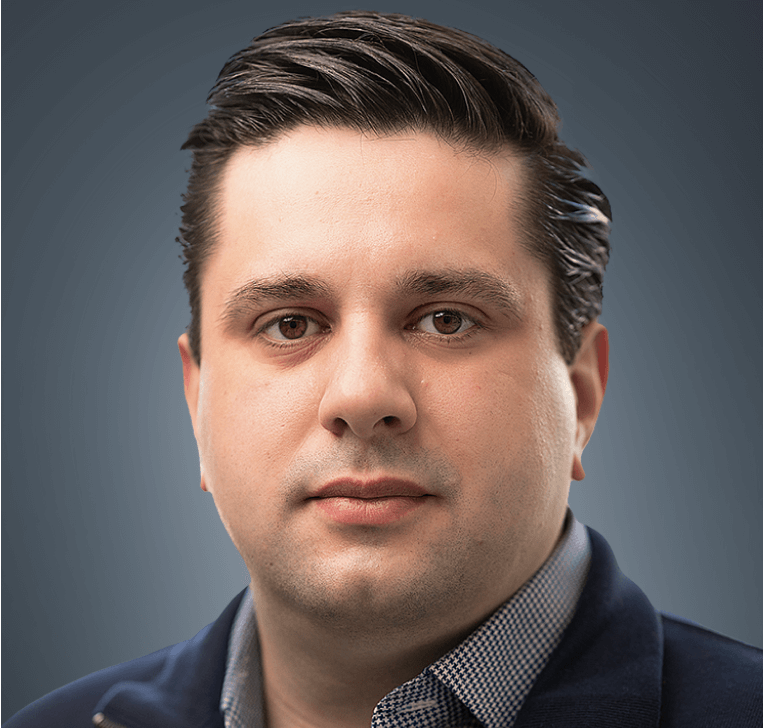
Test human medicine on human tissue. Not on mice.
Nineteen out of twenty drugs that reach the clinic fail. Andrei Georgescu's argument is that we have been blaming the drugs when we should have been blaming the mice.
Andrei Georgescu runs Vivodyne, a company that does something quietly radical: it grows real human tissues in the lab - more than twenty kinds, complete with the cell types, blood-vessel plumbing, and immune behavior of the real thing - and then lets robots and AI test drugs on them before a single person is ever dosed. The point is to find out whether a medicine works in human biology while it is still cheap and safe to be wrong.
The industry he is poking at runs on a hidden tax. A promising compound sails through animal studies, raises money, builds hope, and then collapses in human trials roughly 95% of the time. Georgescu's read is unsentimental: a model that predicts human outcomes 5% of the time is not really a model. It is a coin flip wearing a lab coat.
So Vivodyne grows the patient first. Its lab-grown tissues are about a thousand times larger than the organoids most labs work with, big enough to behave like organs rather than cell clumps. A single robotic run can spin out data from more than ten thousand independent tissue experiments, each one imaged, sequenced at single-cell resolution, and read for protein activity. The company claims it can produce more human-relevant biological data in a year than all U.S. clinical trials combined.
A model that is only predictive 5% of the time isn't a model. We're redefining success in drug discovery.
From a vial of cells to a verdict on a drug
The Vivodyne pipeline
A space-faring tissue engineer who got tired of translation loss
Before he was a CEO, Georgescu was the kind of bioengineer who sent lab-grown tissues into orbit with NASA and built DNA synthesis chips that quietly became industry staples. He studied bioengineering at Cornell, then went to the University of Pennsylvania for a PhD inside Dan Huh's organ-on-a-chip lab - the same lineage that produced the landmark "lung-on-a-chip" work that opened the whole field.
What pushed him from researcher to founder was a phrase he keeps coming back to: the loss of translation between animal studies and human trials. In 2020 he co-founded Vivodyne with Huh, who serves as chief scientific officer, to attack that gap head-on. He finished the doctorate in 2021 and kept building.
He puts the thesis in language a non-scientist can hold: "Testing on human tissue to make drugs for humans, as opposed to testing on mice to make drugs that work in mice." It sounds obvious. The fact that it is not yet how the industry works is exactly the opportunity.
"Pharma has waited decades for scalable human data before clinical trials. We're now generating data from tens of thousands of complex human tissues."
"Nineteen out of 20 drugs taken all the way to clinic will fail - simply because we've fine-tuned them on animals and not on human physiology."
$40 million, a robotic lab, and a move west
In May 2025 Vivodyne raised a $40 million Series A led by Khosla Ventures, the firm that had also led its earlier $38 million seed. The money funds a 23,000-square-foot, fully robotic laboratory at Genesis Marina in South San Francisco - a factory for human data sitting next door to the pharma giants Georgescu wants as customers.
The Penn spinout keeps roots in Philadelphia's Curtis building, but the westward move is deliberate. As Georgescu puts it, it was about plugging into "the kind of R&D and biotech ecosystems out here in San Francisco, as well as the large pharmas that also have offices out here." Build the data engine where the buyers are.
Funding trajectory
We're now generating data from tens of thousands of complex human tissues.
Timing the company to a turning tide
Georgescu is building into a moment. Regulators have started signaling a future where animal testing is no longer the automatic first step for certain drugs, and "human-first" preclinical data is moving from novelty to expectation. Vivodyne's wager is that when pharmaceutical companies are finally allowed - and then asked - to lead with human tissue, the company that already runs ten thousand tissue experiments per robotic pass will be holding the most useful map.
It is a founder profile that resists easy shorthand. Part wet-lab biologist, part roboticist, part software builder, Georgescu has assembled a stack where each layer makes the next one possible. Grow better tissue, and the robots have something worth testing. Run enough tests, and the AI has something worth learning from. Learn enough, and you can finally tell a drugmaker something true about a human being before there is a human being in the room.