A school district can hire teachers, put a computer in a child’s hands and find a way to get that computer online. Then comes another assignment: explaining the work to people who have not watched it happen. Amanda Conschafter has made a career in the territory between an institution doing something and an audience understanding it. Her route there began with English, passed through a Senate office and eventually reached the chief executive’s job at Woodberry Associates in Washington.
The title describes where she sits now. The assignments explain how she got there. Writing, editing, teaching, policy communication and client service recur across her professional background. They involve different rooms and different readers, but each asks the same awkward question: what does the person on the receiving end actually need to understand? A handsome paragraph can still leave that person entirely stranded.
To follow Conschafter’s career is to follow the changing audience. A student needs help with a draft. A constituent needs an explanation of a senator’s position. A school community needs to understand a district initiative. A colleague needs a brief that makes the next task clear. The audience keeps changing; the obligation to make sense remains.
An English education, with an audience attached
Conschafter studied at Converse College in Spartanburg, South Carolina, graduating with a bachelor’s degree in English, summa cum laude. She also earned a master’s degree in English education. The combination puts interpretation beside instruction: understanding a piece of writing and helping someone else understand it. Her subsequent work included writing tutorials and workshops in academic and business settings.
Teaching writing exposes the distance between an author’s intention and a reader’s experience. The author knows the missing background. The reader does not. The author hears the desired emphasis. The reader encounters the words in the order they appear. That difference is ordinary enough to escape notice, and consequential enough to occupy an entire profession.
Her connection to Converse continued after her student years. The college’s summer 2017 magazine placed her on its alumnae association board. A winter 2018 newsletter identified Amanda Cartwright Conschafter, class of 2004, as the representative for the 2000s decade. Here was a further audience to consider: graduates whose shared institution connected people separated by graduation years and geography.
There is a pleasing continuity in that return. A college trains a writer; the graduate later helps represent its graduates. The relationship becomes an ongoing responsibility rather than a line that stops at commencement. For Conschafter, education appears in her training, her service and her professional assignments.
The sentence enters the Senate
Conschafter served on the legislative staff of U.S. Senator Lindsey Graham. Her work included communicating his positions on education, the judiciary and entitlement programs. Those subjects call for explanations of institutions and rules that can be familiar to the office writing about them and unfamiliar to the person opening the response.
The setting gives writing a particular constraint. A policy position belongs to the elected official. The staff member has to communicate it accurately and intelligibly. Literary flourish has limited value if it obscures the answer. The reader has a reason for asking, and the reply must meet that reason somewhere in the middle of the page.
Her later experience included communications for corporate and nonprofit clients, work on a technology firm’s marketing and proposal team, and freelance assignments involving education policy and veterans employment. The formats changed along with the institutions. A proposal, for example, has to answer a request. An explanation has to make an issue comprehensible. A message for a nonprofit has to give an unfamiliar reader enough context to care.
These are different uses of the same craft. They also prevent a neat division between practical writing and serious writing. When an institution needs somebody else to understand what it does, the practical details become the subject. A missing explanation can matter more than an elegant opening.
A school’s work needs a public life
In October 2022, Conschafter published an essay calling on education leaders to communicate their progress. She pointed to specific responses to school challenges: a teaching approach in Dayton, expanded internet access in Mountain View Whisman and a teacher preparation program in Tennessee. Her argument gave public explanation a place alongside the work of improvement.
“In addition to innovating, they must be communicating,” she wrote. The audiences she named extended beyond parents to community and state leaders, businesses and the media. A district’s internal knowledge would have to travel beyond its own offices if other people were to understand the work.
There is a useful editorial demand in that argument. An institution asking for attention should bring particulars. Who is involved? What has changed? How does a person encounter the change? Those questions give a reader something firmer than a promise of progress. They also make it possible to examine the promise.
A communications argument is most interesting when it meets an actual assignment. In Conschafter’s case, a school district brief provides that meeting. The work has nouns attached: housing, internet access, funding and spokespeople. Suddenly the familiar phrase “strategic communications” has a desk, a deadline and something to explain.
“In addition to innovating, they must be communicating.”Amanda Conschafter · October 2022
The brief has verbs in it
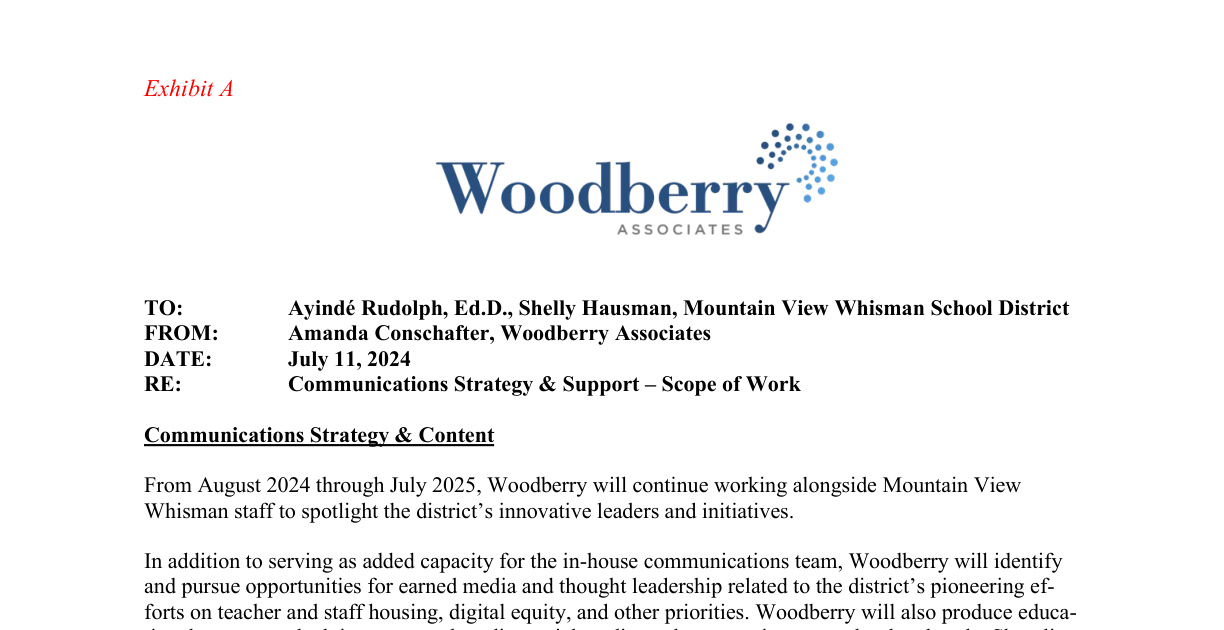
A July 11, 2024 scope of work from Conschafter to Mountain View Whisman School District set out communications support for the following academic year. It described work alongside the district’s staff, including additional capacity for its existing communications team. The priorities included teacher and staff housing, digital equity and explanations connected to school funding.
The document called for gathering details about district initiatives and developing materials such as case studies, profiles and question-and-answer documents. Media outreach and preparation for spokespeople were also part of the assignment. These were proposed responsibilities in a scope of work, rather than a list of outcomes already achieved.
Each format solves a different reading problem. A profile gives an initiative a person. A case study supplies sequence and detail. A question-and-answer document lets the reader begin with the concern they already have. Choosing among them is part of the work. Publishing every available fact in one enormous document is a fine way to prove that facts can be lonely.
The brief also makes collaboration visible. The district has knowledge of its own operations; the communications team helps turn that knowledge into material other people can use. The result depends on the handoff between them. A polished explanation needs something sound to explain, and a sound initiative needs an explanation that survives outside the meeting room.
From the communications team to the whole firm
At Woodberry, Conschafter led the Strategic Communications team before becoming CEO. She now oversees client service delivery and supports the firm’s professionals from its Washington headquarters, while continuing to oversee the communications division. The broader role carries her earlier field of work into executive responsibility.
The organization around her includes people working in public affairs, advocacy management, events, digital strategies and communications. Brian Kennedy is its president. Josie Cooper and Ryan Gough hold partner and senior vice president roles. A message moving through such a firm can involve several kinds of expertise before an outside reader ever encounters it.
That makes the writer’s familiar problem larger. In a draft, the parts must fit together. Across a team, the assignments must fit together. The analogy has limits, of course; colleagues are entitled to opinions in a way that subordinate clauses seldom are. But both settings reward clarity about what belongs where and what has to happen next.
Conschafter has also publicly invited students to apply for paid public affairs internships. One colleague, Olivia Giovenco, later described her own move from a Woodberry internship to a communications associate role and thanked Conschafter and Rachel Reh for their guidance and trust. It is a small, specific view of a career continuing through someone else’s first assignments.
Backpacks belong in the story, too
For the start of the 2024-25 school year, Conschafter celebrated Woodberry’s contribution to a school supply drive for Washington’s Ward 5 Violence Prevention Network. Her post described a collection with plenty of the unglamorous objects that classrooms require. The detail brings education down from the policy level to the equipment a child can actually carry.
The scene offers a modest ending for a story that reaches the executive office. Public affairs can concern institutions, systems and the language around decisions. A school supply collection concerns the objects needed on Monday morning. Both belong to the account she has shared of her team’s work.
Her career gives education several roles: a field of study, a subject of public communication, an institution to serve and a local community to support. Those connections are more revealing than a grand declaration about a calling. They recur in things she has done and assignments bearing her name.
The useful detail in this career is how often someone else must be able to use the result. A school family, a public official, a client and a new colleague arrive with different questions. Communication begins by taking those questions seriously, before deciding how impressive the answer should sound.
Conschafter’s public professional story is built from that accumulation. English studies. Writing instruction. Senate communication. Client assignments. School district briefs. Team leadership. The chief executive’s title is the latest responsibility in that sequence. Underneath it sits a task that a teacher, an editor and a manager can all recognize: giving another person what they need to take the next step.