Catching Up Mid-Stride
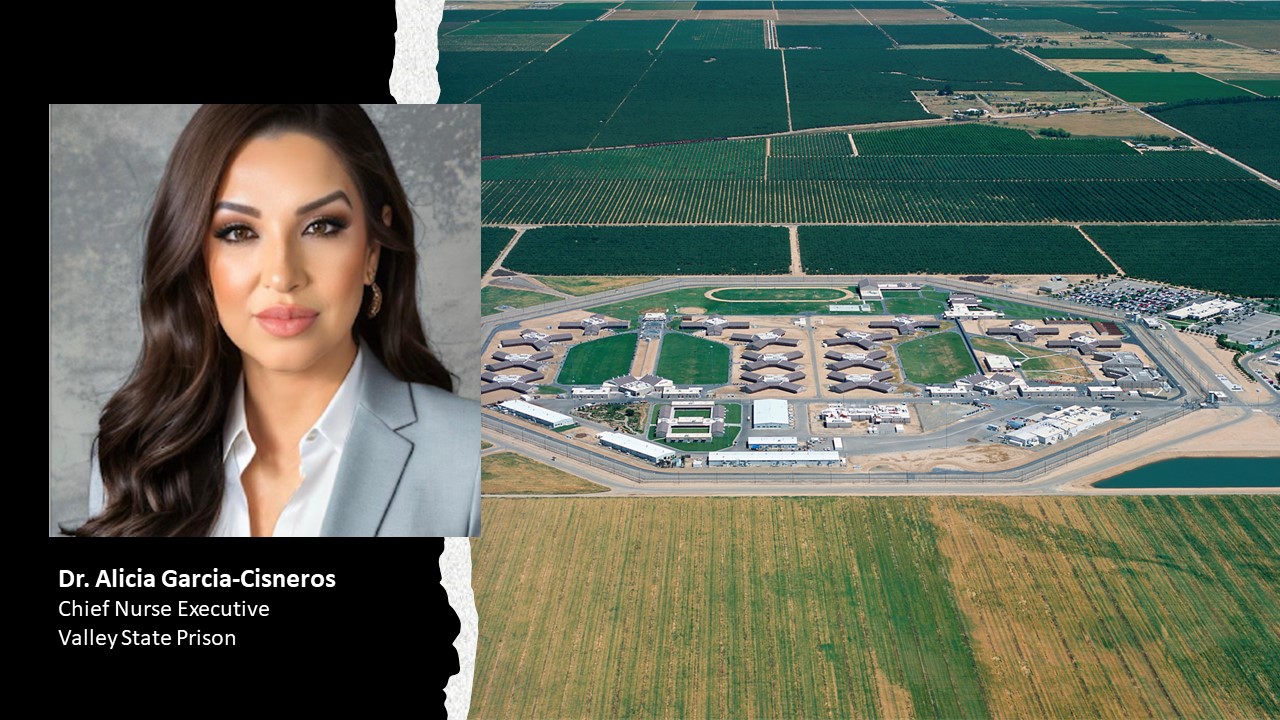
Valley State Prison is not where you expect to find a Watson scholar. It is a 1,700-acre facility in Chowchilla, California, in the flat agricultural heart of the San Joaquin Valley, housing close to 3,000 women in the custody of the California Department of Corrections and Rehabilitation. The healthcare inside those fences is run by the California Correctional Health Care Services, a system born out of federal receivership and chronic constitutional violation, now one of the largest correctional health operations on earth. Dr. Alicia Garcia-Cisneros is its Chief Nurse Executive at that facility, and she arrived with a Caritas Coach certification and a plan.
A Career Built from the Bottom Up
There is a tendency in healthcare leadership profiles to start with the terminal degree and work backwards. Garcia-Cisneros earned her DNP in 2018-2019 from the University of San Francisco's Executive Leadership program - a two-year intensive that covers systems leadership, enterprise risk, health policy, and financial management. The degree matters. But what comes before it matters more for understanding who she is.
She started as a Certified Nursing Assistant. She became a Licensed Vocational Nurse. She spent approximately ten years in nursing school while working clinically, before earning her RN. During her final RN semester, she rotated through a stage IV cancer oncology unit - the kind of environment where you learn very fast what caring actually means at the bedside, and what it costs the people who do it. The credentials after her name - DNP, MSN, RN, NEA-BC, Caritas Coach - do not represent a linear shortcut. They represent a staircase that she built herself, one step at a time.
The California Pivot
Before CCHCS, she had already run nursing programs at institutions most nurse executives would consider destination jobs. Director of Nursing, Maternal Child at Stanford Health Care ValleyCare. Leadership roles at Good Samaritan Hospital in San Jose. Salinas Valley Memorial Healthcare System. Her credentials, experience, and board certification were portable currency in the Bay Area's competitive healthcare market. She chose correctional health anyway.
The decision to join CDCR in early 2023 - first at the Correctional Training Facility in Soledad, then at Valley State Prison by June - was not a step down. It was a deliberate move toward the most underserved patient population in California: the incarcerated. CCHCS was created to fix a system that federal courts found so broken it constituted cruel and unusual punishment. Two decades of reform later, it is still, functionally, a public health challenge on an enormous scale. For someone trained in both executive leadership and Caritas coaching, it is also a calling.
What She Built at Valley State Prison
Within months of arriving at VSP, the moves were institutional, not cosmetic. The Peer Support Specialist Program - where trained peers provide support to other incarcerated individuals - received her leadership attention and advocacy. Shared Governance structures, which give bedside nurses formal input into clinical decisions, were implemented. Multidisciplinary teams were convened to develop nursing protocols. Staff wellness rooms - physical spaces designed to support the psychological needs of healthcare workers in a correctional setting - were established and promoted.
Each of these is, in isolation, a reasonable initiative. Together, they represent a coherent philosophy: that the quality of care provided to any patient depends on the wellbeing and agency of the people providing it, and that the institutional structures around clinical work either support or undermine both. This is Watson's Human Caring Theory made operational. It is also, for anyone who has worked inside a correctional facility, genuinely difficult to pull off inside a bureaucracy built for something entirely different.
The Recognition and What Comes Next
In May 2026, at the CCHCS Nursing Excellence Awards ceremony in Elk Grove - held during National Nurses Week, as the profession's recognition season - Dr. Garcia-Cisneros received the Distinguished Practice Award. The award, chosen through formal nomination and committee review, recognizes staff whose professional contributions improved nursing practice. It is not an award for tenure or seniority. It is awarded for impact.
She has stated her aspirations directly: Fellow of the American College of Healthcare Executives, and public speaking on nursing leadership best practices. For someone who grew up watching her parents work tomato fields and who climbed every rung of the clinical ladder before earning a doctorate, the ambition is earned and specific. She is not done. She is mid-stride.