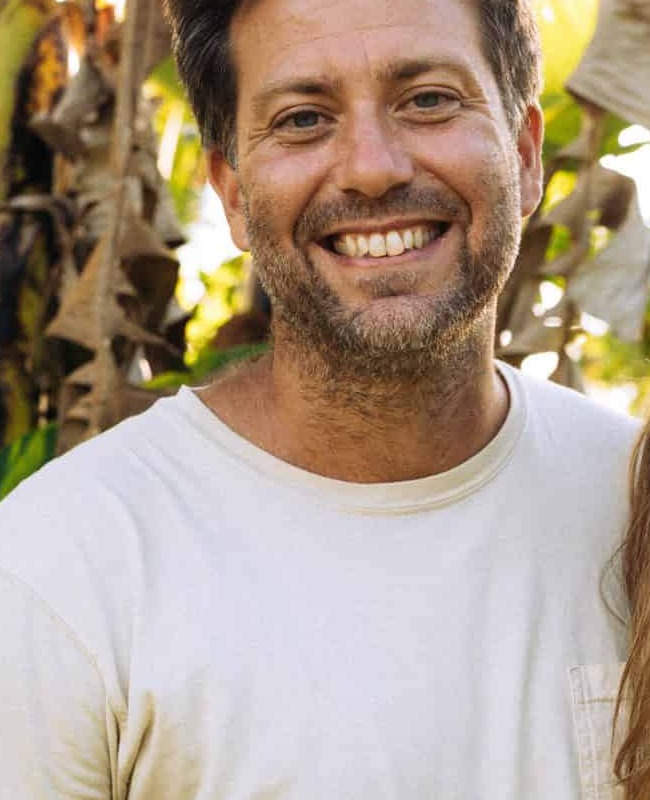
Alex Abelin runs a food company from a banana grove on Kauai. The flagship product is Kiki Milk - a shelf-stable, organic plant milk poured from oats, bananas, sprouted pumpkin seeds and a calcium drawn from marine algae. No gums. No seed oils. No synthetic flavors. It is the kind of label you can read out loud at a kitchen table without tripping over a single ingredient, which turns out to be the entire point.
This is his third act, and the least likely one. Abelin is the co-founder and CEO of PlantBaby, the company behind Kiki Milk, and the through-line of his career is not an industry. It is a habit: he keeps finding a gap in his own life and deciding, against all reasonable advice, to fill it himself.
Before the cartons, there were kiosks. Before the kiosks, there was a job board. Before any of it, there was Google. Abelin joined at 22, fresh out of the Haas School of Business at UC Berkeley, and stayed for more than seven years across public affairs and account strategy roles. Then he did the thing most people only fantasize about: he left, put on a backpack, and disappeared into Southeast Asia alone.
"True disruption leads to value creation - making a product healthier, better."- Alex Abelin
He came back a builder. First came LiquidTalent, a marketplace matching technical talent with the companies chasing it. Then LQD WiFi, a swing at the unglamorous bones of the modern city - connected kiosks that reimagined the dying payphone as a piece of smart-city infrastructure. In 2016, Verizon acquired LQD WiFi, and Abelin joined the telecom giant as an Urban Affairs Manager inside its Smart Cities division. By most founder scorecards, that is the win: build it, sell it, bank it.
He could have run that play a fourth time in tech. Instead he moved to Hawaii, and the brief changed completely.
The pivot nobody scripts
The origin of PlantBaby is almost comically ordinary. Abelin and his wife, Lauren, were new parents looking for a clean, whole-food plant milk for their son, Alakai. They wanted something organic, made from real food, without the gums and synthetic fillers that crowd the back of most cartons. They could not find it. So, in March 2020, they built it - and named the first product after the milk itself, Kiki.
What started as a fix for one family became a thesis about an entire category. Most plant milks were designed for adults who wanted coffee creamer. Abelin and Lauren formulated Kiki Milk in the other direction entirely - whole-food ingredients, organic certification, non-GMO, glyphosate-residue-free, with input from experts who study how kids actually grow. The company's stated mission is three verbs: nourish, inform, and empower the next generation.
It is a tidy slogan. It is also, by 2024, a real business. PlantBaby reported $4.8 million in revenue that year, selling through its own website and a roster of retailers that reads like a tour of where conscious shoppers actually shop: Sprouts, Wegmans, Erewhon, Amazon, Thrive Market. In early 2025, the company closed a roughly $4 million seed round led by B2 Partners at a $20 million post-money valuation, with backing from Big Idea Ventures, Everywhere Ventures, X Factor Ventures, Women's Equity Lab Silicon Valley, and Babylist - bringing the total raised to around $7 million.
The bet sits at a strange intersection: a $10 billion U.S. dairy-alternative market crossed with a $53.6 billion children's food and beverage category. Plenty of companies fish in one pond or the other. Abelin built a boat for the overlap.
A founder's operating system
Ask him how he survives the grind of a third company and the answer is not about hustle. It is about distance. "Don't take it personally," he says of the inevitable rejections and setbacks. "Create separation between you and the business." He reads Eckhart Tolle, leans on mindfulness, and talks about aligning "head, heart and guts" before committing to anything - which is a polite way of saying he has learned the hard way that a great idea you don't actually care about will quietly kill you.
There is a lightness to how he runs things, too. He talks about not taking the work so seriously that you forget to mark the wins - celebrating milestones rather than sprinting past them toward the next fire. For a man on his third startup, that is less a personality trait than a survival skill.
The roadmap, naturally, keeps growing. Kiki Milk already ships in Original, Chocolate, Mac Nut and Unsweetened. On the whiteboard are extensions that turn one carton into a pantry - Kiki Yo, Kiki Ice Cream, toddler milk, superfood sprinkles, and eventually a clean-label plant-based formula. The ambition is not a single hit product. It is to reset the default for what a family pours, scoops and sprinkles from the first year of life onward.
The patient part: distribution
Plenty of founders can formulate a clean product. Far fewer can get it onto a shelf where a busy parent will actually reach for it. The unglamorous story of PlantBaby is the retail grind - moving from a website checkout to the cold case at Sprouts, the aisles of Wegmans, the cult shelves of Erewhon, the search bar of Amazon, and the subscription pantry of Thrive Market. Each of those is its own negotiation, its own set of margins, its own logistics puzzle for a shelf-stable carton shipping out of Hawaii. The $4.8 million revenue figure is the headline. The distribution map underneath it is the actual work.
The cap table tells you who believes the thesis. The 2025 seed round was led by B2 Partners, with a roster that skews toward people who understand both food and families: Big Idea Ventures, Everywhere Ventures, X Factor Ventures, Women's Equity Lab Silicon Valley, and Babylist - the last a registry platform that lives at the exact moment new parents start making decisions about what to buy. For a brand aimed at the first years of a child's life, an investor base wired into that audience is not an accident.
It is worth noticing how consistent the man underneath the pivots actually is. The payphone kiosk and the milk carton look nothing alike, but they rhyme: both are attempts to take something the world had stopped paying attention to and rebuild it for how people live now. Abelin describes himself as driven by "a love of people, planet, and the power of ideas that can make the world a better place." Coming from a serial founder, that should read as a slogan. The odd thing is that the receipts - a Verizon exit, a profitable food brand, a backpack trip taken alone in his thirties - keep backing it up.
There is a tidy MBA version of this career, the one where the Haas graduate climbs a single ladder and optimizes. Abelin did the opposite. He treated each company as a complete sentence rather than a stepping stone, walked away from a comfortable Google badge to wander Asia, and then walked away from a clean tech exit to mix plant milk in Hawaii. The connective tissue is not the category. It is the refusal to accept that the existing version of a thing is the final version - whether that thing is a payphone, a hiring process, or what a family pours into a glass.
He is not the founder who fell into one lucky lane and rode it. He is the one who keeps walking off the map, and somehow keeps drawing a new one.