A chemist who decided the nanoparticle should do the thinking
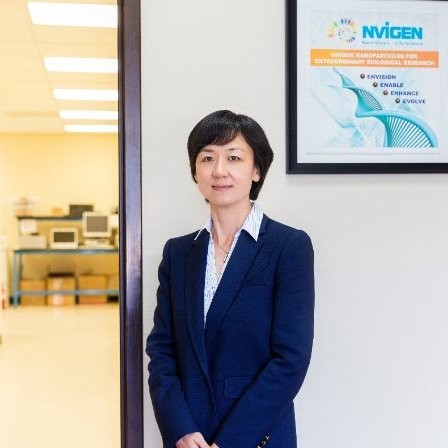
Aihua Fu runs NVIGEN, an 11-person nanobiotechnology company tucked into San Jose, and her bet is unusual for the genomics era: don't build a bigger machine, build a smarter speck. Most diagnostics companies sell instruments - boxes that read your blood. Fu sells the chemistry that goes inside them. Her magnetic and fluorescent nanobeads grab DNA, fish out circulating tumor cells, pull RNA from the contents of a single aspirated cell, and light up proteins, so the box has something worth reading in the first place.
The mission has a deadline shaped like a relapse. NVIGEN's flagship platform, NVIGEN X, is built to read DNA, RNA, protein and cell signals together from a blood draw and predict cancer recurrence at the earliest possible moment - the window when intervention still changes the ending. That is the whole company in one sentence: catch the return before a scan can.
It is a strange place for a person to land who started by arranging gold particles and quantum dots on strands of DNA. But the through-line is consistent. Fu has spent two decades convincing matter at the billionth-of-a-meter scale to behave - first in a Berkeley lab, then at Stanford, and now in a product catalog.
From Beijing to Berkeley, by way of the periodic table
Fu earned her B.S. at Beijing University of Chemical Technology, an M.S. at Rutgers, and then walked into one of the most consequential addresses in modern nanoscience: the UC Berkeley group of A. Paul Alivisatos, where she completed her Ph.D. in Chemistry between 2001 and 2006. Alivisatos helped invent the modern semiconductor quantum dot. Fu's job was to make those dots useful to biology.
She did. Her name sits on early papers that now read like a field's table of contents - "Discrete Nanostructures of Quantum Dots/Au with DNA" in the Journal of the American Chemical Society (2004), and "Semiconductor Quantum Rods as Single Molecule Fluorescent Biological Labels" in Nano Letters. The work asked a deceptively practical question: can you make a glowing crystal small enough, stable enough, and specific enough to tag one molecule and watch it? The answer turned out to be yes, and it turned out to be a business.
Don't build a bigger machine. Build a smarter speck.
Her postdoc at Stanford widened the aperture. Working under engineer Shan X. Wang and molecular-imaging pioneer Sam S. Gambhir, she engineered nanoparticles with enhanced properties for in vitro diagnostics and in vivo cancer imaging and drug delivery. One advisor thought like an electrical engineer; the other thought like a clinician chasing a tumor through a living body. Fu absorbed both grammars - the device and the disease - which is exactly the bilingualism a founder in this field needs.
The pedigree, drawn as a circuit
Scientific careers are inheritances. Here is the line that runs into NVIGEN's reagents.
UC Berkeley. Quantum dots invented and refined. PhD, 2001-2006.
Wang & Gambhir. Nanoparticles for diagnostics, imaging, delivery.
Nanoparticle-Imaging-Delivery. Tunable size, shape, surface, magnetics.
Multiomics cancer profiling. Recurrence, caught early.
What a smart speck actually does
NVIGEN's catalog is a tour of the unglamorous middle of genomics - the sample-prep steps everyone needs and nobody photographs. Magnetic beads (MagVigen, MaxVigen) for capture and separation. cfDNA extraction kits. DNA size selection. Protein diagnostics and immunoassays. Rare-cell capture for circulating tumor cells. In 2024-2025, an independent study published in PLOS ONE benchmarked the MagVigen magnetic nanoparticles as top-performing - the kind of third-party result that matters more than any brochure.
Then there is the part that sounds like science fiction and isn't. NERNST-Seq - Nanoparticle Enhanced RNA Spatial and Temporal Sequencing - uses a nanopipette to aspirate the minuscule contents of a single cell, captures the RNA on magnetic nanoparticles, and sends it to sequencing. You can read a cell without destroying its neighborhood. For tissue biology, that spatial fidelity is the whole point.
The flagship: NVIGEN X
NVIGEN X is the company's swing for the clinic - NGS and multiomics cancer precision profiling designed to be highly sensitive and data-efficient, integrating DNA, RNA, protein and cell information. The goal stated plainly on NVIGEN's own pages: predict cancer recurrence at the earliest possible time and guide the most effective personalized therapy. A liquid biopsy that doesn't just confirm what a scan already saw, but speaks first.
The award shelf
Before the company, there was a wall of recognition that reads like a who's-who of who funds hard chemistry.
The NIH Pathway to Independence Award is worth a second look. It is given to researchers the NIH expects to run their own labs - a federal bet on a scientist's future independence. Fu took that independence and pointed it at a company instead of a faculty line.
Two decades, one scale
Things worth knowing
A blood draw that speaks first
Ask what success looks like and the answer is uncomfortably concrete: a person finishes cancer treatment, goes home, and a routine blood draw - not a frightening scan months later - is the first thing to whisper that something is coming back, early enough to act. That is the bet behind NVIGEN X, and it is the reason a chemist who could have spent a career arranging beautiful crystals chose instead to spend it on sample-prep kits and recurrence assays.
Catch the return before a scan can.
The romance of nanoscience is the imagery - glowing dots, spinning rings, matter folded by DNA. Fu's contribution is less romantic and more durable: she insisted the dots clock in. They have a job now.
Links & sources
Compiled from public sources including NVIGEN.com, Crunchbase, LinkedIn, peer-reviewed publications, and trade press. Facts presented are drawn from those sources; where the public record is silent, this profile stays silent too.