A Texas startup is towing engineless gliders behind cargo planes - reviving a WWII idea to move freight cheaper by air.
Aerolane's pitch is disarmingly simple: attach a rope to a cargo plane, hitch an engineless glider to the other end, and let one set of engines pull two loads through the sky.
The company, formally Aerolane Edge Logistics, Inc., calls the arrangement a "sky train." A conventional turboprop - Aerolane's testing centers on the Saab 340 - acts as the tractor. Behind it trails a purpose-built glider, the Aerocart, carrying cargo but no propulsion of its own. In flight the glider settles into the lead aircraft's slipstream, drafting off its wake much the way a migrating goose drafts off the bird ahead. Remove the engine, the fuel, and the weight that comes with them, Aerolane argues, and the economics of air freight change.
The idea is not new, and Aerolane does not pretend otherwise. Cargo gliders ferried troops and jeeps behind tow planes during the Second World War. What is new is the modern flight-control, autopilot and certification work needed to make aerotowing safe, repeatable and commercially useful. "We're just dusting off some of the most proven concepts in aviation history and modernizing them with today's technology," co-founder and CEO Todd Graetz has said. "It's far less radical than anyone thinks."
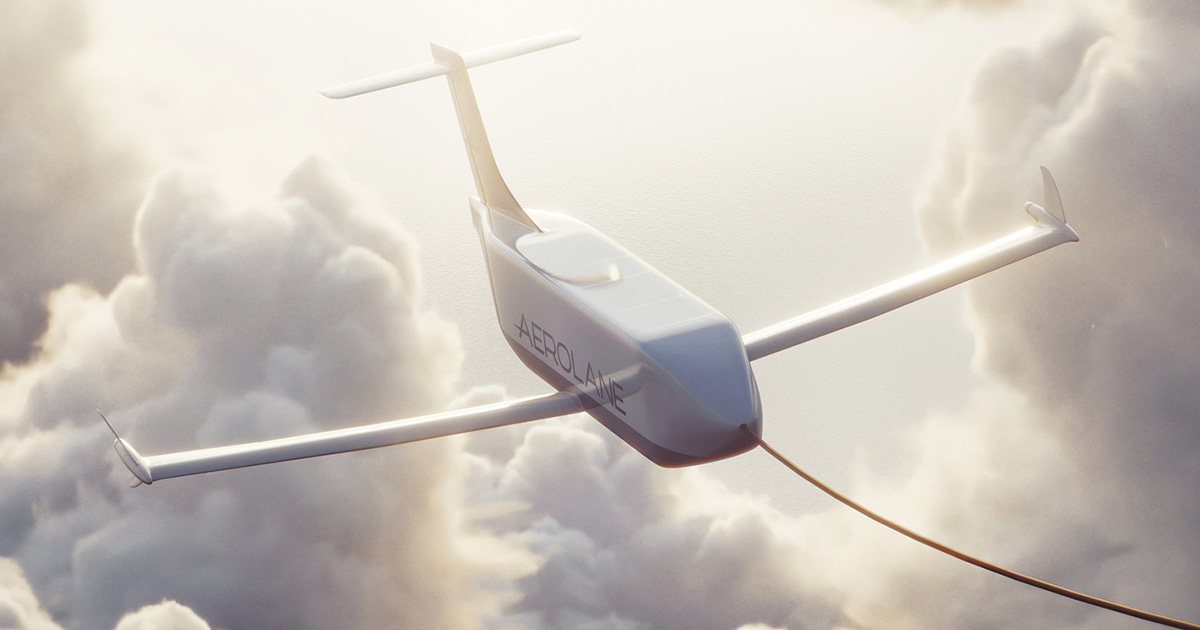
A standard engined aircraft - the tractor - launches with the glider connected by a single-pilot, quick-connect tow line with multi-length rope capability.
Aloft, the engineless Aerocart positions itself in the lead plane's slipstream, cutting drag and "surfing" the wake to fly efficiently on borrowed energy.
The pair covers regional cargo routes together, moving a second load of freight without a second set of engines burning fuel.
Figures reflect Aerolane's public claims; the system remains in FAA Supplemental Type Certification.
"Is it possible to enable the capabilities and speed of air at the cost of ground transportation?"Aerolane's founding question
Aerolane offers the concept in two flavors - one that pairs two powered aircraft, and one that swaps the trailer for a purpose-built glider with no engine at all.
A purpose-built, engineless glider towed behind a Saab 340. Designed for aerodynamics from the start, it targets the deepest cost savings by eliminating engines and fuel on the trailer.
Two standard engined Saab 340s operated as a connected pair in formation. A lower-risk entry point that still stretches range while a second aircraft rides efficiently behind.
The connective tissue: a single-pilot quick-connect tow rig, drop-in ready for existing airframes without extended downtime. Optimizes glider position in the slipstream.
Aerolane's roadmap points toward autonomy that lets a single crew operate two aircraft at once - moving the glider toward autonomous towed flight.
Aerolane's claimed operating-cost reduction depends on the configuration - the further you move from two powered planes toward an engineless glider, the bigger the gap.
Source: Aerolane product materials and public statements. Figures are company claims, not independently audited.
Air freight is fast and expensive; trucking is cheap and slow. Aerolane is aiming at the gap between them - air speed at something closer to ground cost - inside a global air-freight market it pegs at roughly $135 billion.
That framing sets it apart from most aerospace startups, which tend to design radical new airframes or bet on electric propulsion. Aerolane's differentiator is subtraction: it removes the most expensive component - the engine - from half the formation, and it does so with a system meant to drop into aircraft carriers already fly.
Its competitive field includes conventional freighter operators and a new generation of cargo-aviation ventures such as Natilus, Elroy Air and Grid Aero, as well as the intermodal trucking that handles time-sensitive freight today. Aerolane's wager is that certifying a towed glider is a nearer-term path to real payload than building an all-new aircraft.
The customers it courts are regional air-cargo carriers and logistics shippers who feel every point of fuel cost. A reported $300 million contract with an unnamed large regional carrier - signed while the glider was still in certification - is the clearest early sign the math resonates.
The founding team draws from Amazon Prime Air, BNSF Railway's drone program, Israel Aerospace Industries and the FAA - people who have certified hard things before.
Kimchi co-founded Amazon Prime Air; Graetz ran BNSF Railway's beyond-visual-line-of-sight drone program.
Veterans of Amazon Prime Air, BNSF, IAI and the FAA launch the company in Southlake, Texas.
Experimental testing of towed-glider prototypes begins across the southern United States.
The company raises roughly $10-11.5M, led by New Vista Capital with other aviation investors.
Aerolane details its C-Series pair and G-Series engineless glider on the Saab 340 platform.
Aerolane opens flight operations at Perot Field Fort Worth Alliance Airport to advance FAA certification.
Aerolane closed an initial seed round of roughly $10-11.5 million in 2023, with investors including New Vista Capital, Shasta Ventures, Ascend, Sand Hill Angels and RedBlue Capital - among them former Boeing chairman and CEO Dennis Muilenburg.
Sources: Aerolane.com, Interesting Engineering, New Atlas, Transport Topics, Dallas Innovates, Fort Worth Report, Crunchbase, CB Insights. Figures marked "claimed" or "reported" reflect company statements pending independent verification.