Person / Founder / Aviation
Todd
Graetz
He runs Aerolane, which wants to move air cargo at the price of a truck. The method is a rope, a glider, and a very old idea.
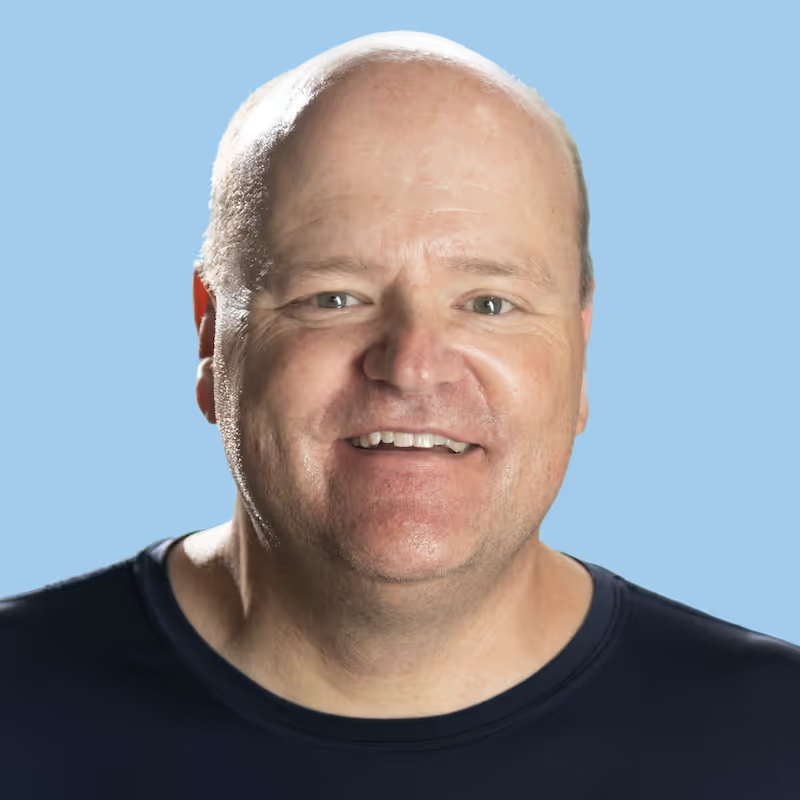
He runs Aerolane, which wants to move air cargo at the price of a truck. The method is a rope, a glider, and a very old idea.
Aerolane's pitch is that the cheapest cargo capacity on a plane is the capacity that is already flying with it.
Todd Graetz is the co-founder and chief executive of Aerolane, a Texas aviation company that builds autonomous towed cargo gliders called Aerocarts. The device does something plain enough to draw on a napkin: a lead plane tows a glider full of freight behind it, on a line, and the glider rides the aircraft's wake to stay aloft for only a marginal increase in fuel burn. Double the payload. Roughly the same tank of gas.
This is not a new plane. That is the entire point. Building faster aircraft is expensive and slow and takes decades of certification. Graetz's bet is the opposite - that you can bolt more capacity onto the aircraft that already exist by putting some of the cargo outside of them, on a rope. The company frames the whole thing as a single question: is it possible to get the speed of air at the cost of ground?
The Aerocart is patented. The concept is not remotely new - Allied armies towed cargo gliders behind transport planes in World War II, then largely stopped. Aerolane's contribution is autonomy, modern materials, and software, plus a founding team that spent a decade learning exactly which parts of flight regulators care about.
The company was founded in 2021 and describes itself as speed-centric: it exists to compress the gap between how fast air moves freight and how cheaply the ground does. Flight testing has been running since 2022 across the southern United States, in Texas and Florida, and the team has developed two generations of converted glider prototypes. By the company's own account it went from concept to a flying reality in roughly three years, which in aviation - an industry that measures certification in decades - is fast enough to be worth noting.
Graetz's role in that structure is specific. He is the operator and the regulatory hand: the co-founder who has actually stood on the government side of the table, run a large drone program inside a Fortune 500 company, and sat on the committees that decide what a company like Aerolane is allowed to do. In a startup selling a genuinely unusual flying object, that is arguably the most valuable seat.
Aerolane describes the aerodynamics in terms most people already understand - wake surfing behind a boat, or geese drafting in a V. A trailing glider rides the invisible wave of air the lead aircraft leaves behind. The lift is mostly borrowed. The fuel is mostly already being spent.
Use an existing cargo aircraft. No new airframe, no decades-long clean-sheet certification program.
The autonomous Aerocart trails behind on a tow line, loaded with freight, riding the lead plane's wake for lift.
Total payload roughly doubles while fuel burn rises only marginally - speed of air, closer to the cost of ground.
We are excited to locate our flight operations headquarters at AllianceTexas. It is a great privilege to operate in one of the nation's most critical intermodal cargo hubs.- Todd Graetz, on Aerolane's move to Perot Field Fort Worth Alliance Airport, 2025
Graetz did not come out of aerospace. He came out of freight rail. For years he was part of BNSF Railway's field operations and innovation team, where he co-founded the railroad's uncrewed aircraft systems program and its Advanced Train Operations group.
That drone program was not a hobby project. It helped launch some of the first long-range, beyond-visual-line-of-sight commercial drone flights in the United States under the FAA's Pathfinder program - flying aircraft the operator could not see, over real infrastructure, with the regulator watching closely.
Along the way he collected the kind of resume line most founders never touch: seats on the FAA Drone Advisory Committee and multiple FAA advisory and rulemaking committees, plus a board seat at AUVSI, the trade body for unmanned systems. He helped shape the rules. Then he built a company that lives inside them. He studied at the University of Denver and remains an active private pilot.
The unusual thing about Aerolane's founding trio is how literally its members have already done the hard version of this. Two of Graetz's co-founders came straight out of Amazon Prime Air, the drone-delivery program that spent years learning, at great expense, exactly how hard it is to fly autonomous aircraft over people and get regulators comfortable with it.
The bench around them reads the same way. Aerolane's leadership pulls from BNSF, Norfolk Southern, BAE Systems, NASA, and L3Harris; its advisory board includes veterans of UPS Flight Forward and Boeing HorizonX; and its defense board is stocked with retired senior U.S. Air Force officers, including a former Vice Chief of Staff of the Air Force. That is a lot of institutional gravity for a company whose signature product is, at heart, a well-engineered tow line. The weight is the point: certifying a new class of towed autonomous aircraft is a regulatory project as much as an engineering one, and the roster is assembled to survive that scrutiny.
Built BNSF Railway's drone program and helped write FAA drone rules. Active private pilot. The operator and regulatory hand of the group.
Founded Amazon's Prime Air drone-delivery program. A serial builder with a long patent trail and multiple startup exits behind him.
Prime Air's chief uncrewed aircraft test pilot and a former Israeli Air Force pilot. The person who actually flew the experiments.
The goal is shipping that arrives as fast as same-day and costs about as much as ground.
Aerolane's stated aim is to unlock the capacity already latent in cargo aircraft - to make every flight more productive, more efficient, and more sustainable by hauling more per gallon burned. The move to Perot Field at AllianceTexas put its flight testing, FAA certification work, and product development inside the AllianceTexas Mobility Innovation Zone, one of the country's densest intermodal cargo hubs, which is a practical choice as much as a symbolic one. Graetz called it a privilege to operate at what he described as one of the nation's most critical cargo crossroads.
What is notable about Graetz is how little he leans on the word disruption. The public markers he points to are flight-test hours and experimental licenses - the slow, dull, verifiable stuff. For a company selling a striking idea, that restraint is the most telling detail. He talks like someone who has already sat on the regulator's side of the table and knows the difference between a rendering and a rating.
There is a sustainability argument folded into all of this, and it is the rare kind that is also an economic one. Air freight is expensive and fuel-hungry; a system that roughly doubles what a single flight carries for a marginal increase in fuel burn lowers the cost per package and the emissions per package at the same time. Aerolane frames this as making every cargo flight more productive, efficient, and sustainable - which is a tidy way of saying the green pitch and the money pitch are, for once, the same sentence. Whether the Aerocart clears certification and reaches routine commercial service is still unsettled, and Graetz is careful not to pretend otherwise. What he has built so far is a credible team, a patented idea with real flight hours behind it, and a headquarters in the middle of the cargo world. The rest is the long, unglamorous work of proving it in the air.
Graetz on the FAA, DJI, and the next era of U.S. drone innovation - a conversation from The Drone Ultimatum podcast.
► FAA, DJI, and the Next Era of U.S. Drone Innovation - YouTube