For twenty years, the promise of regenerative medicine was a picture: a syringe of living stem cells, injected into a wound, rebuilding what disease had taken. Aegle Therapeutics looked at that picture and quietly deleted the cells. What it kept is smaller, stranger and, the company argues, the part that was doing the work all along - the tiny packages a stem cell releases when it wants to talk to injured tissue.
Those packages are called extracellular vesicles, or EVs. Think of a stem cell less as a bricklayer and more as a switchboard: it heals largely by secreting a stream of signals - proteins, snippets of genetic code, growth factors - bundled into nanoscale bubbles that neighboring cells swallow and act on. Aegle's founding idea is almost aggressively simple. Collect the bubbles. Skip the cell.
The company, based in Woburn, Massachusetts, with a research foothold in Miami, has turned that idea into a lead therapy called AGLE-102 - a cell-free product made of EVs harvested from bone-marrow mesenchymal stem cells. It is not a slide or a mouse study. It is in people, under an FDA Fast Track designation, chasing a rare disease that has broken a long line of would-be cures.
01 / The diseaseThe condition where a hug can tear skin
Aegle's first target is recessive dystrophic epidermolysis bullosa, or RDEB - a rare, inherited, mostly pediatric disease. Patients are born missing functional type VII collagen, the molecular Velcro that anchors the outer layer of skin to the layer beneath. Without it, skin shears off under the mildest friction. A blanket, a waistband, a parent's embrace can raise a blister or open a wound. Children with the disease are sometimes called "butterfly children" because their skin is as fragile as a wing.
There is no cure, and for years the standard of care was essentially wound dressing and pain management. That is the gap Aegle is aiming at - and it is a hard one, because the underlying problem is genetic. You cannot bandage your way to collagen VII.
The disease is also, in the cold arithmetic of drug development, a good place to start. It is monogenetic, which means the biology is legible - one missing protein, one broken gene, a clear target to aim at. It is severe and unmet, which is why regulators offer incentives like Fast Track to speed promising candidates along. And it is pediatric, which raises the stakes for every family waiting on a trial. Aegle chose the hardest version of an easy-to-explain problem.
02 / The mechanismA package that carries the part and the instructions
Here is where AGLE-102 gets clever. Most rare-disease approaches try to do one thing: replace a missing protein, or edit a broken gene, or graft engineered skin. AGLE-102 is designed to arrive carrying more than one payload at once. The vesicles are loaded with collagen VII protein itself - the missing part - and with COL7A1 mRNA, the genetic recipe that tells a cell how to build more of it. Delivery and instruction manual, in the same envelope.
The structural anchor RDEB patients lack, delivered directly to the wound bed.
Genetic instructions that prompt the patient's own cells to produce collagen VII.
MSC-derived biomolecules that calm inflammation and modulate the immune response.
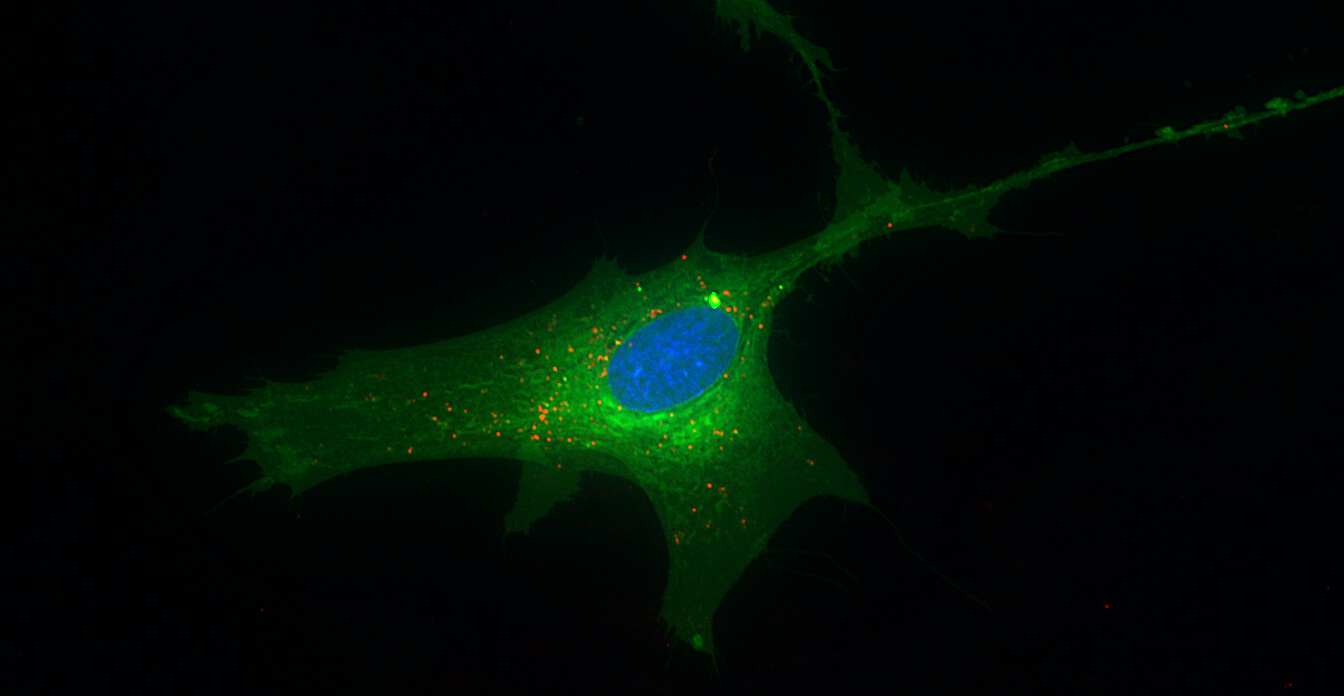
Because the vesicles come from mesenchymal stem cells, they carry those cells' well-documented calming properties - anti-inflammatory and immunomodulatory signals - along for the ride. And because there are no living donor cells in the final product, AGLE-102 behaves as a non-immunogenic, allogeneic therapy: an off-the-shelf batch rather than a bespoke transplant grown for one patient.
03 / Why cell-freeDeleting the cell solves a logistics problem
There is a practical reason to prefer the messenger over the messenger's sender. Living cells are a manufacturing and supply nightmare: they are fragile, they demand deep-freeze logistics, they can behave unpredictably once inside a patient, and dosing them consistently is genuinely hard. A vesicle is a defined biological product. It can, in principle, be characterized, batched, stored and dosed with far more of the discipline the industry expects from a drug.
That is the quiet strategic bet inside Aegle: identify the part of an expensive, temperamental therapy that actually does the healing, and productize only that. It is a lesson a founder in almost any field can borrow - strip a complex offering down to its active ingredient, then build the whole company around shipping just that.
04 / The pipelineOne platform, three shots on goal
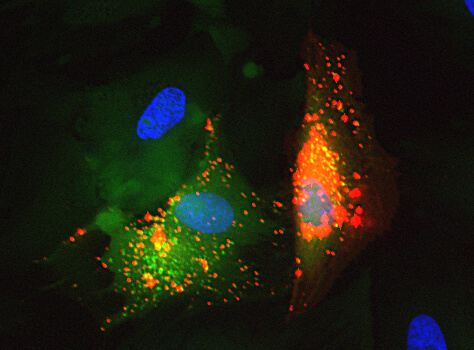
RDEB is the lead, but the same EV platform points at several problems where mesenchymal stem cells have shown benefit. Aegle has run a first-in-human proof-of-concept in severe burns and scarring, and it is working in preclinical models on graft-versus-host disease, the immune complication that can follow bone-marrow transplants. The through-line is regeneration and immune calming - two things MSC vesicles appear to do naturally.
05 / The peopleA banker and a dermatologist walk into a lab
Aegle's leadership is an unusual pairing. CEO and co-founder Shelley A. Hartman is not a bench scientist. She spent 19 years in investment banking, the last seven as a Managing Director at Goldman Sachs serving healthcare and life-science clients, before running a medical-device startup and then joining Aegle as an Entrepreneur-in-Residence at the University of Miami. She took the CEO seat in 2019.
The science comes from co-founder and Chief Scientific Officer Evangelos V. Badiavas, Ph.D., M.D., a dermatologist and researcher whose work on stem cells in wound healing underpins the company's EV harvesting technology - technology Aegle exclusively licenses from the University of Miami. In 2025, the company added industry veteran Scott Braunstein, M.D. as Chairman of the Board.
06 / The moneySmall round, first-in-class result
Aegle is a study in capital efficiency. It completed a $6.5M Series A in 2020 - backed by Tellus BioVentures, New World Angels, DEFTA Healthcare Technologies and DeepWork Capital - and has kept the team small, in the neighborhood of four people, while advancing a first-in-class therapy into human trials. Total reported funding sits around $10M once later financing is counted. In a field where rivals raise nine figures before dosing a patient, that is a different way to run the play.
07 / The marketWhere a vesicle fits in a crowded field
Aegle is not alone in chasing dystrophic epidermolysis bullosa - Krystal Biotech's topical gene therapy, Abeona's cell therapy and others are pursuing the same patients by very different routes. And the broader world of exosome and EV therapeutics is filling up fast, with companies like Capricor, ExoCoBio and Evox exploring vesicles for their own indications. What distinguishes Aegle is the combination: a cell-free EV product carrying both a protein and its mRNA recipe, aimed first at a rare disease that carries regulatory tailwinds like Fast Track.
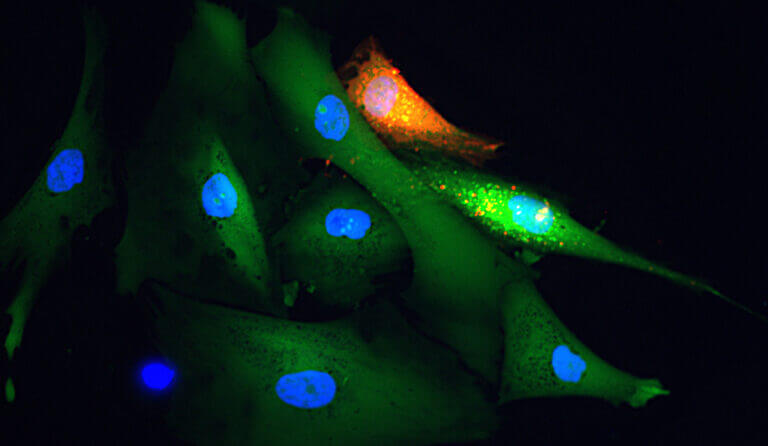
The honest caveat: this is early-stage medicine. AGLE-102 is in a Phase 1/2a trial designed to test safety and early signs of efficacy, not a therapy with an approval and years of outcomes behind it. Positive first-patient data is encouraging, not conclusive, and a cell-free vesicle approach still has to prove it can deliver enough functional collagen VII, durably, across many patients. That is precisely what the trial exists to find out - and it is the condition under which the whole thesis either holds or doesn't.
What is not in doubt is the shape of the idea. Aegle Therapeutics took the most photogenic image in regenerative medicine, cropped out the cell, and asked whether the leftover - the message - was the medicine the whole time. For a butterfly child with no other options, that question is worth asking in a clinic, not just a journal.