Artificial intelligence arrives dressed as software. A prompt goes in. An answer floats out. The transaction feels almost weightless, which is convenient for everyone except the people who have to buy the chips, secure the power, cool the racks, wire the network and keep the whole arrangement alive at three in the morning. Aaron Ginn has made a career of looking for the mechanism hidden behind the experience. At Hydra Host, the mechanism is now the business.
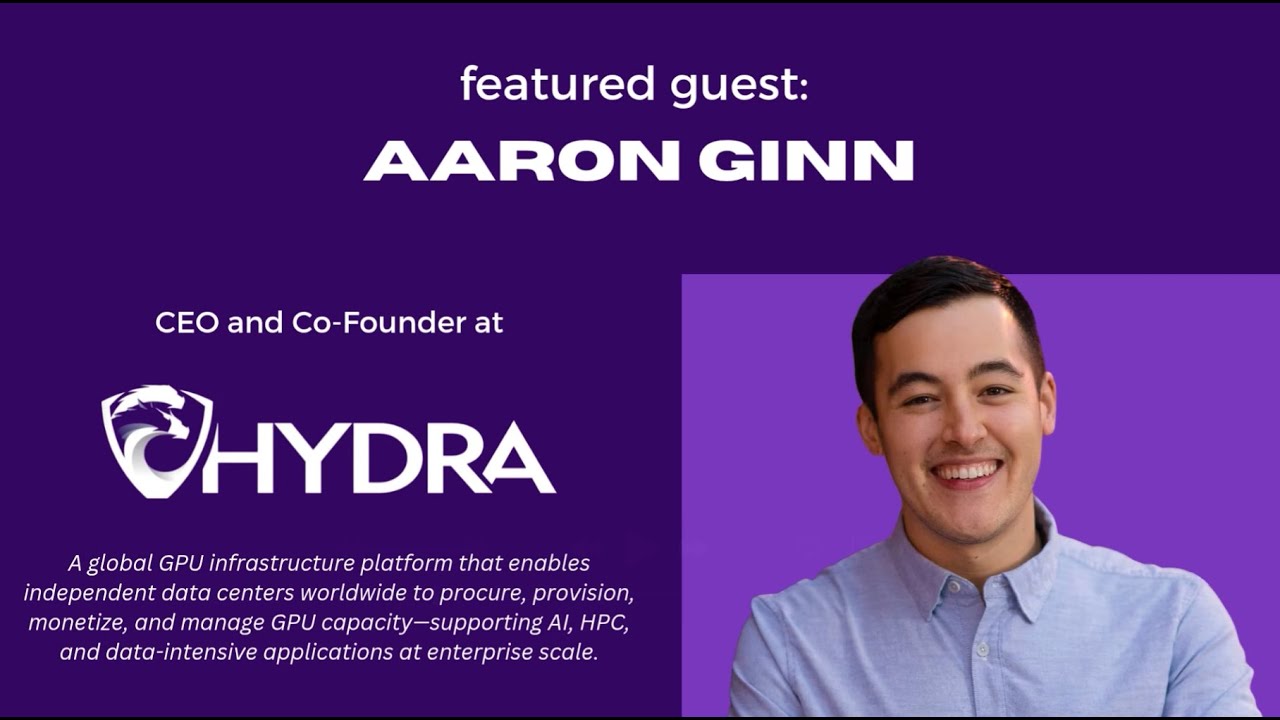
Ginn is the company’s CEO and one of three co-founders, alongside Garrett Johnson and Ariel Deschapell. Hydra Host gives independent data centers a common software layer for provisioning, metering and selling bare-metal GPU clusters. On the other side, it gives AI labs, inference companies and enterprises a route into that capacity. Think of it as a control room joined to a booking desk, except the seats are NVIDIA processors and the itinerary may involve a data center on another continent.
In June 2026, Hydra Host announced a $100 million Series A led by Kindred Ventures, with NVIDIA, ARK Invest, Comcast Ventures, Magnetar, PEAK6 and other investors participating. Ginn’s accompanying dispatch offered the sort of figures that make an infrastructure story feel suddenly physical: $2.8 billion in booked compute contracts, more than 60 data centers, 18 countries and five continents. The numbers were less a victory lap than a map of the job ahead.
The distribution instinct
The straight-line version of Ginn’s résumé makes little sense until you notice the repeated verb: distribute. He worked on growth for Mitt Romney’s 2012 presidential campaign. He held growth and product roles at StumbleUpon, where discovery was the product, and at Everlane, where he worked on product development and user experience as an online brand learned to meet customers offline. He wrote early essays about growth hacking and helped make the term part of the startup vocabulary.
Growth, in that era, was often reduced to a bag of tricks. Ginn’s own record points to the more durable interpretation: study how people encounter a thing, remove friction, observe what they do, and reshape the system around the evidence. A clothing company and a GPU cluster look like different species. Yet both need an interface, a buyer and a reason to return.
Politics added another kind of interface problem. In 2013, Ginn co-founded Lincoln Network, the organization now known as the Foundation for American Innovation. Its purpose was to bring technologists and policy thinkers into the same room, two groups fluent in different dialects and equally certain the other one was speaking too loudly. The organization grew into a technology-policy institution in Washington. In 2017, Forbes named Ginn to its 30 Under 30 list in Law & Policy.
Then came Fabius Labs, a product, strategy and technology firm created for organizations with something to build. It was another venture with Johnson. Ginn has said Hydra Host is their fourth company together and his second with Deschapell. Silicon Valley mythology prefers the electric first meeting. Ginn’s version is closer to a repertory company: the cast knows where everyone stands, which scenes each can carry, and when to get out of the way.
Built-in trust. It’s something that’s kind of magical and you can’t really replace it.Aaron Ginn on working repeatedly with a co-founder
He compares the co-founder relationship to a second marriage. The useful part of the comparison is not romance; it is memory. A repeated partnership has already seen missed forecasts, revised plans and the small indignities of building. That history becomes operating infrastructure. In a young company, trust is the only system that has been tested before the product is.
Following the constraint
Hydra Host did not emerge with its current shape fully formed. When Ginn publicly introduced the company after a year in stealth, the pitch centered on a zero-trust, cross-cloud platform built for resilience and security. It promised to move applications across public and private cloud providers and reduce dependence on any one hyperscaler. The founding concern was control: where software runs, how it survives failure, and who gets locked in.
Customer demand pulled that concern down the stack. By 2023, Ginn was describing a network of independent data centers whose specialized hardware was hard to discover and harder to use. The cloud had trained developers to expect an easy button. Bare metal offered better control and, for predictable workloads, attractive economics. What it lacked was the easy button.
Hydra Host’s answer became Brokkr, an operating system for the AI factory. It standardizes the awkward but essential work: provisioning clusters, tracking use, managing customers and reporting performance and revenue. The company also acts as an offtake network, matching the output of those clusters with buyers. Software alone cannot settle a hardware market. Someone must help capacity find demand.
From concrete to computation
Hydra Host operates between infrastructure owners and compute buyers, turning a collection of physical assets into a provisioned service.
This explains Ginn’s favorite industrial metaphor. Tokens, he argues, are becoming a measurable unit of machine intelligence, and falling token prices can create more consumption rather than less. “Tokens are the new oil” is the catchy half. The revealing half is the refinery. Hydra Host wants to own neither every oil field nor every application. It wants to make the conversion dependable.
A founder who permits wandering
Ginn is unusually candid about the amount of wandering involved in company formation. Founders often retrofit a clean destiny onto a messy sequence of interests, experiments and customer requests. He prefers to describe the early work as “an expression of art or discovery.” The line is revealing because it grants a company permission to change without making change sound like defeat.
His operating advice follows. Product-market fit is a threshold recognized most clearly after crossing it. The practical response is to take more swings, learn from misses and preserve enough time to keep playing. He identifies most strongly with the zero-to-one stage: assembling a team, setting a direction and turning an idea into a project. But he also acknowledges the founder’s harder transition, when individual work must give way to management and the project must become an organization.
One of his more useful tactics is almost comically plain: write down the things you are bad at or do not want to do, then use the list as a hiring plan. It is a bracing corrective to the founder as universal genius. A title does not enlarge a person’s range. It merely makes the gaps more expensive.
We convert megawatts into tokens.Aaron Ginn on Hydra Host’s operating brief
Ginn’s public conversation roams beyond business. His newsletter moves among philosophy, economics, culture, faith and friendship. He says he reads business books less as instruction manuals than as biographies, looking for principles and values without pretending that another executive’s circumstances can be copied. The habit fits his career. He is interested in systems, but alert to the people who make systems behave unpredictably.
The geography returns
The AI boom has restored geography to technology. Latency matters. Electricity matters. Export controls matter. National governments increasingly care where models run and where data resides. Ginn has argued for distributed and sovereign infrastructure, a world in which compute can live closer to its users and under a wider variety of owners. His move from San Francisco to Colorado sharpened the point. Innovation, in his telling, need not orbit one small patch of California.
In 2025, Hydra Host joined NVIDIA’s DGX Cloud Lepton as a cloud partner and said it managed more than 20,000 GPUs across more than 40 data-center partners. The company also participated in sovereign AI infrastructure work in El Salvador. By the following June, its reported network had expanded beyond 60 sites. The pattern is regional by design: a common operating layer stretched across very different pieces of real estate.
Growth work across a presidential campaign and StumbleUpon.
Co-founds Lincoln Network, later the Foundation for American Innovation.
Works on growth, product and customer experience at Everlane.
Introduces Hydra Host publicly after a year of stealth development.
Hydra Host announces a $100 million Series A and a five-continent footprint.
There is wit in building the invisible layer. If Hydra Host works, customers should spend less time admiring it. The data-center operator sees capacity sold and clusters behaving. The AI company sees compute arrive. The interface becomes ordinary, which is how infrastructure wins.
Ginn’s ambition is to make any data center capable of becoming an AI factory and to make those factories easier to find, run and monetize. It is an expansive goal expressed through decidedly unromantic work. Procurement. Provisioning. Metering. Support. Compliance. The future may be intelligent, but it will still need an invoice.
His career has moved from growth to governance to GPUs, yet the connective tissue is consistent. Find a valuable thing trapped behind friction. Build the interface. Create the network. Then pay close attention when the market tells you the original idea was merely the first draft. In an industry addicted to prediction, Ginn’s advantage may be a practiced willingness to notice what has already changed.