Crypto has an unusual talent for turning a simple sentence - “I bought a coin” - into a small archaeological dig. The purchase happened on one exchange. The asset moved to a wallet. It was swapped through a decentralized protocol, staked, wrapped, airdropped and eventually sold somewhere else. By April, the investor does not have a ledger. The investor has clues.
ZenLedger exists to assemble those clues. Founded in 2017 by Patrick Larsen and Bryan Starbuck, the company imports transaction histories from exchanges, wallets and blockchains, then calculates cost basis, holding periods, gains and losses. The output is deliberately ordinary: audit trails, tax summaries, Form 8949, Schedule D and files that tax software or a tax professional can digest. Crypto goes in. Paperwork comes out.
That sounds narrow until you see the customer list hiding inside the workflow. There is the occasional investor with 73 trades, the active trader with 7,300, the accountant trying to review both, and the enterprise or government team that needs analytics and a defensible record. ZenLedger now offers DIY tax plans, professional preparation, a suite for tax pros, portfolio tracking, tax filing through april, and enterprise products spanning compliance, data ingestion, background checks and forensic accounting.
Sell the shovel receipt, not another shovel
Larsen arrived with a résumé that reads like three people sharing a jacket: Air Force Academy chemistry graduate, Navy helicopter mission commander, Chicago Booth MBA, investment banker, Amazon business manager and startup operator. In a 2020 interview, he described wanting to return to the technological frontier after Amazon and an e-commerce startup. Crypto in 2017 was impossible to ignore.
But he did not want to issue a token. He wanted an infrastructure problem that “could fit in a box” - something his team could understand and execute. Two forces were moving at once: retail investors were flooding into crypto, and regulators were paying attention. The IRS had challenged Coinbase for customer records. However futuristic the asset looked, the reporting obligation was arriving by mail.
“I want to help build the infrastructure in the space because I think it's growing fast.”Patrick Larsen, On the Brink interview, 2020
This is the first useful thing to copy. Do not merely ask what a boom enables. Ask what compulsory chore the boom creates. Online stores created returns. Cloud software created identity management. Crypto created a need to reconstruct financial history across systems that were not designed to agree with one another. The mandatory chore can be more durable than the fashionable behavior that produced it.
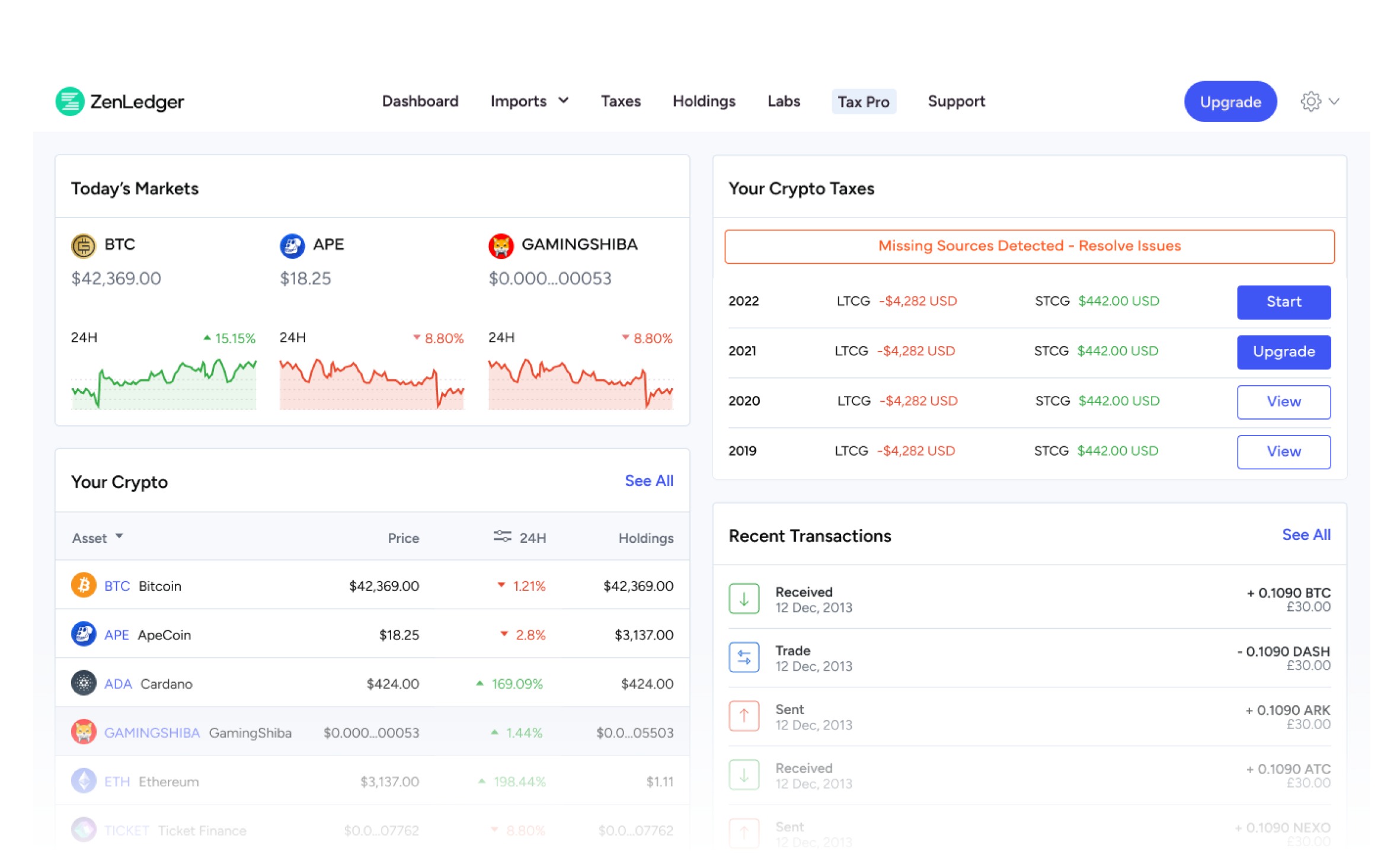
The math is familiar. The memory is not.
Capital-gains arithmetic is not ZenLedger's secret. The hard part is identifying what happened before the arithmetic begins. A transfer between a user's own wallets should not be treated like a sale. A token arriving from staking may be income. A missing purchase price can corrupt every gain downstream. An exchange CSV may use its own labels, time zone or symbol conventions. A defunct platform may not produce a clean export at all.
So what failed first? Public customer complaints and ZenLedger's own help material point to the same fragile joint across this category: ingestion and reconciliation. An unsupported wallet, malformed CSV or probable missing source appears before the polished tax form. The product can flag the hole, but software cannot conjure a transaction record that no longer exists. The honest value proposition is not “press one button and taxes disappear.” It is “put the mess in one place, expose the gaps, and give yourself or your accountant a workable review queue.”
That distinction matters because more than half of ZenLedger customers in a 2021 founder interview reportedly worked with a tax professional. The software is a translator between two groups who often speak past one another: crypto users who understand the transaction but not the tax treatment, and accountants who understand tax forms but may not know a liquidity-pool token from a sandwich.
What it costsA transaction meter disguised as peace of mind
A ZenLedger account can aggregate transactions for free. Payment begins when the user needs to view and download a year's tax reports. At the time of publication, the DIY ladder starts at $49 per year for up to 100 transactions, rises to $199 for up to 5,000, and reaches $399 for up to 15,000. Unlimited transactions cost an additional $600. A 60-minute enrolled-agent consultation is listed at $275; prepared work is priced much higher and varies with the job.
| Plan | Annual activity | Listed price |
|---|---|---|
| Silver | Up to 100 transactions | $49/year |
| Gold | Up to 5,000 transactions | $199/year |
| Platinum | Up to 15,000 transactions | $399/year |
| Unlimited add-on | Above the standard cap | +$600 |
The model has a neat fit with the pain. A buy-and-hold customer produces little data and pays less. A DeFi regular can generate thousands of taxable events and pays more. ZenLedger also keeps the tax professional in the loop: users can invite one into the account, while firms can buy a dedicated professional workflow. Enterprise and government work moves farther up the value chain, where security, APIs, analytics and auditability matter as much as the final form.
The expansionOne data layer, four buyers
Make me fileable
Imports, calculations, tax reports, tax-loss tools and filing handoff.
Make this reviewable
Client access, familiar reports and a structured queue for exceptions.
Make this scalable
Secure ingestion, tax services, compliance workflows and analytics.
Make this traceable
Blockchain analysis and forensic accounting for investigative work.
The company did not abandon its consumer wedge; it widened the number of buyers who need the same normalized data. A $6 million Series A in 2021 was aimed at hiring and portfolio management. A $15 million Series B led by ParaFi Capital followed in May 2022, bringing reported total funding to roughly $27 million. At that point ZenLedger said it served more than 50,000 users. GeekWire reported 47 employees; the current company footprint is closer to 15.
Partnerships show the direction more clearly than slogans. TurboTax support made consumer handoff easier. eToro and BitPay put tax access near transaction activity. The april partnership extended the journey into state and federal filing. COMPLY connected digital-asset intelligence with institutional compliance. Secureframe helped with the controls behind SOC 2 Type 2, announced in 2024. In late 2025, ZenLedger added support for Sui, another reminder that integration work never really ends.
“The core accounting and reporting infrastructure that ZenLedger provides will be critical to making everyone's lives easier as they earn, transact, and invest in crypto.”Mark Cuban, commenting on the 2021 Series AWhere it wins - and where it does not
The moat is tedious, and the edge cases bite
ZenLedger competes with CoinTracker, CoinLedger, Koinly, TaxBit, TokenTax and Crypto Tax Calculator, plus the world's most stubborn incumbent: a spreadsheet assembled at 1:12 a.m. The category shares many headline features - exchange imports, cost-basis methods, tax forms and DeFi support. ZenLedger's differentiation is broader positioning: consumer reporting beside tax-pro collaboration, professional preparation, government analytics and enterprise compliance.
That breadth does not cancel the category's conditions. The system works best when source records are available, integrations correctly interpret the activity, and the user is willing to resolve exceptions. It works less well when an exchange has vanished, a wallet history is incomplete, an exotic protocol produces events the software misclassifies, or a taxpayer assumes automation equals advice. ZenLedger says its DIY software can help import and reconcile data, but it does not gather every record for the user or provide individualized tax advice.
What changed the company's mind was less a single pivot than accumulated evidence about the buyer. Larsen began with a bounded tax problem. The market kept revealing adjacent people who needed the same cleaned ledger: the CPA, the investigator, the compliance officer, the exchange partner. ZenLedger responded by moving from “your crypto tax app” toward an accounting and compliance layer, while keeping the annual report as the entry product.
The playbook is clean enough to steal. Start with the painful deliverable, not the dashboard. Build backward to the messy inputs. Make uncertainty visible before presenting a confident total. Give the expert reviewer a seat inside the workflow. Price in proportion to the volume that creates the work. Then look for adjacent buyers whose problem begins with the same normalized data.
None of that makes crypto tax delightful. Delight is probably the wrong ambition. On a good day, ZenLedger makes it finite: a list of imports, a list of exceptions, a calculation, a report. In a market famous for inventing new kinds of money, the durable trick may be helping people remember where the old money went.