01 — TODAYThe Books, Closed by Sundown
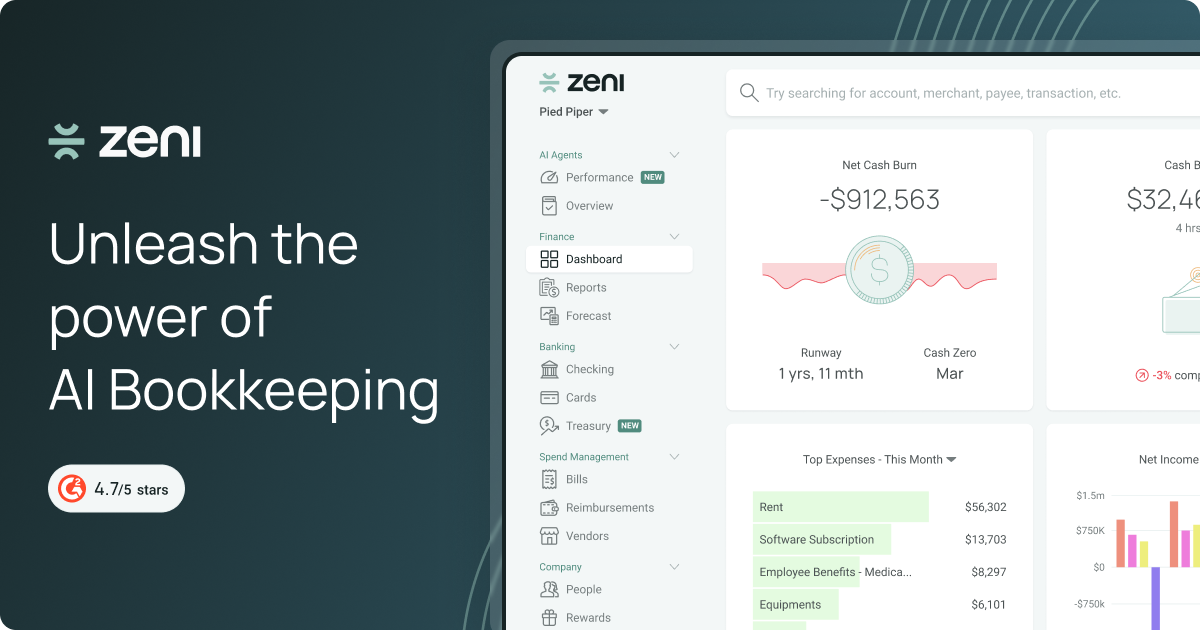
It is 7:14 p.m. on a Tuesday. A Series A founder in Brooklyn opens her laptop, types her domain into a dashboard, and watches the day's expenses sort themselves. The Brex swipe at lunch. The Stripe payout from this morning. The Gusto run. All of it categorized, reconciled, mapped to a chart of accounts she has not opened in eleven months. Her books, for today, are closed.
This is the small, almost embarrassing miracle that Zeni sells. Not a feature. Not an integration. The fact that a startup founder, in 2026, can know tonight what her company spent today - and, crucially, can know it before her competitors do.
Zeni is the AI-powered finance operations platform for venture-backed startups. It runs bookkeeping, bill pay, employee reimbursements, business banking, and tax-and-CFO services through one dashboard. The promise is unfashionable but specific: every customer's books are closed daily, not monthly. The Palo Alto company is roughly 260 people, has raised $47.5 million, and is led by a pair of twin brothers who have done this kind of thing before.
02 — THE PROBLEMThe Slowest Department in a Fast Company
Software has eaten almost every workflow at a modern startup. Sales pipelines refresh in real time. Engineering dashboards alert on a slow query inside ten seconds. Marketing attribution updates while a campaign is still running.
Finance, somehow, did not get the memo. The standard practice - still - is to wait for month-end, hand a folder of bank statements and credit-card receipts to a bookkeeper, and receive a profit-and-loss statement two-to-four weeks after the period it describes. By the time a founder learns that burn spiked in March, it is May. By the time she learns the spike was a one-time vendor renewal, it is June, and she has already laid off two people she did not have to.
The diagnosis is older than the cure. What changed, in the late 2010s, was that two technologies finally matured at the same time: bank-grade APIs (so a ledger could read the truth instead of waiting to be told) and machine learning models that could categorize a transaction with higher accuracy than a tired contractor at 11 p.m. The opening was real. The companies stepping into it were mostly not.
03 — THE BETThe Shinde Brothers, Twice Burned
Swapnil and Snehal Shinde are identical twins. They are also, by founder-bingo standards, slightly improbable: two prior companies, two prior exits, and a stubborn refusal to retire. Their first, Dhingana, was an Indian music streaming service sold to Rdio in 2014. Their second, Mezi, was an AI travel concierge acquired by American Express in 2018 for a reported $125 million.
Both companies, the brothers like to point out, had the same back-office problem. Bookkeeping was always late. Numbers were always stale. The founders making product bets were making them on data old enough to vote.
The bet, in 2019, was that the right shape of the answer was not pure software. It was AI doing the routine ninety percent - the transaction sorting, the bank reconciliation, the receipt scraping - paired with a human finance team handling the judgment calls software cannot, yet, be trusted with. A flat monthly fee. A daily close. One dashboard. One vendor. The founder gets back the eight hours a week she was spending on finance, and her CFO gets to do something other than chase invoices.
04 — THE PRODUCTAn Agent for Every Annoying Thing
The product, today, is a stack of agents wearing finance hats. Each automates a specific corner of the back office. None of them complain about Sunday-night bill runs.
AI Bookkeeping
Daily close, transaction categorization, GAAP-compliant ledger.
AI Bill Pay
Vendor invoices ingested, approved, paid - and posted back to the books.
AI Reimbursements
Receipts in, payouts out, ledger lines written.
AI Business Checking
FDIC-insured account that yields and reports to the dashboard.
AI Cards
Credit and debit cards with auto-categorized spend and cashback.
AI Treasury
Idle cash, swept automatically into yield.
CFO & Tax Services
Fractional CFO, R&D credits, federal and state filings.
AI Accountant Agent
The 2025 release: complex workflows handled end-to-end.
The trick, if you want to call it that
Most AI accounting tools either go full software (cheap, lonely) or full services (slow, expensive). Zeni runs both lanes at once. AI does the volume. Humans do the calls AI is not, in 2026, ready to make. The result is the unfashionable answer: software + people, priced like software.
Company Milestones
05 — THE PROOFWhat the Numbers Say
A company that promises real-time numbers ought to have a few of its own. Zeni's are not Series-D pyrotechnics, but they are the right shape for a company arguing that finance ops can be a category.
Funding, Headcount, and the Argument for a Category
Sources: company disclosures, TechCrunch, Accounting Today, third-party revenue estimates. Numbers are reported; bar heights are scaled for readability, not for an audit.
The customer base skews the way you would expect: SaaS startups, e-commerce brands, fintechs, the occasional consumer-internet company - the ventures that have raised money and want to stop hiring controllers to do the work software should. The platform sits on top of QuickBooks, syncs with Gusto and Chargebee, and reports back to a dashboard the founder actually opens.
06 — THE MISSIONQuiet Finance
Ask Swapnil Shinde what Zeni is for, and the answer usually skips past the product. The company exists, he will say, to make finance feel like the rest of the modern startup: ambient, fast, slightly boring in a good way. A founder should not be surprised by her own runway. She should not learn about a payroll mistake in week three. She should not be told that her gross margins are wrong in time to fix the deck but not in time to fix the business.
What Zeni is selling, if you squint
Calm. The slightly underrated emotion that comes from knowing your books are right, today, without having spent any of your own time making them so. The name, Zeni, is what happens when you take the word zen and give it a finance department.
07 — TOMORROWThe Back Office, Disappearing
The longer arc is the interesting one. If AI agents can run a startup's books on their own - if a small group of finance experts can supervise hundreds of customers instead of three - the economics of back-office work change. The expensive thing about a controller is not the controller; it is the labor leverage. Software shifts the leverage. Zeni is betting it shifts it enough that the entire finance stack at a Series B company becomes one dashboard and one vendor.
This is not a small bet. The incumbents - QuickBooks, NetSuite, the Big Four advisory shops - have decades of installed base and a regulatory moat to match. Zeni's wager is that the speed difference compounds. Daily numbers beat monthly numbers, every month. The founder who can see her runway by sundown makes a different decision than the founder who waits until the fifteenth.
It is now 7:21 p.m. The founder in Brooklyn closes her laptop. Her bookkeeper, somewhere, did not stay up late. Her CFO is at dinner. Her runway, as of the transaction that cleared three minutes ago, is six months and eleven days. She knows this because the company her competitors have not heard of yet decided that she should.
Filed2026YesPress