Popular on Instagram, Invisible to the Algorithm That Matters Next
DTC fashion brands built empires on paid social, influencers, and email. But when an AI assistant is asked what to buy, many of them simply don’t come up. Inside the visibility gap — and how to close it.
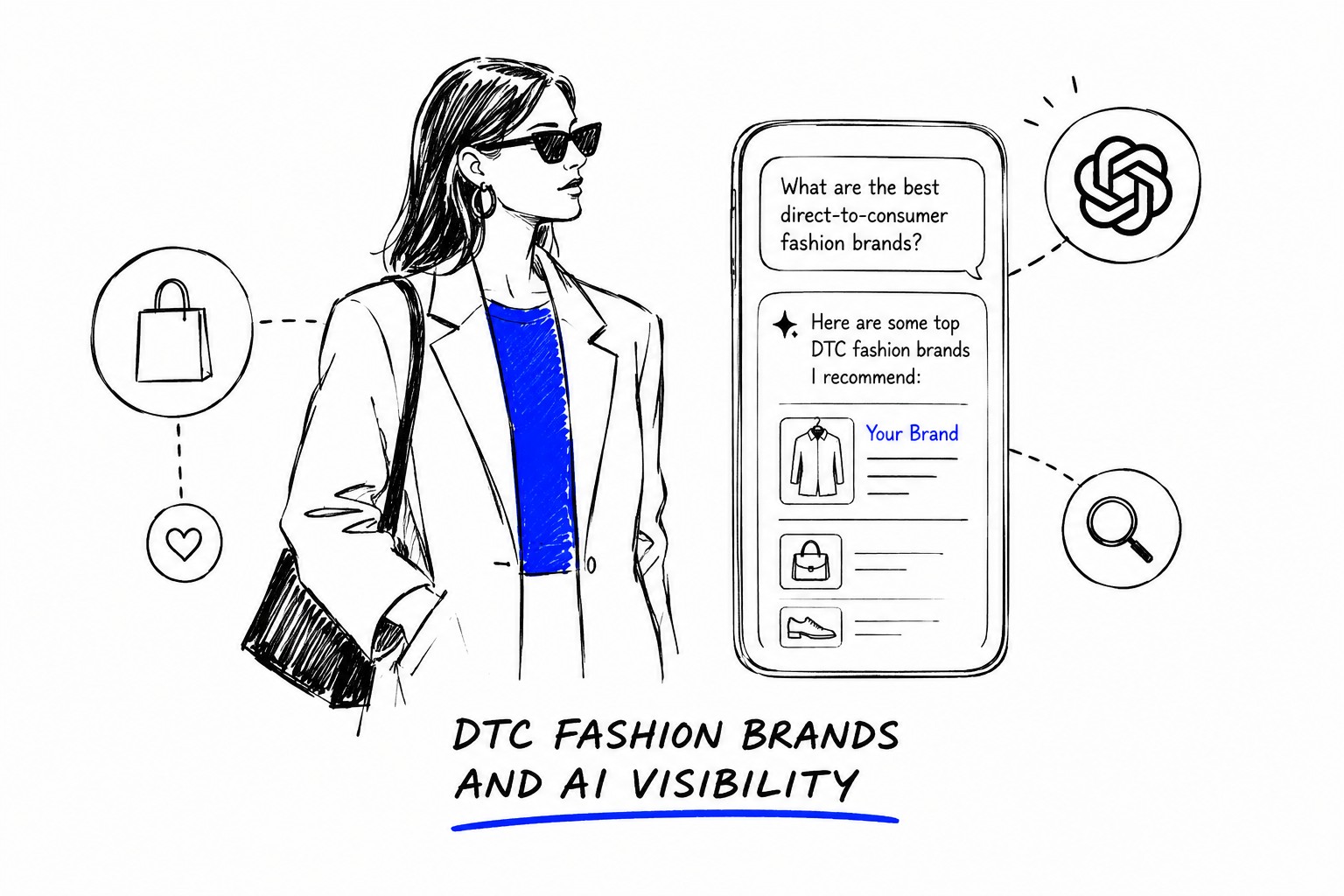
Ask a modern AI assistant to recommend a going-out dress, a pair of premium joggers, or a wardrobe of everyday basics, and something curious happens. The brands that dominate your Instagram Explore page, that spend fortunes on creators, that fill your inbox with flash-sale subject lines — many of them simply don’t come up. In their place: Nordstrom, Macy’s, H&M. The incumbents. The very names the direct-to-consumer movement set out to disrupt.
It is one of the quietest but most consequential asymmetries in commerce right now. A generation of DTC fashion brands built hundreds of millions in revenue on paid social, influencer marketing, email and SMS. Those channels made them famous with shoppers. They did almost nothing to make them legible to machines. And as generative AI becomes a front door to shopping — where an assistant narrows thousands of options to a short list of names — being famous with people is turning out to be a different thing from being trusted by the model.
“Social popularity alone does not translate into AI prominence.”
The paradox of the social-first brand
The mechanics are structural, not accidental. AI systems that generate recommendations lean heavily on the parts of the web that read like evidence: editorial features, buyer’s guides, structured product data, encyclopedic entries, expert reviews, and long threads of community discussion. That is the raw material a model can cite. A viral TikTok, a paid placement, a well-segmented email flow — whatever their commercial power — are largely invisible to that process. They are owned channels, not third-party authority.
So the brands that mastered the feed find themselves under-indexed in the corpus the model actually reads. The channels that built them are not the channels that AI reads. And because the model has little independent, citable material to draw on, it defaults to the names that have accumulated decades of it.
Who is underperforming — and why
The pattern repeats with almost eerie consistency across the DTC landscape. Fashion Nova is a juggernaut on Instagram and TikTok, but comparatively thin in trusted editorial sources and buying guides. PrettyLittleThing carries a heavy influencer presence yet fewer authoritative references than legacy retailers. Boohoo shows up in the news — but often for business troubles rather than as a fashion recommendation, a distinction that shapes how an AI frames the brand.
Oh Polly and Meshki draw awareness largely from creators rather than broad knowledge-graph presence. Princess Polly is adored by Gen Z creators, yet cited far less often in trusted fashion publications than established houses. Gymshark, at north of £500M in revenue, wins fitness queries handily — and then loses general fashion ones to Nike and Adidas. And the premium basics cohort — Cuts Clothing, Marine Layer, Mott & Bow — pairs fierce customer loyalty with a thin independent editorial footprint that leaves AI systems with little to reference.
Social reach vs. how often AI names the brand
The five levers AI weighs heavily
Strip the problem down and it resolves into five inputs — the ones AI recommendation quality tends to hinge on, and the ones social-first brands tend to under-invest in.
A brand can be exceptional at social engagement, influencer marketing, paid acquisition, and email — and still register as a near-blank on all five. That is precisely the position many DTC labels occupy today.
The legacy advantage
Here is the finding that reframes the whole debate. Multiple AI visibility studies have found that legacy retailers — Nordstrom, Macy’s, H&M — are recommended by AI more often than digitally native DTC brands with similar or even higher online engagement. The incumbents didn’t win the model by out-marketing anyone. They won it by accident, through decades of press coverage, syndicated product data, and dense third-party citation that quietly accumulated in exactly the corpus AI reads.
“The channels that built these brands are not the channels that AI reads.”
The opportunity in an emerging field
The good news buried in all of this is that the game is young — and therefore winnable. AI visibility is still an emerging discipline, without the entrenched leaderboards of traditional search. That means a DTC brand does not need the marketing budget of Zara or Nike to move the needle.
What it needs is a deliberate shift of investment toward the levers the model rewards: authoritative editorial coverage, comprehensive product and category content, structured data, digital PR, expert reviews, and consistent brand information across the web. The brands that make that shift first stand to capture recommendation share before the space matures and the incumbents notice.
“A DTC brand doesn’t necessarily need the marketing budget of Zara or Nike to improve its AI presence.”
The last decade of DTC was a masterclass in owning the customer relationship — the feed, the inbox, the creator. The next one will be decided somewhere the brands can’t buy an ad: in whether an AI trusts them enough to say their name. For labels that spent years being loudly, visibly popular, the uncomfortable task ahead is to become something quieter and more durable — cited.