The Sky, Finally Paying Attention
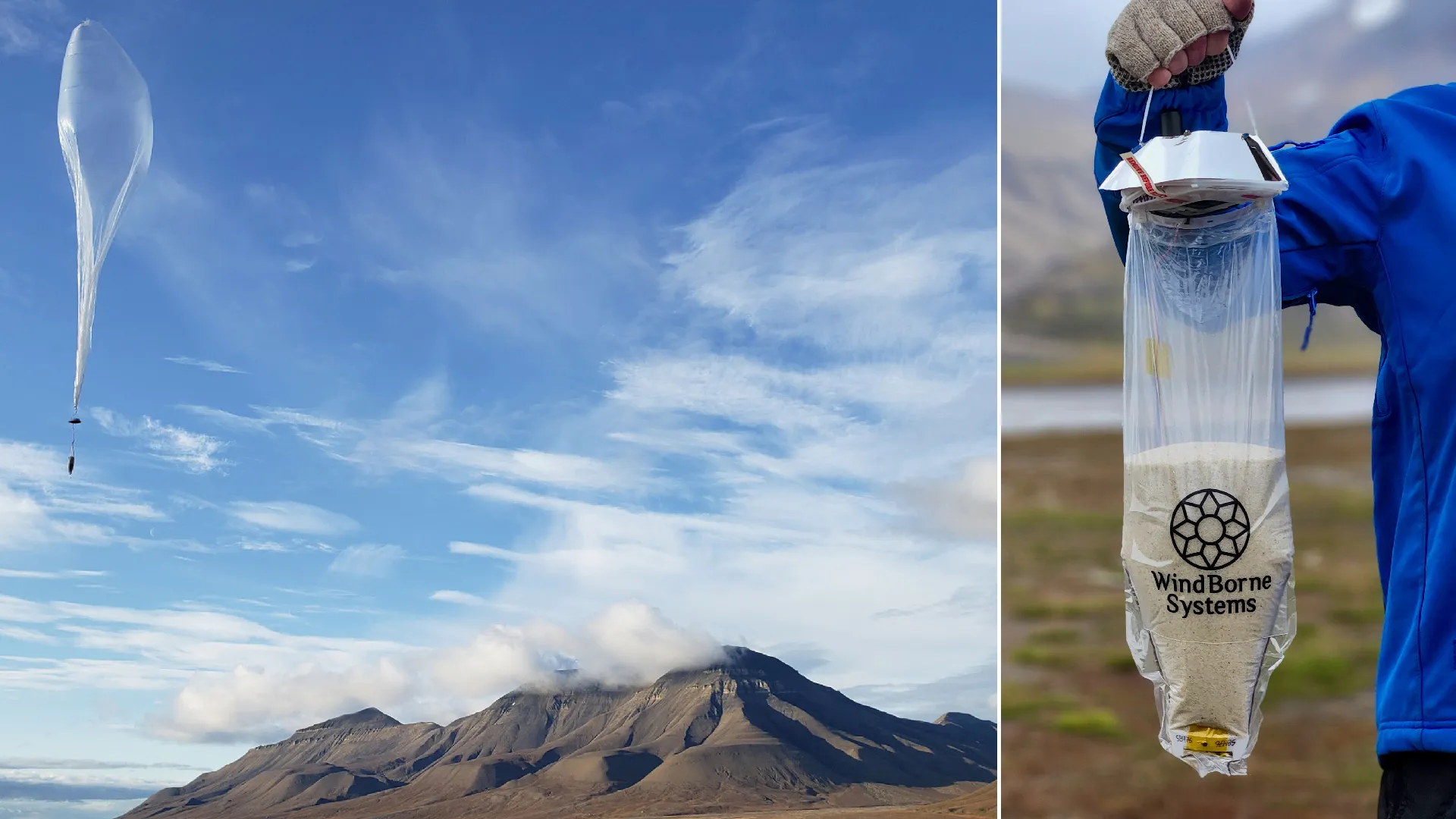
Right now, somewhere over the South Atlantic, a balloon the size of a small car and lighter than a house cat is riding a 15,000-foot wind current eastward at 40 knots. It weighs under two kilograms. Its skin is 20 micrometers thick - less than half the width of a human hair. Inside, sensors are logging temperature, pressure, humidity, and wind every few seconds. This data will reach forecasters within minutes, fed into a model that is, as of early 2025, the most accurate global weather AI on the planet.
That balloon is one of thousands WindBorne Systems has launched. And the company is only getting started.
"Over two-thirds of Earth's surface has almost no weather observations. That's not a gap. That's the entire problem."
- WindBorne Systems, founding premiseWindBorne Systems operates from Redwood City, California, with 86 people, a freshly expanded 50,000 sq ft balloon factory, and a two-product strategy that is starting to look like a platform: Atlas, the balloon constellation, and WeatherMesh, the AI forecast model that eats Atlas's data for breakfast.
The Forecast Was Wrong Because the Data Was Missing
The global weather observation network is a patchwork of a hundred-year-old infrastructure. Radiosondes - the standard weather balloon - get launched twice a day from roughly 900 land stations, mostly clustered in the Northern Hemisphere's wealthier countries. They go up once, take one profile, then fall back to Earth and are discarded. Over the oceans, polar regions, and vast stretches of Africa, South America, and Central Asia, there is almost nothing.
Weather models are only as good as the data they ingest. The gaps are not minor edge cases. Cyclones form over open ocean. Arctic warming reshapes weather patterns across continents. Agricultural decisions that feed billions hinge on precipitation forecasts that are still, frankly, unreliable weeks out. The meteorological establishment has known this for decades. It just hadn't found a cheap, scalable fix.
"A single Atlas balloon collects about 50 vertical atmospheric profiles over its lifetime. A standard weather balloon collects one - then gets thrown away."
- WindBorne Systems product documentationThe math on this is not subtle. If each conventional balloon yields one profile at a cost of roughly $150-$200 per launch, and each Atlas balloon yields 50 profiles over 50-plus days at a fraction of the per-profile cost, the economics of atmospheric data collection look very different with WindBorne in the picture.
Four Stanford Engineers and a Question Worth Asking
WindBorne grew out of Stanford's Student Space Initiative. The four co-founders - John Dean (now CEO), Kai Marshland (CPO), Andrey Sushko (CTO), and Joan Creus-Costa - were working on high-altitude balloon systems as students when they realized the same technology that could carry experiments to the stratosphere could also carry weather sensors across the globe at a fraction of what any aerospace contractor would charge.
In 2019, they incorporated. Khosla Ventures wrote the first check. The bet was simple but slightly audacious: build a balloon that lasts weeks instead of hours, can navigate itself by riding different wind layers, and can phone home in real time. Then build the AI model that turns all that fresh data into better forecasts.
The balloon part turned out to be doable. The film is 20 micrometers thick - comparable to a kitchen produce bag - and the navigation system uses altitude adjustments to catch different wind currents, no propulsion needed. It is, functionally, a solar-powered atmospheric sensor that steers itself by exploiting the structure of the atmosphere it is measuring.
"They started as students launching balloons for fun. The line between that and a $23M company with NOAA as a customer is shorter than most VCs would have predicted."
- Paraphrased from early investor notesTwo Systems, One Closed Loop
WindBorne's architecture is harder to copy than it looks. The company operates Atlas, its balloon constellation, and WeatherMesh, its AI forecast model, as a single integrated system. Atlas generates observations that improve WeatherMesh's accuracy. Better accuracy makes WeatherMesh's data worth more to enterprise and government clients. Those revenues fund more Atlas launches, which produce more observations. This is either a virtuous cycle or a moat, depending on whether you are building it or trying to compete with it.
Long-duration autonomous balloons. 20-micrometer film. Sub-2 kg. 50+ day flights. Self-navigating by altitude. ~50 atmospheric profiles per unit vs. 1 for standard radiosondes.
Global AI forecast model. WeatherMesh-2 is 8-24% more accurate than Google DeepMind's GraphCast. Predicts wind, temperature, precipitation, humidity, solar radiation. WeatherMesh-3 is open-source.
Real-time atmospheric data and industry-specific forecast solutions, delivered as a service. Clients span agriculture, aviation, energy, logistics, and insurance.
Target: 10,000 concurrent balloons by 2028 to achieve complete global atmospheric coverage - including oceans and polar regions where conventional observation is minimal.
The 150x cost efficiency over ocean data collection is not a rounding error. It is why NOAA started buying Atlas data, why the Air Force signed up, and why the Gates Foundation wrote a check. The economic argument and the humanitarian argument happen to point in the same direction, which is a position most climate-tech startups spend years trying to engineer.
When NOAA Calls, You Are Doing Something Real
WindBorne's customer list is a quick way to assess whether the technology actually works. NOAA - the agency responsible for U.S. weather forecasting - began purchasing Atlas sensor data in 2025. The U.S. Air Force established a partnership in summer 2024 and provided awards to support AI weather forecasting enhancements. The U.S. Navy is also a collaborative partner. These are not pilot programs. These are agencies whose entire purpose is accurate weather data.
In early 2025, after federal staffing cuts reduced the National Weather Service's operational capacity, WindBorne offered to provide its atmospheric data free of charge to help fill the gap. The offer generated significant press attention and raised the obvious question: why is a 86-person startup more prepared to cover for a national weather agency than the federal government's own contingency plans?
"Named to TIME Magazine's Best Inventions of 2025. Not bad for a company that started by launching balloons in a Stanford parking lot."
- TIME Magazine, Best Inventions 2025The company has also reached sectors where forecast accuracy has direct financial consequences. Agriculture customers rely on precipitation forecasts to schedule irrigation and planting. Energy utilities need wind and temperature data to balance power grids. Aviation needs upper-atmosphere wind profiles. Insurance companies need to price extreme weather risk. All of these markets have been running on models that are data-poor by definition - until Atlas started filling in the blanks.
Funding backs the story. Investors include Khosla Ventures (led both the pre-seed and Series A), Footwork VC, Pear VC, Convective Capital, Susa Ventures, and Ubiquity Ventures. Total raised exceeds $23M.
The Forecast Is a Public Good. The Data Is Not.
WindBorne's stated mission is to build a planetary nervous system. That framing is ambitious, but the problem it describes is real: the atmosphere is one connected system, and humans are attempting to model it with sensors covering roughly a third of its surface. The resulting forecasts are good enough for most days in most places. They are not good enough for the moments that matter most - the cyclone track, the flash flood window, the polar vortex disruption that knocks out the Texas grid.
By 2028, the company wants 10,000 concurrent Atlas balloons in flight, providing continuous coverage over every ocean and remote landmass. At that scale, WeatherMesh would have access to a volume and geographic distribution of real-time atmospheric data that no existing model has ever had. The improvement to forecast accuracy - and thus to every decision that depends on forecast accuracy - would be measurable in lives and dollars.
"Weather forecasts are used by everyone. The data infrastructure behind them is owned by almost no one. WindBorne is quietly changing that ownership map."
- WindBorne Systems company analysisThe company's open-source release of WeatherMesh-3 signals that it does not intend to keep all of this proprietary. The scientific community gets access to the model; WindBorne gets a research ecosystem and a brand position as the serious player in AI weather. The tension between being a data business and a public-good provider is genuine - and navigating it well may be the actual hard problem.
Back over the South Atlantic, that balloon is still climbing slightly, nudging toward a wind layer that will carry it northeast toward the African coast. It will spend another three weeks aloft. By the time it comes down, the atmospheric profiles it collected will have passed through WeatherMesh, into a NOAA data pipeline, and potentially into the forecast that tells a Kenyan farmer whether to plant this week. The balloon does not know that. The algorithm does not care. But someone, somewhere, is making a better decision because of both.
That is, quietly, what WindBorne Systems has built.