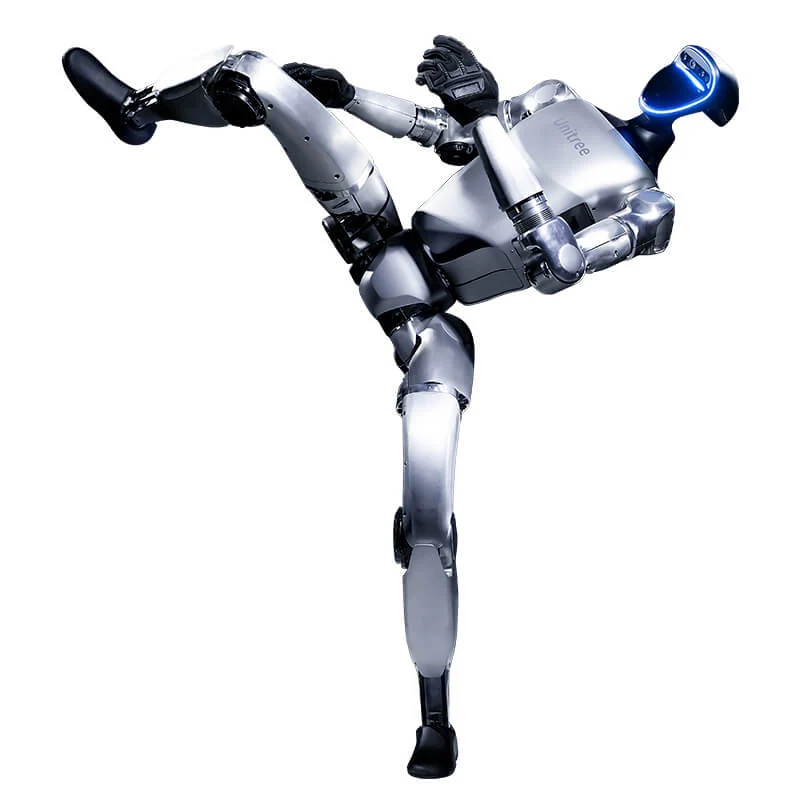
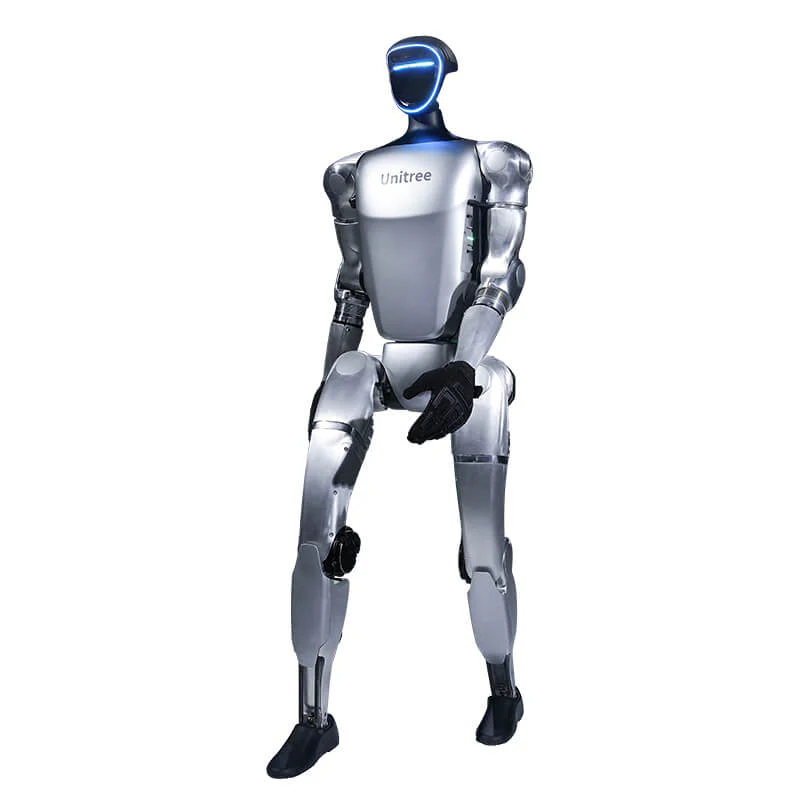
Unitree's G1 can kick, twirl and fold itself into the approximate volume of a carry-on suitcase. The more consequential trick happens in procurement: a university lab can put a commercially produced humanoid on a purchase order without first building a humanoid company. The sticker on Unitree's global shop reads $13,500. The machine stands 1.32 meters tall, weighs about 35 kilograms and carries the body plan that factories, homes and greenhouses were built around: two legs, two arms and a torso slim enough for a doorway.
That opening price has done heroic work in headlines. It also needs an asterisk the size of the robot. Unitree says the base G1 does not support secondary development. Buyers who want to write behaviors, add dexterous hands or run their own research should choose G1 EDU, whose price depends on configuration. In plain English, $13,500 buys remarkable moving hardware for supplied functions and demonstrations. The programmable research platform is a different shopping conversation.
01 / The answer firstWho is this actually for?
Buy a G1 EDU if your team already has a narrow experiment that needs a human-shaped body. Think locomotion research, whole-body teleoperation, reinforcement-learning transfer, human-robot interaction, manipulation in human workspaces or a student program that needs physical hardware after simulation. Queen's University Ingenuity Labs, for example, is exploring agriculture-oriented telerobotics and studying how people behave around humanoids. Its near-term plan starts with a human operator, not an autonomous farmhand.
The G1 also fits an integrator building a client demonstration, an exhibition operator who understands remote control and a production team that needs a physical character. A basic unit can be a credible motion platform for those jobs. It is a weak fit for someone shopping for domestic labor, unattended security or a clever roommate. Unitree founder Wang Xingxing said in 2025 that advanced AI remained the obstacle to mass robot deployment and that robotics had not reached its "ChatGPT moment." The hardware can arrive before the general intelligence does.
“The promise with it is that it can kind of do tasks that humans normally have done.”Ramzi Asfour, Queen's University Ingenuity Labs
02 / The bodyWhy the movement matters
G1's real advantage is packaging. The base robot has 23 joint motors: six per leg, five per arm and one at the waist. EDU configurations can reach 43 with added waist and wrist movement plus hands. The knee is rated to 90 N·m on the base model and 120 N·m on EDU, while maximum arm load rises from roughly 2 kg to 3 kg. Those are component and pose-dependent limits, not permission to send the robot across a warehouse carrying boxes all day.
Wide joint travel gives the machine its instantly recognizable crouch, quick recovery and slightly uncanny walk. Unitree lists ±155 degrees of waist rotation and knee travel from 0 to 165 degrees. In March 2025, the company published a standing side flip and said the robot suffered no damage during programming or filming. It was an effective proof of dynamic control. The research value is quieter: teams can investigate gait, recovery and whole-body policies on repeatable hardware instead of fabricating every actuator and cable route themselves.
| Decision point | G1 base | G1 EDU | Why it matters |
|---|---|---|---|
| Joint motors | 23 | 23-43 | More waist, arm, wrist and hand articulation expands research scope. |
| Secondary development | No | Yes | This is the dividing line for teams writing their own behaviors. |
| Dexterous hand | Not included | Optional Dex3-1 | Manipulation work needs fingers, integration time and often tactile sensing. |
| High-end compute | Not listed | Optional modules including Orin | Training and deploying perception-heavy policies requires more compute. |
| Warranty | 8 months | 18 months | Downtime and repair logistics belong in the project budget. |
03 / The sensesA capable body needs a stack
Every G1 includes an eight-core CPU, depth camera, 3D LiDAR, four microphones, a 5 W speaker, Wi-Fi 6 and Bluetooth 5.2. The quick-release 9,000 mAh battery uses a 13-series lithium pack and is rated for about two hours. Dynamic movement, added compute and manipulation can shorten that. A second battery may help a lab schedule, but changing one does not turn a two-hour platform into an eight-hour employee.
For developers, Unitree maintains SDK2 in C++ with a Python interface, ROS 2 support over Cyclone DDS, official robot descriptions, MuJoCo simulation and an Isaac Lab-based reinforcement-learning repository. That ecosystem is the part another team can steal: prototype policies in simulation, establish a conservative test harness, then move selected behavior onto the robot. The Explore mobile app handles status, calibration, joint fine-tuning, tutorials and documents. It is a maintenance companion, not a no-code autonomy button.
The effort hides after checkout
Conceptual scale, not a price quote. Hardware options, software work, safety engineering, spares and operator time accumulate differently for every project.
Independent experience adds useful friction to the brochure. A 2026 MotorTrend report on Munro & Associates' teardown said its base G1 needed several software updates before it worked and could not get itself up after testers pushed it over. Munro also found plenty to admire in subsystem design, while judging the manufacturing approach early: billet-machined aluminum and some 3D-printed plastics looked more like low-volume production than a mature appliance. Owner discussions on Reddit similarly describe waiting for updates, configuration confusion and the practical gap between the base model and advanced hands.
04 / The billThe $13,500 question
As of August 18, 2026, Unitree's global store listed the base G1 at $13,500, marked it backordered and quoted shipping from $300 to $1,200. The buyer also handles customs duties, taxes and import clearance. EDU is sold through the sales team. Hands, tactile arrays, extra joints and optional high-performance compute move the quote upward. Regional pricing, certification needs and support arrangements can change the total again.
Compare robots by access, not by viral price. Figure, Apptronik and Tesla are pursuing larger machines with factory ambitions, but they are not equivalent retail products. Booster's T1 and Fourier's GR-1 are closer research-platform comparisons. Unitree's own R1 starts lower and may cover lighter demonstrations. G1's edge is its combination of compact size, active motion-control demonstrations, direct availability and public developer tooling. Its compromise is modest payload and a configuration ladder that puts serious development above the headline price.
Strong yes
A funded robotics lab with simulation experience, a defined paper or prototype, trained operators and time for integration.
Qualified yes
An integrator or production studio that needs repeatable motion and can operate the robot under direct supervision.
Probably wait
A small business hoping for an autonomous general worker. The software, hands and deployment engineering are still the job.
Hard no
A household expecting laundry, dishes or unsupervised care. This is forceful research hardware, not a home appliance.
Give the robot a boring room
Unitree warns that humanoid robots are powerful, structurally complex and still early. Keep people at a sufficient distance. Start restrained or supported, remove trip hazards, document an emergency-stop routine, control network access, plan falls and never treat a polished demo as a safety certification. Thirty-five kilograms of fast-moving hardware deserves a perimeter.
05 / Before the POFive questions that save money
First, what behavior must run? “Explore humanoids” is a theme, not a test plan. Name the task, environment, success metric and human supervision. Second, which configuration exposes the control you need? Get SDK, joint, hand, compute and warranty details in writing. Third, how will you simulate? A policy that first meets the floor on real hardware can turn tuition into repair work.
Fourth, who owns safety and maintenance? Budget rigging, barriers, spare batteries, replacement parts, secure networking and trained operators. Ask where repairs happen and how long parts take. Fifth, is a humanoid necessary? If wheels and one arm solve the task, choose the simpler body. G1 earns its complexity when legs, two-handed reach or a human-shaped workspace are essential to the experiment.
Buy the experiment, not the backflip.
Unitree G1 is a meaningful product because it compresses years of electromechanical work into hardware a team can order. The base model is an accessible motion and demonstration machine. G1 EDU is the more consequential product: a compact physical platform around which researchers can build. Neither is a general-purpose worker. For buyers who understand that boundary, the G1 can remove a large amount of hardware invention from a robotics program. For everyone else, it is a persuasive reason to visit a lab before visiting checkout.