Why deflect customers with a chatbot maze when you could remove the thing that made them dial? Spiral uses Deep AI Research to read every conversation and hunt down the root cause.
Subject: linkedin.com/feed/update/urn:li:activity:7465150759555235840
// Ask it anything. It already read the transcripts.
Most contact center strategy treats the customer as the problem to be managed. Route them, queue them, deflect them, and count the deflection as a win. Spiral by UJET starts from the opposite premise: the reason for the call is the problem. Fix that, and the call never happens.
The platform ingests 100% of conversational data - phone calls, chats, emails, tickets, surveys, app reviews, even agent notes - and applies what UJET calls Deep AI Research to surface the root causes hiding inside conversations no human has ever read. Businesses collect roughly 300,000 support conversations a month and manually analyze about 5% of them. Spiral reads the other 95%.
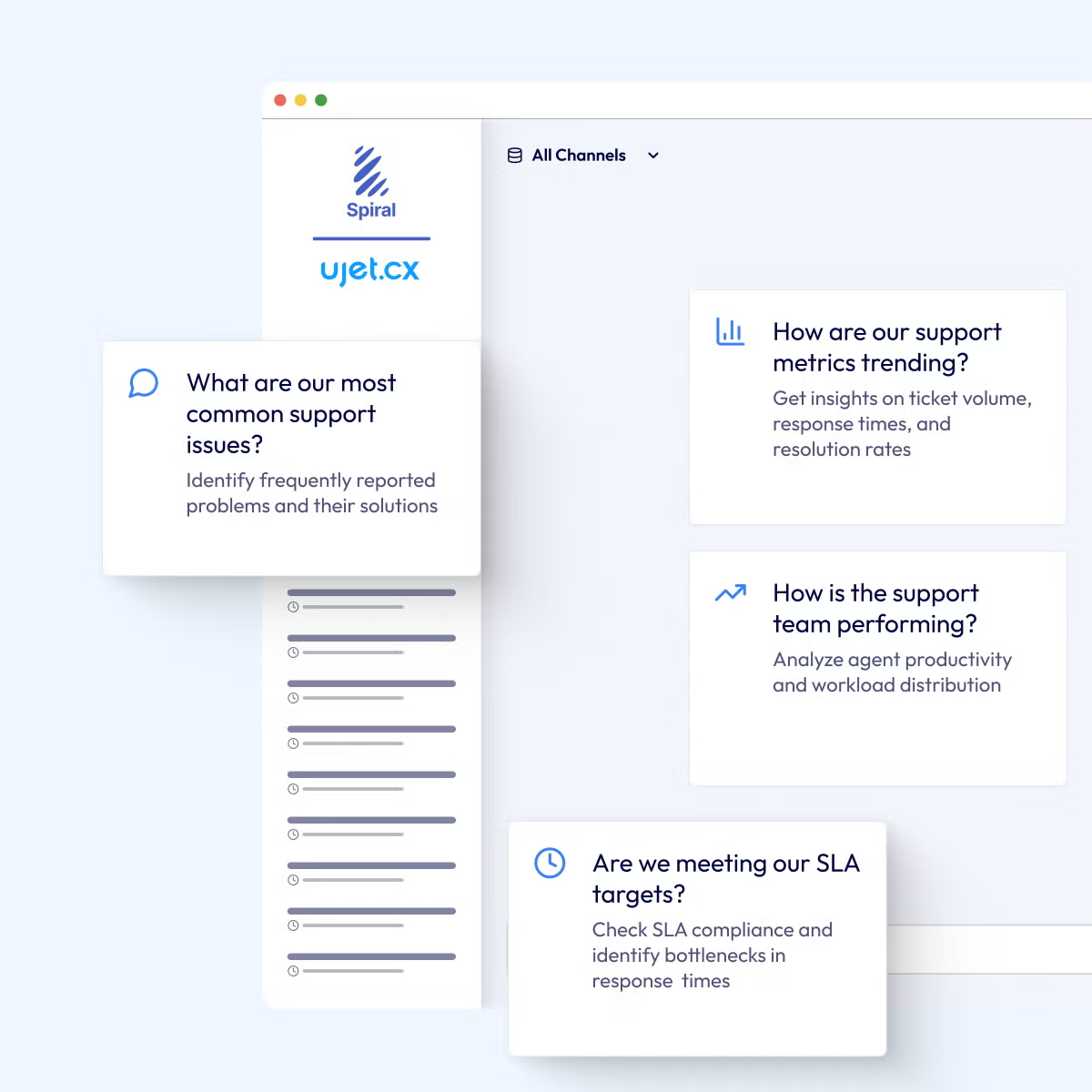
It does this without a keyword list. Using large language models and unsupervised clustering, Spiral builds its own taxonomy of issues - an unbiased map that updates as customers change what they complain about. Multi-label classification catches emerging problems while they are still small. And anyone in the company can type a plain-language question and get a decision-grade answer sourced from every channel, no data scientist required.
That last part matters. As Spiral likes to put it, a CX leader wears a lot of hats - "data scientist" probably shouldn't be one of them. The AI agent puts the analyst on everyone's desk.
"Why not fix the reason customers are calling instead of putting up AI walls to deflect them when they do?"— The premise behind Spiral by UJET
The trap with older "conversational intelligence" tools is that they only find what you told them to look for. Set up keyword rules and boolean logic and you catch known problems - the ones you already knew about. The emerging issue, the one a customer mentions three weeks before it becomes a firestorm, slips right past.
"You can only find issues you've already told the system to look for," is how Spiral frames the flaw. Autonomous taxonomy is the answer: instead of programming the system, you let it read and organize. Setup drops from months to hours, and the "unknown unknowns" finally show up on a dashboard.
"Contact centers are optimizing work that shouldn't exist."— Jared Gaines, Spiral by UJET
The order is deliberate. Before you automate a call or hand it to a person, ask whether the call should exist at all.
Eliminate the root cause. If a broken checkout flow generates payment calls, fix the flow - the contact disappears at the source.
Hand the routine, low-judgment inquiries - order status, tracking - to AI that does them well.
Reserve human agents for the complex, empathy-driven, high-value moments that actually need judgment.
LLMs and unsupervised clustering build a dynamic, unbiased issue map from your data. No manual tagging, no keyword bias.
Multi-label classification captures context, splits chief complaints from sub-issues, and flags new trends early.
Ask in plain language. Get contextual answers, dashboards and reports instantly - no data science expertise needed.
Unstructured conversations become visual intelligence with drill-down and real-time financial impact measurement.
"Deflection isn't a strategy. It's debt."— Spiral by UJET
On November 18, 2025, UJET acquired Spiral, a Seattle conversational-analytics startup founded and led by Elena Zhizhimontova. Spiral did not disappear into the parent - it continues as a standalone product, Spiral by UJET, still sold and supported as the focused tool its customers rely on.
The logic is a clean division of labor. UJET's cloud contact center platform provides the "how" - automated self-service and live-assisted interactions. Spiral provides the "why" - the conversational intelligence that explains what customers actually need. Together they form a feedback loop: understand the problem, fix or automate it, then measure whether the fix worked.
The stakes are financial, not just philosophical. UJET estimates that failing to understand customer problems costs organizations somewhere between $5 million and $30 million in churn. Named users of Spiral include Turo, Owlet and Whitepages.