Twenty-eight seconds is not long. It is enough to miss an elevator, burn a piece of toast, or hear the first half of a customer explaining a problem they wish they did not have. After three months using UJET and Spiral, Turo reported that its average handle time had fallen by exactly that amount. Customer satisfaction rose 5%. SLA performance improved 91%. Three numbers, all pointing back to a more interesting question: what if the customer had never needed to call?
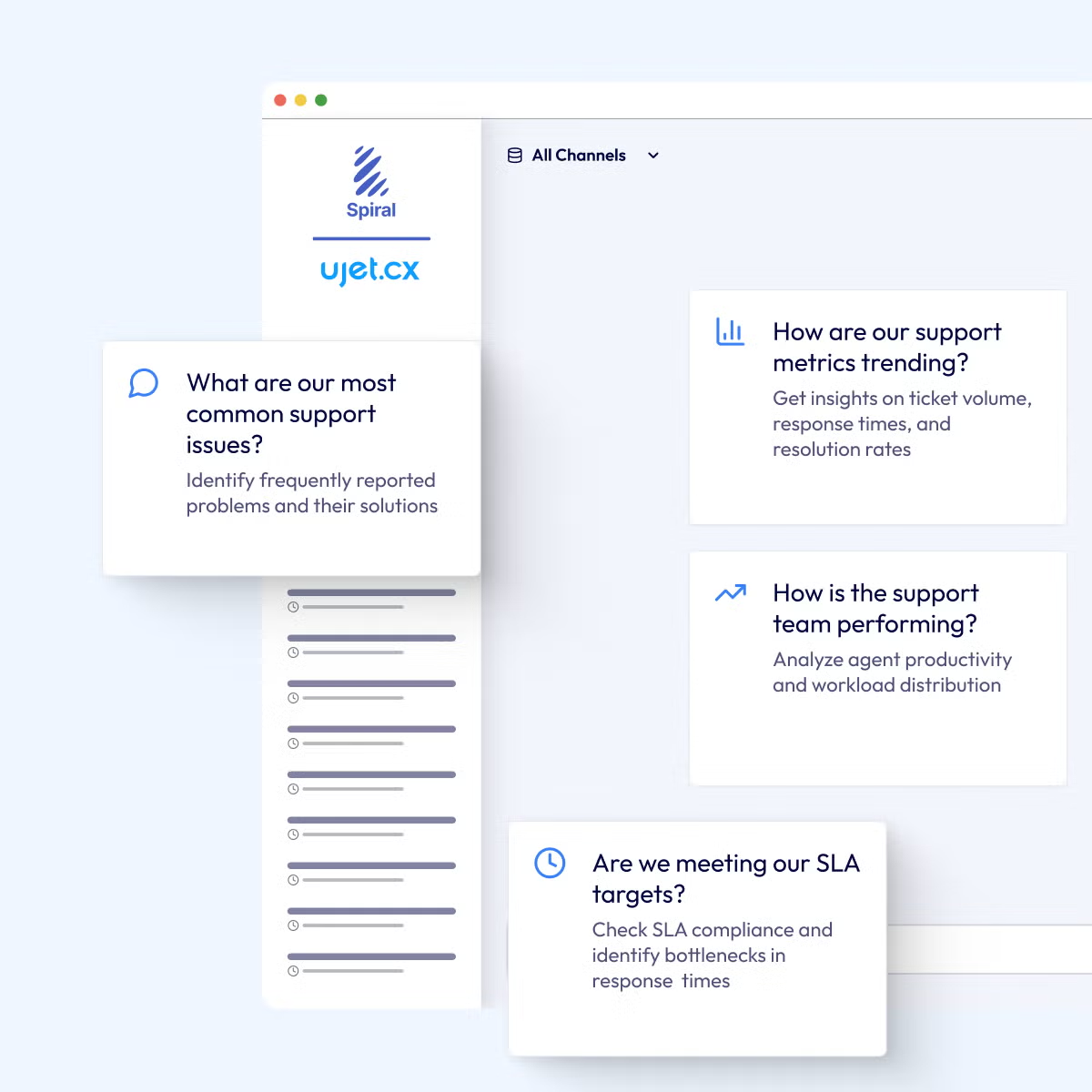
Spiral by UJET is built around that question. The conversational analytics product reads customer interactions across voice, chat, email, surveys, social channels and reviews. UJET says it analyzes 100% of the material it receives, then organizes the jumble into a taxonomy of complaints, sub-issues and emerging patterns. A team can ask a question in ordinary language and get an answer assembled from the evidence beneath it.
The thesis is blunt enough to fit on a sticky note: the best contact is the one that never needed to happen. A quicker answer is useful. Removing the password loop, confusing policy, billing error or product regression that produced the question is better. This turns customer service from a department that clears demand into a sensor for reducing it.
“The best contact is the one that never needed to happen.”Spiral by UJET thesis
The queue is a product document
Companies possess an awkward abundance of customer language. Calls live with the contact-center platform. Chats sit in another system. Reviews wait in public. Surveys are measured, averaged and put into slides. The customer experiences one company; the data experiences several filing cabinets.
Traditional analysis often samples those cabinets or searches for terms chosen in advance. UJET says many companies manually extract only about 5% of customer-reported issues. The danger is not merely that 95% goes unread. A predetermined keyword can only find a problem someone already imagined. The complaint with no accepted name stays quiet until it becomes expensive.
The listening gap
Illustrative comparison based on UJET's stated figures for manually extracted issues and Spiral's conversation coverage.
Spiral generates its taxonomy from the conversations themselves. Its system combines large language models with unsupervised clustering, seeking the chief complaint as well as the smaller stories nested inside it. UJET describes these as “unknown unknowns,” the things no dashboard owner thought to make a dropdown for. Multi-label classification matters here because one conversation can be about a refund, a confusing onboarding step and a release bug at the same time. Customers rarely respect database schemas.
Once the issue map exists, the investigative agent makes it queryable. A support leader can ask why handle time moved. A product team can examine what changed after a release. Finance can ask which recurring issue carries the largest cost. The output can include contextual answers, reports, charts and dashboards. The question box is the visible trick; the structured evidence below it is the useful one.
Turo found the seconds hiding upstream
Turo used UJET's contact-center platform and Spiral together. Julie Weingardt, Turo's chief operations officer, said the analytics helped the company build a Voice of the Customer program by capturing structured feedback during the support journey. The team used the resulting insights to refine self-service, improve its knowledge base and better guide agent responses.
In UJET's published case-study snapshot, the effects appeared within three months. Average handle time declined by 28 seconds. CSAT scores increased by 5%. SLA performance improved by 91%. Those metrics do not prove that every gain came from a single feature, and UJET presents them as the result of Turo's combined work with its platforms. They do show what root-cause clarity can look like when it leaves a dashboard and enters operations.
“Spiral AI's platform allows us to analyze customer conversations and commentary, pinpointing areas where we can improve proactively.”Julie Weingardt, Chief Operations Officer, Turo
The 28 seconds are appealing because they are concrete. Yet handle time can become a mischievous goal when pursued alone: rush the call, celebrate the average, and wait for the customer to return. Spiral's argument is that understanding the reason for contact can improve the conversation now and reduce similar conversations later. Better self-service and a clearer knowledge base are not merely deflection devices when they resolve the original confusion.
UJET bought the why
UJET acquired Spiral on November 18, 2025, for an undisclosed amount. The company kept it alive as Spiral by UJET, a standalone, platform-agnostic product, while beginning deeper integration with its contact-center platform and AI organization. The division of labor has a pleasing symmetry. UJET manages how automated and live-assisted interactions happen. Spiral examines why those interactions arrived.
Elena Zhizhimontova, Spiral's founder and CEO, described the original aim as turning millions of customer conversations into clear, actionable insight. Under UJET, she said, the focused product would continue with deeper integrations and a more CX-oriented roadmap. The acquisition announcement named Owlet and Whitepages among Spiral's customers, with Turo as a joint customer of both companies.
Spiral does not require a company to replace its existing contact-center stack. UJET describes it as a non-disruptive intelligence layer able to ingest exported data. Typical onboarding is said to take one to three days. The product supports more than 75 languages and regional dialects, according to UJET, and is SOC 2 Type II certified. Personally identifiable information is redacted on receipt before the material is processed for insights.
What sits beneath the question box
- Automatic taxonomy generation instead of fixed tags
- Specific issue and sparse-signal detection across channels
- Plain-language investigation with reports and charts
- Dashboards that connect issues to operational and financial impact
A smaller queue is a sharper signal
The ordinary contact-center scorecard rewards the work visible inside the contact center: time to answer, time to resolve, adherence to the service level. Those measures matter because waiting is unpleasant and abandoned calls solve nothing. But they begin after the company has already created demand for help.
Conversational analytics becomes more valuable when it travels. A billing complaint belongs partly to finance. Confusing onboarding belongs partly to product. A broken promise in a campaign belongs partly to marketing. Support happens to hear the consequence first. Spiral tries to give the whole organization one vocabulary for it, so the argument can move from whose chart is right to which cause should be removed.
There is a management challenge hiding in that promise. A solved root cause may make the support queue quieter, which can look less dramatic than a heroic day clearing tickets. Prevention has poor theatre. No one applauds the call that did not happen. The evidence has to survive the silence, linking a fix to the issue volume, customer effect and cost it changed.
That is why the Turo figures are more than decoration. They provide a short, measurable chapter in a longer idea. Read the conversations. Name the precise friction. Send the evidence to the team capable of changing it. Then watch not only how quickly the queue moves, but whether the queue has less reason to exist.
Questions worth asking
What is Spiral by UJET?
It is a platform-agnostic conversational analytics and AI issue hub that analyzes customer interactions, organizes issues automatically and makes the findings searchable in plain language.
What data can Spiral analyze?
UJET says it can ingest calls, live chats, emails, surveys, social media, app reviews and customer-specific metadata from exportable sources.
Does Spiral require manual tagging?
No. It uses large language models and unsupervised clustering to generate a dynamic taxonomy from an organization's own conversation data.
Is it only available with UJET?
No. UJET describes Spiral by UJET as a standalone, platform-agnostic product, while also integrating it more deeply with UJET's contact-center platform.
What results did Turo report?
A UJET case-study report says Turo achieved a 28-second reduction in average handle time, a 5% increase in CSAT scores and a 91% improvement in SLA performance in three months.