The 95% You Never Read
Most support teams hand-read one conversation in twenty and decide the rest by intuition. Here is what actually changes in the operating rhythm when you read everything.
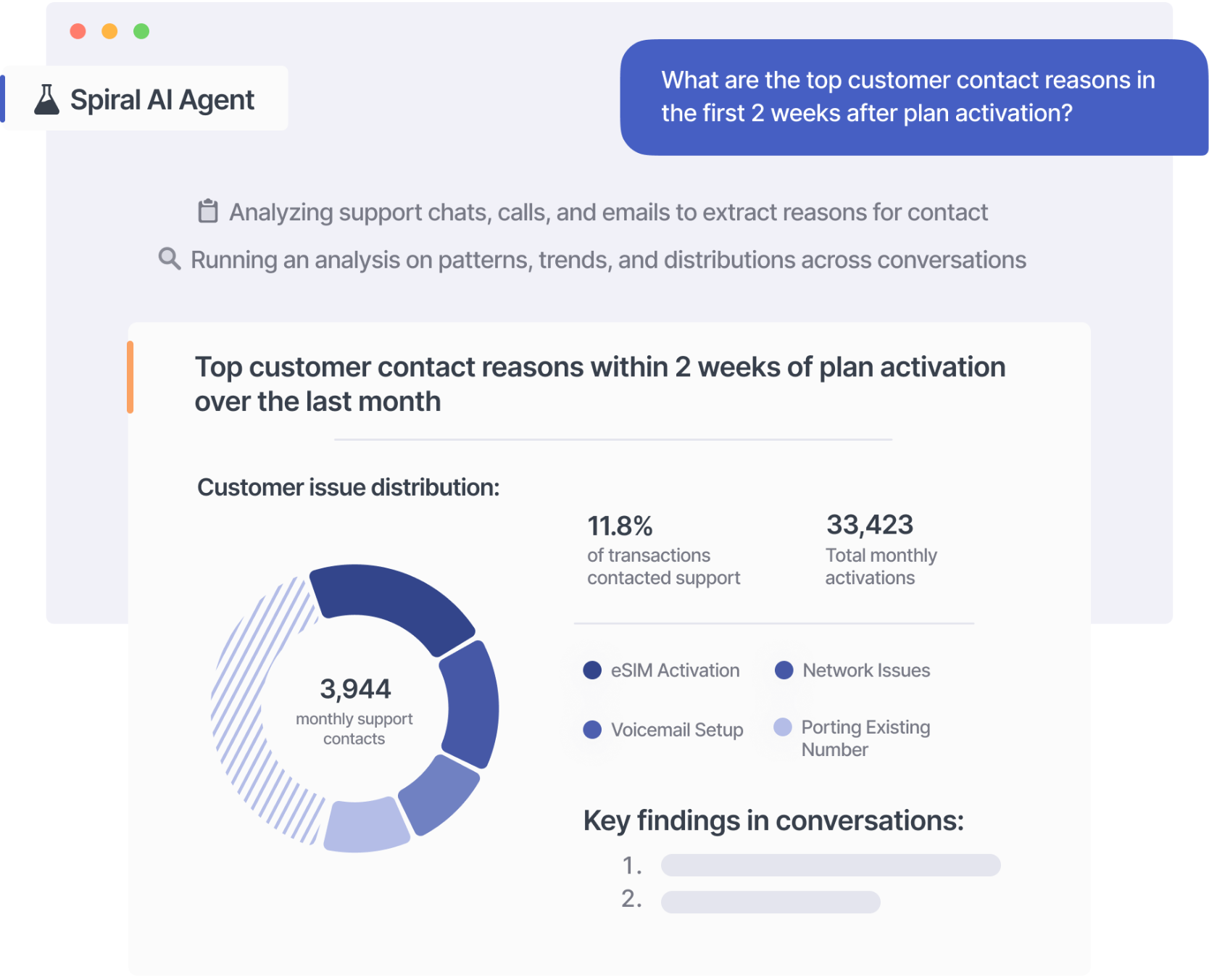
Walk into almost any support review and you will find a room making confident decisions from a sample. Analysts hand-read a slice of conversations — call it one in twenty — and the roadmap forms around the impression that slice leaves behind. It feels rigorous. It is mostly a guess. The other nineteen conversations are inferred, not read, and nobody in the room quite says so out loud.
Spiral by UJET has a blunt name for the missing part: the 95% Blind Spot. It is the share of conversational data most companies never examine, and it is where the undetected root causes live. The company puts a number on it that is easy to dismiss until you do the arithmetic yourself — up to $30 million a year in preventable churn, plus roughly $7 for every avoidable contact. The bill exists whether or not anyone reads it.
The interesting story here is not the technology. It is what changes in the operating rhythm when you stop sampling and read everything — voice, chat, email, surveys, social and reviews, all of it. Three things move at once, and none of them are about the software.
The RhythmA week at 5% versus a week at 100%
Picture the 5% week. QA is a scorecard exercise: a handful of calls scored against a rubric, the results generalized to a team of hundreds. An emerging issue — a broken flow, a confusing policy change, a bug that started quietly on Tuesday — is invisible, because a thin sample cannot see something that is happening in three percent of contacts. It takes a quarter to become obvious, and by then it has a name and a body count. The contact-driver report, when it arrives, reads like a support summary: tidy categories, no urgency, filed and forgotten.
Now picture the 100% week. QA stops being a scorecard and becomes an actual measurement, because you are no longer extrapolating from twenty calls to twenty thousand. Emerging issues surface in days, while they are still small enough to fix cheaply. And the contact-driver list stops being a report and becomes a product backlog — a ranked, costed queue of the reasons people are calling, handed to the teams who can make the calls stop.
Before · 5% coverage
- QA is a scorecard sampled against a rubric
- Emerging issues take a quarter to surface
- Contact drivers read like a support report
- Roadmap decisions made on intuition
After · 100% coverage
- QA becomes real, population-level measurement
- Emerging issues surface in days
- Contact drivers become a product backlog
- Decisions made on what customers actually said
The MechanicsHow you read all of it
Reading everything used to be a fantasy for anyone without an army of analysts. Spiral by UJET ingests conversational and feedback data from voice calls, live chats, emails, NPS and CSAT surveys, social media and app reviews, then does the tedious part automatically. Large language models and unsupervised clustering build a taxonomy from the ground up — no manual tagging, no keyword bias, no committee arguing over category names. Multi-label classification catches the chief complaint and the sub-issues underneath it with roughly 98% accuracy, including the sparse signals that a sample would miss entirely.
On top of that sits an ask-anything agent. You type the question a director would actually ask — why did handle time spike this week, or what is driving cancellations, or where are we about to see trouble — and it returns the root cause, the affected customers, the financial impact, a trend line and a recommended fix in seconds. It builds the dashboard on the way to the answer. Onboarding runs one to three days, it needs no dedicated data science team, it is SOC 2 Type II certified, it handles 75-plus languages, and it redacts PII before a human ever sees it.
The ProofWhat Turo found in three months
The case that matters is the one with published numbers. After three months on Spiral, Turo reported average handle time down 28 seconds, CSAT up 5%, and SLA performance improved. None of that came from adding agents or tightening scripts. It came from reading the conversations they already had and acting on what the conversations said.
That word — proactively — is the whole shift. At 5% coverage you are always reacting, always a quarter behind the thing you should have caught in a week. At 100% you get to move first: fix the flow before the calls pile up, catch the regression before the reviews land, retire the contact driver before it becomes a category on someone's scorecard. The technology is impressive, but the technology is not the point. The point is the operating rhythm underneath it, and the quiet, expensive line it finally lets a support team live by: the best contact is the one that never needed to happen.