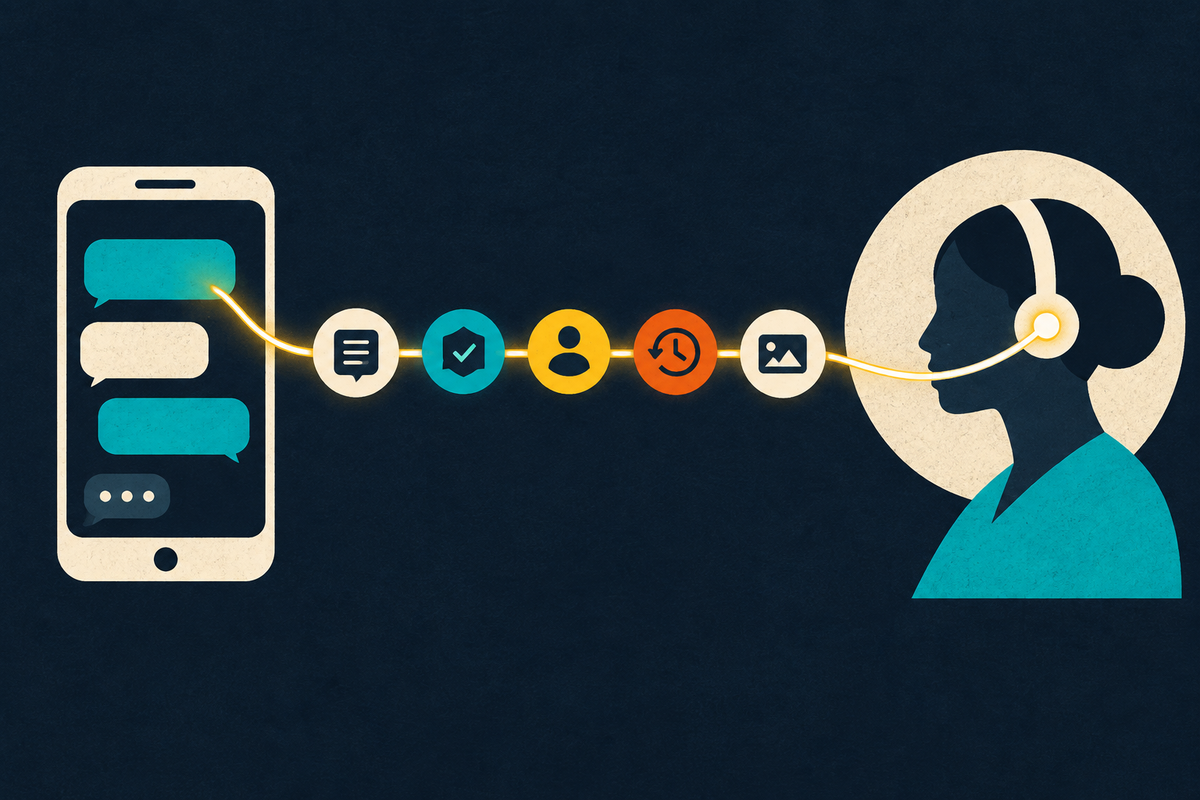
A customer opens chat because calling feels expensive. They explain the problem, authenticate, paste an order number, upload a photo and endure a bot's troubleshooting tree. Then the issue gets complicated. The chat offers a phone call. A new agent answers and says the seven words that turn convenience into farce: “Can you tell me what happened again?”
That sentence is not a soft-skills failure. It is an architecture review delivered by a tired customer. In UJET's 2026 survey of 250 U.S.-based frontline contact-center agents, 65% said customers express frustration on most or every call about repeating information already given to a self-service AI agent or chatbot. The same survey found 81% of agents use more than four tools at once, while 93% feel they must double-check information supplied by AI. When context breaks, the agent inherits both the detective work and the customer's raised temperature.
So here is a more useful platform test than asking whether a vendor is “omnichannel.” Start a realistic chat. Authenticate. Add an order. Share an image. Create some history. Escalate to voice. Then look over the agent's shoulder and count what arrived.
Four platforms, four places to keep the truth
The interesting difference is not that one platform has context and the others do not. Each vendor documents substantial continuity. The difference is where the conversation's truth lives.
UJET is CRM-first. Its product pages say CRM data—including the contact record, account status, device information, customer journey data, notes, recordings and transcripts—can be exchanged in real time before an agent joins. Media and event data from its mobile SDK are stored in the CRM, while biometric or app-level authentication can be used in the support flow. In that design, chat and voice are two doors into the same customer record.
Zendesk is ticket-first. In Agent Workspace, messaging, chat and voice can live in a single ticket interface. Bot conversation history is visible when a human takes over; agents can open the call console from the ticket; the context panel can show the user, interaction history and custom objects; attachments remain in the conversation. The ticket is the suitcase. Continuity is strongest when the chat and call stay attached to that same suitcase.
Intercom is conversation-first. Intercom Phone sits inside the Inbox, and its documentation says a Messenger chat can switch to voice or video while keeping the same context. Files and images live in the conversation, and calls, recordings and transcripts appear in the thread. User and company attributes sit beside it. That is a direct path when escalation begins inside Messenger; a separately dialed inbound call introduces the usual identity-matching questions.
Salesforce is record-first at enterprise scale. Service Cloud Voice puts telephony, real-time call transcripts, digital channels and CRM data in the Service Console. Salesforce describes purchase history, warranty information, past interactions and the call transcript appearing alongside the customer record. But Salesforce is famously configurable, which is another way of saying the demo path must match the path your architects actually build.
What survives the native handoff
On the documented happy path, the transcript survives across all four, though the container differs: CRM activity in UJET, a ticket thread in Zendesk, a conversation thread in Intercom, and conversation or voice-call records in Salesforce. Prior history also survives when the customer is resolved to the correct CRM contact, Zendesk user, Intercom user or Salesforce record.
| Platform anchor | Transcript | Identity | Account / order | History | Files / photos |
|---|---|---|---|---|---|
| UJET CRM-first | Native CRM context | App + biometric options | CRM record | CRM journey data | CRM-stored media |
| Zendesk Ticket-first | Unified ticket | User match / setup | Fields + objects | User + ticket history | Ticket attachments |
| Intercom Conversation-first | Conversation thread | User match; verify | User/company data | Inbox history | Messenger files |
| Salesforce Record-first | Conversation records | CRM + auth design | CRM + case record | Cross-channel history | Test agent placement |
NATIVE = explicitly documented in the platform's core handoff or workspace. TEST SETUP = supported context whose identity assurance, data population or immediate agent placement depends on configuration. Plan, edition, consent, routing and integrations can change results.
Account and order context is where procurement teams should slow down. UJET and Salesforce lead with CRM data as a native premise. Zendesk can expose ticket fields, user context and custom objects, while Intercom can show user and company attributes. But “can display” is not the same as “arrives pre-populated in the call the agent receives.” Bring the actual commerce, billing or policy system into the test.
Identity is more slippery. A phone-number match is not authentication. UJET documents biometric verification through its mobile SDK and the use of an existing PIN, passcode or device biometrics. Intercom explicitly advises teams to verify users before discussing sensitive information in a phone-number-matched flow. Zendesk and Salesforce can surface the matched customer record, but the assurance level depends on the identity and telephony design. Ask the agent what proves who the caller is—not merely which record opened.
Files are the easiest object to lose in a polished demo. UJET documents image and video capture during a call and storage of media in the CRM. Zendesk supports attachments in the unified ticket conversation. Intercom supports files and images in Messenger conversations. Salesforce can associate files and transcripts with service records, but whether a digital-session attachment lands in the voice agent's immediate view is an implementation question worth testing explicitly.

The scorecard is a test script, not a podium
A simple comparison is useful only if the labels are honest. UJET's native story is strongest when a mobile app and CRM are central: it is designed to carry verified identity, device data and rich media into the CRM-backed interaction. Zendesk's strength is operational continuity inside one ticket. Intercom's is the low-friction switch from an active Messenger conversation into native voice. Salesforce's is the depth of customer, case and enterprise data available inside its service console.
None of those strengths guarantees your deployment. Plan, edition, channel, telephony partner, SDK work, routing logic, record matching, retention settings and agent-screen configuration all matter. Even transcripts can be subject to recording consent or admin settings. The correct verdict is not a universal yes or no. It is “present without agent search,” “present after a click,” “available through integration” or “missing.” Those four labels expose more truth than a row of green checks.
Run the test twice. First, escalate inside the authenticated app or messenger—the paved road every vendor will prefer. Second, abandon the chat and dial the public number five minutes later. The second run reveals whether continuity belongs to the customer record or only to the session.
A 20-minute bake-off buyers can steal
Create a test customer named Riley with two past contacts and one open order. Have Riley sign in, start with the bot and ask why that order is late. Supply an order number even though the account already contains it. Upload a photo of a damaged package. Ask a follow-up that forces escalation. Accept a callback, then repeat the scenario by dialing in separately.
Freeze the demo when the call connects.
- Ask the agent to prove Riley's identity—not just name the record.
- Summarize the bot exchange without asking Riley.
- Name the open order and its current status.
- Identify the two earlier contacts.
- Open the damaged-package photo.
- Transfer to a second agent and repeat the check.
Time each retrieval. Do not let the presenter rescue the flow with search. Score presence, placement and provenance. Presence asks whether the object exists. Placement asks whether it is already in the agent's working view. Provenance asks where it came from and whether it updates the system of record. Add one more column for failure behavior: what happens when matching is ambiguous, consent blocks a transcript, an upload is unsupported or the customer changes devices?
Finally, let frontline agents grade the run. Executives notice elegant routing diagrams; agents notice the tab they must open 80 times a day. The UJET survey's tool count matters here: context that technically exists in a fifth application has not survived in any customer-meaningful sense.
UJET's bet is that context should not travel far
UJET's differentiated claim is less “we move context better” than “we avoid creating a second home for it.” Its CRM-first material says customer data and personally identifiable information remain in the CRM or a private repository rather than a separate contact-center silo. Real-time exchange supplies routing and agent context; automated updates return interaction details to the record.
That architecture is attractive because a handoff becomes a change of interface, not a migration between competing databases. The transcript, customer record, device information, journey notes, media and call artifacts orbit the same source of truth. UJET's mobile SDK sharpens the case: app version, device details, location and last actions can join photos, videos and biometric verification. For mobile-heavy service journeys—banking, delivery, travel, healthcare—that is richer than simply carrying chat text into a dialer.
The trade-off is equally clear. CRM-first succeeds only if the CRM record is clean, the connectors are correctly mapped and agents receive a disciplined workspace. A single source of truth can still be a single source of confusion. The bake-off should inspect write-back behavior, duplicates, latency and what happens when no confident customer match exists.
The handoff is the product
Contact-center buying often rewards the opening act: a fluent bot, a clever summary, a beautiful agent copilot. Customers judge the scene change. They remember whether the human knew why they were there.
That makes chat-to-voice escalation a compact test of the whole stack. It touches identity, data architecture, channel orchestration, media, routing and the agent desktop in one ordinary moment. It also turns “omnichannel” from a slogan into something observable. Either the five objects arrive or they do not. Either the agent can trust them or must verify them. Either the customer continues or restarts.
SOURCES: UJET CRM-first architecture; UJET intelligent omnichannel; UJET Mobile SDK; UJET Agent and AI Disconnect survey, 250 U.S. frontline agents; Zendesk Agent Workspace; Intercom Phone; Salesforce Service Cloud Voice. Product behavior varies by plan and configuration; this comparison uses vendor-documented native paths.