The 95% Blind Spot Every Contact Center Pretends Isn't There
Most contact centers score under 5% of their calls and guess at the rest. Spiral by UJET reads 100% of conversations — and Turo used it to cut handle time by 28 seconds.
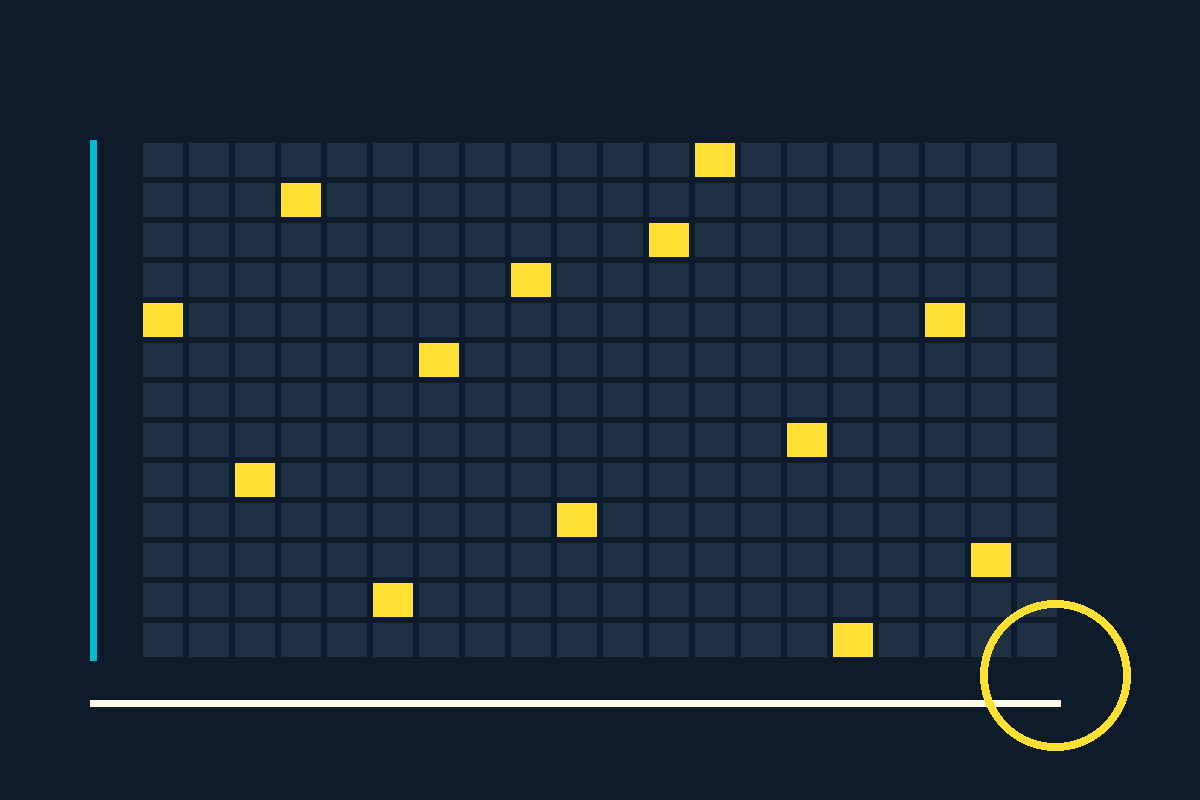
THE BLIND SPOT, VISUALIZED. Each square is a slice of your conversation volume. The lit ones are what QA actually reads. The dark field is everything else.
There is a number most contact centers know and almost none say out loud. It is not their CSAT, their abandon rate, or their cost-per-contact. It is the share of customer conversations anyone ever actually analyzes. For the typical operation, that number is under five percent.
Five percent. A quality team pulls a handful of calls, scores them against a rubric, coaches an agent, and closes the ticket. The rubric is fine. The coaching is fine. The problem is the denominator. Every roadmap decision, every staffing forecast, every "customers keep complaining about X" hallway consensus is built on a rounding error's worth of evidence — and a great deal of confident guessing about the rest.
UJET has a name for the rest. They call it the 95% Blind Spot: the unread majority of conversations where churn drivers, product regressions, and avoidable contacts sit in plain sight, narrated by customers in their own words, and never once looked at.
01 — THE ARGUMENTSampling was a workaround, not a strategy
Sampling exists for one reason: reading everything used to be impossible. You could not put a human on a hundred thousand calls, so you put a human on fifty and extrapolated. That was a reasonable compromise in a world without a machine that could read. It is a strange thing to keep defending in a world that has one.
This is the argument behind Spiral by UJET, the company's conversational analytics product. Instead of a sample, Spiral reads 100% of conversations — calls, chats, emails, surveys, social posts, app reviews — across more than seventy-five languages. Not sentiment scores. Not keyword counts. The actual content of what customers said, turned into what UJET calls decision-grade intelligence: the root cause, who it hit, what it costs, and what to do about it.
Most companies are flying blind because they only ever look at about 5% of their conversational data. The premise behind Spiral by UJET
02 — HOW IT WORKSThree moving parts, no manual tagging
Traditional text analytics asks a team to sit in a room and argue about taxonomy — what to call things, which bucket a complaint belongs in, who owns the spreadsheet. It takes months and it is obsolete the day it ships. Spiral skips the room.
First, autonomous taxonomy generation. Clustering and LLM models build a standardized issue taxonomy directly from the data — no months of manual tagging, no naming-convention holy wars. Second, blind-spot and ultra-specific issue detection. Chief complaints, sub-issues, and sparse signals — the emerging problem buried in eleven calls out of a hundred thousand — surface with roughly 98% accuracy. Third, a queryable AI agent. You ask a plain-English question and get an explainable, financially quantified answer in seconds.
Ask it like a colleague
- "Why did handle time spike this week?"
- "What's driving cancellations this month?"
- "Where are we about to see trouble?"
The answers do not come back as a dashboard you still have to interpret. They come back with a root cause, the customers affected, the dollars attached, and a recommended fix — derived from real conversations rather than a sentiment gauge pointing vaguely at "negative."
03 — THE RECEIPTSWhat Turo found in the 95%
Turo, the peer-to-peer car-sharing marketplace, pointed Spiral at its full conversation stream instead of a slice of it. The blind spot, read at last, turned into operations work: handle time came down, satisfaction went up, service levels improved.
Spiral AI's platform allows us to analyze customer conversations and commentary, pinpointing areas where we can improve proactively. Julie Weingardt — Chief Operations Officer, Turo
Note the word proactively. Firefighting is what a team does when it can only see five percent of the fire. Read all of it, and the same team starts putting problems out before the customer ever calls.
04 — THE STAKESAn unread call is the expensive kind
The blind spot is not free. UJET estimates the visibility gap costs companies up to $30 million a year in preventable churn and roughly $7 per avoidable contact — the repeat calls, the "I already explained this," the friction that a product fix would have erased if anyone had seen the pattern.
And it is not a nine-month integration to find out. Spiral is platform-agnostic, SOC 2 Type II certified with automatic PII redaction, and typically live in one to three days. Most customers see ROI within days — because the moment you read the other ninety-five percent, the avoidable contacts and churn drivers are simply there, waiting to be fixed.
05 — WHY IT TRAVELSOne product, every desk
The reason the blind spot survives is that no single team owns it. Support sees tickets, product sees releases, finance sees numbers, and the conversation — the one place all three problems are described in plain language — belongs to nobody. Spiral hands the same reading to everyone: support kills avoidable contacts, product catches regressions early, operations trades firefighting for prevention, and finance models the ROI of a fix before committing a dollar.
The 95% Blind Spot is the kind of number that, once you have heard it, you cannot un-hear on your next QA review. Five percent of conversations analyzed. Ninety-five percent guessed. The good news is that a blind spot you can measure is a blind spot you can close — and the machine that reads the rest already exists.